
Class 10 Social Question and Answer: Work And Economic Life
Looking for SSLC Class 10 Social Science Studies textbook answers? You can download Chapter 2: Work And Economic Life Questions and Answers PDF, Notes, and Additional Q&A here. SSLC Social Science solutions follow the Karnataka State Board Syllabus, making it easier for students to revise and score higher in exams.
Karnataka SSLC Social Sociology Textbook Answers—Reflections Chapter 2
Work And Economic Life Questions and Answers, Notes, and Additional Q&A
Class 10 Social Sociology Chapter 2
Work And Economic Life
Scroll Down to Download Work And Economic Life PDF
I. Fill in the blanks
- Division of labour leads to
- Workers without special training are called unskilled workers.
- Workers who have special training and expertise are called skilled workers.
II. Answer the following in a sentence:
Question 1.
What is Division of Labour?
Answer:
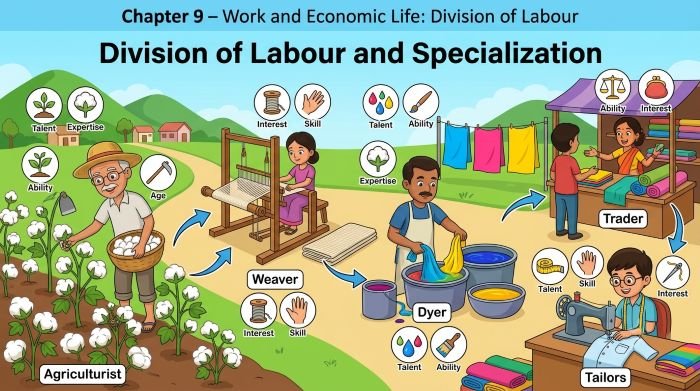
Division of labour means work being done by people according to their interests, tastes, abilities, age, skills, expertise, gender and talents.
Question 2.
What is Labour with Payment?
Answer:
Work that provides wages, salary or any other material benefit is called paid work.
Question 3.
What is Labour without Payment?
Answer:
Work done without receiving wages or any material benefit, but for self-satisfaction or other purposes, is called unpaid work.
Question 4.
What is the Organised Labour Sector?
Answer:
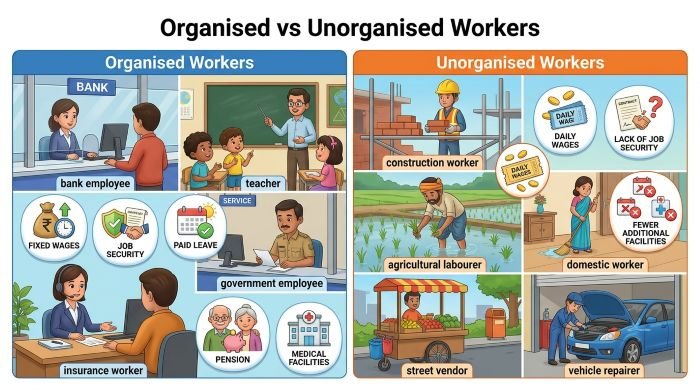
The organised sector consists of workers whose work is governed by specific legal rules and regulations and who receive fixed wages and other facilities.
Question 5.
What is the Unorganised Labour Sector?
Answer:
The unorganised sector consists of workers whose work is not governed by specific rules and regulations and who generally earn daily wages or other material benefits.
Question 6.
What are the challenges faced by unorganised sector workers?
Answer:
Unorganised workers face problems such as lack of job security, fixed wages, allowances, medical facilities and protection from exploitation.
III. Discuss the following in groups and answer them:
Question 1.
Explain the nature of discrimination in labour.
Answer:
Labour discrimination means inequality in work and wages. Men and women may not always receive equal opportunities, responsibilities and remuneration for similar work. Women are often paid less than men for doing the same kind of work, especially in the unorganised sector. Discrimination may also occur in agriculture based on gender, age and ability. Improvement in literacy and government measures have helped reduce such discrimination.
Question 2.
What are the measures for removal of unemployment?
Answer:
The following measures can help in removing unemployment:
- Population control
- Encouragement of cottage industries
- Development of agriculture
- Industrial development
- Educational reforms
- Encouragement of vocational education
- Rural development programmes
- Employment-guarantee programmes
- Creating more employment opportunities in the service sector through information technology.
Question 3.
What are the differences between organized and unorganized workers?
Answer:
Organised Workers | Unorganised Workers |
They work in specific fields with rules and regulations. | They work in areas where there are no specific rules and regulations. |
They are under the control of the government or relevant legal authorities. | They are generally not under proper government control. |
They have training, talent, experience and educational qualifications. | All workers may not have special training or qualifications. |
They have job security. | They are denied job security. |
They get fixed wages, pensions and medical facilities. | They generally receive only wages without additional facilities. |
Examples: Insurance companies, educational institutions, banks, armed forces, government departments, etc. | Examples: Domestic servants, construction workers, agricultural labourers, hawkers, vegetable vendors, etc. |
Additional Questions and Answers
Very Short Answer Questions
Question 1.
What is labour?
Answer:
Labour is an act performed by an individual using energy or effort to achieve a particular goal and obtain economic or material benefit.
Question 2.
Why is labour important?
Answer:
Labour is an integral part of economic life and is essential for fulfilling the basic requirements of life.
Question 3.
What does division of labour lead to?
Answer:
Division of labour leads to specialization.
Question 4.
What is specialization?
Answer:
Specialization means acquiring sufficient expertise, training and skill in a particular field.
Question 5.
What is paid work?
Answer:
Work that provides wages, salary or any other material benefit is called paid work.
Question 6.
What is unpaid work?
Answer:
Work done without material benefit but for self-satisfaction or other purposes is called unpaid work.
Question 7.
What is labour discrimination?
Answer:
Inequality in work and wages is called labour discrimination.
Question 8.
Which sector has more labour discrimination?
Answer:
Labour discrimination is found more in the unorganised sector.
Question 9.
What is unemployment?
Answer:
Unemployment means the inability to get work despite having the proper age, ability and interest to work.
Question 10.
Mention any two causes of unemployment.
Answer:
Over-population and illiteracy are two causes of unemployment.
Short Answer Questions
Question 1.
How does division of labour help society?
Answer:
Division of labour helps people to specialize in different fields according to their abilities and skills, thereby increasing production, trade and economic development.
Question 2.
How has industrialization influenced the class system?
Answer:
Industrialization and specialization have contributed to the development of different economic classes in modern society.
Question 3.
Why is specialization important in modern society?
Answer:
Specialization is important because it provides people with expertise and skills in particular fields and helps industries, trade and commerce to develop.
Question 4.
How does labour discrimination affect women?
Answer:
Women may receive lower wages and fewer responsibilities than men even when they perform similar work.
Question 5.
What are the major causes of unemployment?
Answer:
The major causes are over-population, mechanization, excessive division of labour, social inequality, insufficient capital and illiteracy.
Question 6.
What are the consequences of unemployment?
Answer:
Unemployment can lead to poverty, ill-health, crime, corruption, family disintegration, cheating, deception and other social problems.
Multiple Choice Questions (MCQs)
1. Division of labour leads to:
A) Unemployment
B) Specialization
C) Poverty
D) Migration
Answer:
B) Specialization
2. Which of the following is a basis for division of labour?
A) Skill
B) Ability
C) Age
D) All of the above
Answer:
D) All of the above
3. Specialization means:
A) Working without payment
B) Acquiring expertise and skill in a particular field
C) Avoiding work
D) Changing jobs frequently
Answer:
B) Acquiring expertise and skill in a particular field
4.Work that provides wages or salary is called:
A) Unpaid work
B) Paid work
C) Social work
D) Voluntary work
Answer:
B) Paid work
5. An artist painting a picture for self-satisfaction is an example of:
A) Paid work
B) Organised work
C) Unpaid work
D) Industrial work
Answer:
C) Unpaid work
6. Inequality in work and wages is called:
A) Specialization
B) Labour discrimination
C) Division of labour
D) Unemployment
Answer:
B) Labour discrimination
7. Labour discrimination is more commonly found in the:
A) Organised sector
B) Government sector
C) Unorganised sector
D) Banking sector
Answer: C)
Unorganised sector
8. The Equal Wages Act was enacted in:
A) 1950
B) 1965
C) 1976
D) 1985
Answer:
C) 1976
9. Unemployment means:
A) Not wanting to work
B) Inability to get work despite being willing and able to work
C) Working for a short period
D) Working without specialization
Answer:
B) Inability to get work despite being willing and able to work
10. Which of the following is a cause of unemployment?
A) Over-population
B) Sufficient capital
C) Literacy
D) Industrial development
Answer:
A) Over-population
11.Which of the following is NOT a cause of unemployment?
A) Illiteracy
B) Social inequality
C) Insufficient capital
D) Rural development
Answer:
D) Rural development
12. Which of the following is an effect of unemployment?
A) Poverty
B) Better health
C) Economic stability
D) Job security
Answer:
A) Poverty
13. Which programme can help reduce unemployment?
A) Vocational education
B) Discouraging industries
C) Reducing agriculture
D) Closing cottage industries
Answer:
A) Vocational education
14. Which sector has created many employment opportunities through the growth of information technology?
A) Service sector
B) Agricultural sector only
C) Household sector
D) Traditional sector only
Answer:
A) Service sector
15. Workers governed by specific legal rules and regulations are called:
A) Unorganised workers
B) Organised workers
C) Casual workers
D) Unskilled workers
Answer:
B) Organised workers
16. Which of the following is an organised sector?
A) Street vending
B) Domestic service
C) Banking
D) Roadside repair work
Answer:
C) Banking
17. Which of the following is an example of an unorganised worker?
A) Bank employee
B) Government employee
C) Construction worker
D) Armed forces employee
Answer:
C) Construction worker
18. Organised workers generally receive:
A) No fixed wages
B) Fixed wages and other facilities
C) No leave
D) No medical facilities
Answer:
B) Fixed wages and other facilities
19. Which of the following is generally NOT available to unorganised workers?
A) Daily wages
B) Job security
C) Work opportunities
D) Material benefit
Answer:
B) Job security
20. Rural youth often migrate to cities in search of:
A) Better employment opportunities
B) Agricultural work
C) Less education
D) Fewer opportunities
Answer:
A) Better employment opportunities