
Class 10 Social Question and Answer: Challenges of India and Their Remedies
Looking for SSLC Class 10 Social Science Studies textbook answers? You can download Chapter 2: Challenges of India and Their Remedies Questions and Answers PDF, Notes, and Additional Q&A here. SSLC Social Science solutions follow the Karnataka State Board Syllabus, making it easier for students to revise and score higher in exams.
Karnataka SSLC Social Political Science Textbook Answers—Reflections Chapter 2
Challenges of India and Their Remedies Questions and Answers, Notes, and Additional Q&A
Class 10 Political Science Chapter 2
Challenges of India and Their Remedies
Scroll Down to Download Challenges of India and Their Remedies PDF
I. Fill in the blanks with suitable words:
1. Developing deep attachment with the place of living is called Regionalism.
2. The Right to information act was implemented in the year 2005.
3. According to 2011 census the literacy rate was 74.04%.
4. The first woman judge of Supreme Court of India was Justice Fathima Beevi.
II. Discuss in groups and answer.
Question 1:
What are the measures that can be undertaken to control communalism?
Answer:
Measures to control communalism are:
- Promoting national integration and unity among people.
- Providing value-based and secular education.
- Taking strict action against communal violence and hate speech.
- Encouraging religious tolerance and mutual respect.
- Conducting awareness programmes for communal harmony.
- Ensuring equal rights and opportunities to all citizens.
- The media should avoid spreading communal feelings.
Question 2:
Mention the measures taken to eradicate illiteracy.
Answer:
The measures taken to eradicate illiteracy are:
- Providing free and compulsory education.
- Establishing more schools in rural and backward areas.
- Implementing adult education programmes.
- Giving scholarships and incentives to students.
- Creating awareness about the importance of education.
- Providing mid-day meals and free textbooks.
- Encouraging girls’ education and reducing school dropouts.
Question 3:
What are the measures undertaken by the Government of India to eliminate gender discrimination?
Answer:
The measures undertaken by the Government of India to eliminate gender discrimination are:
- Providing equal rights through the Constitution.
- Implementing laws against dowry, child marriage and domestic violence.
- Promoting women’s education through various schemes.
- Reserving seats for women in local self-government institutions.
- Providing employment opportunities and equal wages for women.
- Conducting awareness programmes on gender equality.
- Establishing women’s welfare organizations and helplines.
Question 4:
Which are the methods to be undertaken to solve problems due to the rise of population explosion?
Answer:
The methods to solve problems caused by population explosion are:
- Creating awareness about family planning.
- Encouraging small family norms.
- Providing proper education, especially to women.
- Increasing employment opportunities.
- Improving health and medical facilities.
- Controlling early marriages.
- Promoting the use of contraceptives and birth control methods.
- Reducing poverty and illiteracy.
Question 5:
Who are Gender Minorities? What initiatives have been taken to eliminate discrimination against Gender Minorities?
Answer:
Gender minorities are people whose gender identity is different from the traditional categories of male and female, such as transgender persons.
Initiatives taken to eliminate discrimination against Gender Minorities:
- Providing equal rights through constitutional protection.
- Enacting the Transgender Persons (Protection of Rights) Act, 2019.
- Prohibiting discrimination in education, employment and healthcare.
- Creating awareness about gender equality and human rights.
- Providing welfare schemes, identity cards and reservation benefits.
- Establishing support centres and helplines for transgender persons.
- Encouraging social acceptance and respect for gender minorities.
Question 6:
Make a list of programmes implemented to eradicate poverty.
Answer: The programmes implemented to eradicate poverty are:
- Mahatma Gandhi National Rural Employment Guarantee Act (MGNREGA).
- Pradhan Mantri Awas Yojana (PMAY).
- National Rural Livelihood Mission (NRLM).
- Public Distribution System (PDS).
- Antyodaya Anna Yojana (AAY).
- Integrated Rural Development Programme (IRDP).
- Swarna Jayanti Gram Swarozgar Yojana (SGSY).
- Mid-Day Meal Scheme.
- Pradhan Mantri Jan Dhan Yojana (PMJDY).
- National Food Security Act (NFSA).
Question 7:
Profiteering results in various negative consequences. Justify the statement.
Answer: Profiteering results in various negative consequences because traders sell goods at very high prices to earn excessive profit. This creates many problems in society.
- Increase in prices of essential goods.
- Exploitation of consumers.
- Artificial scarcity of commodities.
- Rise in black marketing and hoarding.
- Increase in economic inequality.
- Poor people suffer due to the high cost of living.
- It disturbs economic stability and social welfare.
Question 8:
What is smuggling? Give your suggestions to control it.
Answer: Smuggling is the illegal transport or trade of goods into or out of a country without paying taxes or following government rules.
Suggestions to control smuggling:
- Strengthening border security.
- Imposing strict laws and punishments.
- Increasing vigilance by customs officials.
- Creating public awareness about the harmful effects of smuggling.
- Controlling corruption among officials.
- Encouraging people to report illegal activities.
- Using modern technology for monitoring borders and transport.
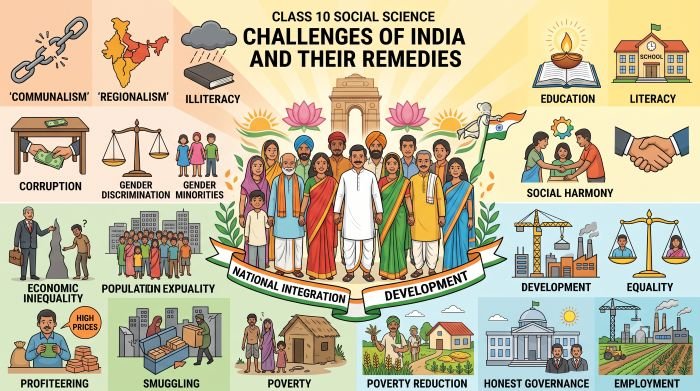
Additional Questions and Answers
Question 1.
What is communalism?
Answer:
Communalism refers to the division of the national community on the basis of religion and the feeling that the interests of one religious group are opposed to those of another.
Question 2.
What are the effects of communalism?
Answer:
Communalism causes division of society, mutual distrust, social unrest, economic antagonism, political rivalry and threatens the unity and integrity of the nation.
Question 3.
What is regionalism?
Answer:
Regionalism means the strong feeling of people in favour of the local area or region in which they live.
Question 4.
How does extreme regionalism affect national unity?
Answer:
Extreme regionalism can harm national unity and integrity. It may lead to inter-state border disputes and disputes over sharing of river water.
Question 5.
What is sub-regionalism?
Answer:
Regionalism that exists in different areas within a state is called sub-regionalism.
Question 6.
What are the main causes of illiteracy?
Answer:
Poverty, migration, child labour, child marriage, lack of interest in education and assigning baby-care responsibilities to older children are some of the causes of illiteracy.
Question 7.
Mention any four programmes introduced to eradicate illiteracy.
Answer:
- National Literacy Mission
- Sarva Shiksha Abhiyan
- Sakshara Bharat Programme
- Samagra Shiksha
Question 8.
What is corruption?
Answer:
Corruption is the improper and selfish use of power or influence for personal gain by violating rules and regulations.
Question 9.
Mention the causes of corruption.
Answer:
Casteism, nepotism, lack of accountability, weak laws, selfishness, lack of supervision and inefficient anti-corruption agencies are some causes of corruption.
Question 10.
What is the role of Lokayukta in controlling corruption?
Answer:
The Lokayukta deals with complaints related to corruption, unnecessary delays and harassment in government work.
Multiple Choice Questions (MCQs)
- Developing a strong feeling in favour of one’s local area is called:
A) Communalism
B) Regionalism
C) Corruption
D) Poverty
Answer:
B) Regionalism
- Regionalism within different areas of a state is called:
A) Nationalism
B) Communalism
C) Sub-regionalism
D) Globalism
Answer:
C) Sub-regionalism
- Which of the following can be a cause of illiteracy?
A) Poverty
B) Industrialisation
C) Urbanisation
D) Economic growth
Answer:
A) Poverty
- The National Literacy Mission was launched in:
A) 1975
B) 1988
C) 1995
D) 2001
Answer:
B) 1988
- Article 21A of the Indian Constitution relates to:
A) Right to Property
B) Right to Education
C) Right to Equality
D) Right to Religion
Answer:
B) Right to Education
- The Right to Information Act was implemented in:
A) 1995
B) 2000
C) 2005
D) 2010
Answer:
C) 2005
- Which institution deals with corruption complaints in Karnataka?
A) Election Commission
B) Lokayukta
C) Finance Commission
D) Planning Commission
Answer:
B) Lokayukta
- The Central Vigilance Commission is associated with:
A) Education
B) Health
C) Controlling corruption
D) Agriculture
Answer:
C) Controlling corruption
- Which of the following is an effect of corruption?
A) Increased transparency
B) Better administration
C) Weakening of social and economic systems
D) Equal distribution of wealth
Answer:
C) Weakening of social and economic systems
- Which of the following is a measure to reduce gender discrimination?
A) Promoting women’s education
B) Restricting women’s employment
C) Preventing women from voting
D) Reducing educational opportunities
Answer:
A) Promoting women’s education
- The Transgender Persons (Protection of Rights) Act was enacted in:
A) 2005
B) 2014
C) 2019
D) 2022
Answer:
C) 2019
- Economic inequality refers to:
A) Equality between all people
B) Gap between rich and poor
C) Increase in literacy
D) Growth of population
Answer:
B) Gap between rich and poor
- Demographic dividend occurs when:
A) The working population is a larger proportion of the total population
B) The population completely stops growing
C) The elderly population is the largest group
D) There is no working population
Answer:
A) The working population is a larger proportion of the total population
- Which of the following is a problem caused by over-population?
A) Unemployment
B) Increased literacy
C) Better housing
D) More resources per person
Answer:
A) Unemployment
- MGNREGA is related mainly to:
A) Rural employment
B) Space research
C) Higher education
D) Foreign trade
Answer:
A) Rural employment
- Poverty means inability to obtain:
A) Luxury goods
B) Basic necessities of life
C) Foreign products
D) Expensive vehicles
Answer:
B) Basic necessities of life
- Which of the following is a cause of profiteering?
A) Proper price monitoring
B) Illegal hoarding
C) Fair competition
D) Consumer awareness
Answer:
B) Illegal hoarding
- Profiteering can lead to:
A) Lower prices
B) Increased inflation
C) Reduced inequality
D) Greater economic stability
Answer:
B) Increased inflation
- The illegal movement of goods across national borders is called:
A) Export
B) Import
C) Smuggling
D) Trade
Answer:
C) Smuggling
- Which of the following helps to control smuggling?
A) Weak border security
B) Illegal trade
C) Strict coastal and border vigilance
D) Black marketing
Answer:
C) Strict coastal and border vigilance
- Which organisation was established at the national level to control corruption?
A) Lokpal
B) Lok Sabha
C) UPSC
D) Election Commission
Answer:
A) Lokpal