
Class 10 Social Question and Answer: World Wars and India’s Role
Looking for SSLC Class 10 Social Science Studies textbook answers? You can download Chapter 9 : World Wars and India’s Role Questions and Answers PDF, Notes, and Additional Q&A here. SSLC Social Science solutions follow the Karnataka State Board Syllabus, making it easier for students to revise and score higher in exams.
Karnataka SSLC Social History Textbook Answers—Reflections Chapter 9
World Wars and India’s Role Questions and Answers, Notes, and Additional Q&A
Class 10 History Chapter 9
World Wars and India’s Role

Scroll Down to Download World Wars And India’s Role PDF
I. Fill in the blanks with suitable words.
- World War I ended in the year 1918.
- Versailles Pact was signed in the year 1919.
- Italian dictator was Mussolini.
- The leader of the Nazi Party in Germany was Adolf Hitler.
- World War II started in the year 1939.
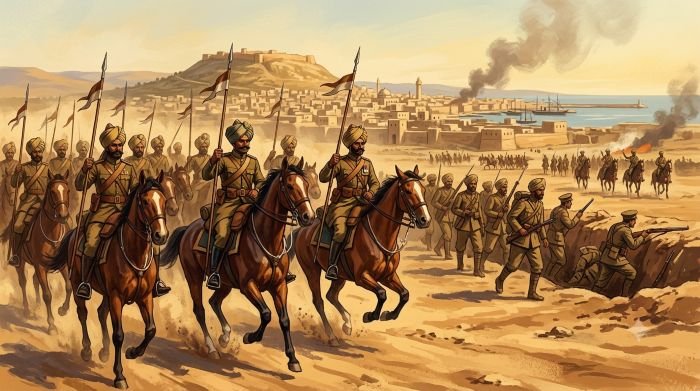
- As the head of Mysore Lancers Colonel J. Desiraja Urs was sent to the war field.
II. Discuss the following in groups and answer them:
Question 1.
Explain the immediate cause for World War I.
Answer:
The immediate cause of World War I was the assassination of Archduke Franz Ferdinand, the heir to the Austrian throne, on 28th June 1914. He was assassinated in Sarajevo by Gavrilo Princip, a Serbian nationalist. This incident created a serious conflict between Austria-Hungary and Serbia, which eventually led to the outbreak of World War I.
Question 2.
‘Nazi ideology destroyed Germany.’ Justify this statement.
Answer:
Nazi ideology promoted extreme nationalism, racial superiority and hatred towards Jews and other communities. Hitler suppressed political opponents, banned labour unions and established dictatorship. The Nazis carried out mass persecution and killings, leading to immense loss of life. Hitler’s aggressive expansion and ambition to conquer Europe led to World War II. Germany was eventually defeated, its cities were destroyed, and Hitler died in 1945. Thus, Nazi ideology brought destruction and suffering to Germany.
Question 3.
What were the causes for World War II?
Answer:
The major causes of World War II were the humiliation imposed on Germany by the Versailles Treaty, economic problems and unemployment after World War I, the rise of dictators like Hitler and Mussolini, aggressive nationalism and imperialism, and Hitler’s ambition to expand German territory. Japan’s expansion in East Asia and Germany’s invasion of Poland on 1st September 1939 also led directly to the war.
Question 4.
Name the Commandants of Mysore Lancers.
Answer:
The important Commandants of Mysore Lancers were A.T. Tyagaraj, A. Lingaraja Urs, Subbaraja Urs, B.P. Krishne Urs, Mir Turab Ali, Sardar Bahadur, B. Chamaraja Urs and Colonel J. Desiraja Urs.
Question 5.
What were the results of World War II?
Answer:
World War II caused enormous loss of life and destruction. The United Nations Organisation (UNO) replaced the League of Nations. The USA and Soviet Union emerged as rival superpowers, leading to the Cold War. Many Asian and African countries gained an opportunity to become independent, while European colonial powers lost several colonies. The use of atomic bombs also led to competition among powerful nations to acquire nuclear weapons.
Question 6.
Where is Teen Murti Chowk?
Answer:
Teen Murti Chowk is in New Delhi. It is associated with the war memorial commemorating the contribution of the Mysore, Jodhpur and Hyderabad Lancers during World War I.
Question 7.
How did Britain utilise the resources of India during World War II?
Answer:
Britain utilised India’s agricultural products, industrial goods and raw materials for the war. Indian ordnance factories upgraded their technology and increased the production of war-related goods and weapons. India also supplied resources and soldiers to support the Allied war effort.
Additional Questions and Answers
Question 1.
What were the two groups formed during World War I?
Answer:
The two groups were the Triple Entente and the Triple Alliance. Britain, France and Russia formed the Triple Entente, while Germany, Austria-Hungary and Italy formed the Triple Alliance.
Question 2.
Why was the League of Nations established?
Answer:
The League of Nations was established after World War I with the intention of preventing future wars and maintaining peace among nations.
Question 3.
Who was Adolf Hitler?
Answer:
Adolf Hitler was the leader of the Nazi Party in Germany. He became Chancellor of Germany and later established a dictatorship. His aggressive policies and expansionist ambitions contributed to the outbreak of World War II.
Question 4.
What was the Holocaust?
Answer:
The Holocaust was the systematic mass persecution and murder of Jews by the Nazi regime during World War II. Millions of Jews were killed.
Question 5.
Who was Mussolini?
Answer:
Benito Mussolini was the Italian dictator and founder of the National Fascist Party. He established a dictatorship in Italy and joined Hitler during World War II.
Question 6.
What were the main features of Fascism?
Answer:
The main features of Fascism were intense nationalism, glorification of violence, destruction of political opponents, racial supremacy, imperialist expansion and support for authoritarian rule.
Question 7.
When did World War II begin and end?
Answer:
World War II began in 1939 and ended in 1945.
Question 8.
Which countries formed the Axis Powers?
Answer:
Germany, Italy and Japan formed the major Axis Powers.
Question 9.
Which countries were the major Allied Powers?
Answer:
The major Allied Powers were Britain, France, Soviet Russia, the United States and China.
Question 10.
What was the immediate cause of World War II?
Answer:
The immediate cause of World War II was Germany’s invasion of Poland on 1st September 1939.
Question 11.
What was the role of Mysore Lancers in World War I?
Answer:
The Mysore Lancers fought in places such as the Suez Canal and Palestine. They played an important role in defeating enemy forces and capturing important areas.
Question 12.
What was the contribution of India during World War I?
Answer:
India provided soldiers, money, animals, weapons, clothing, raw materials and other supplies to support Britain during World War I. About 1.5 million Indian soldiers participated in the war.
Question 13.
What was the role of the Indian Army during World War II?
Answer:
The Indian Army fought in several regions, including East Africa, West Asia, Burma and Italy. Its training and military experience helped the Allied forces defeat the Axis Powers.
Question 14.
How did World War II contribute to India’s independence?
Answer:
World War II weakened Britain economically and politically. Several colonies began demanding independence. The changing international situation and India’s growing national movement created favourable conditions for India to achieve independence in 1947.
Question 15.
What was the importance of the Burma campaign?
Answer:
The Burma campaign from 1942–1945 was important for the Indian Army because Indian soldiers received rigorous military training and gained valuable battlefield experience. Their efforts contributed to victory against Japanese forces.
Multiple-Choice Questions (MCQs)
1. World War I took place between:
a) 1910–1914
b) 1914–1918
c) 1918–1922
d) 1939–1945
Answer:
b) 1914–1918
2. The immediate cause of World War I was the assassination of:
a) Adolf Hitler
b) Benito Mussolini
c) Archduke Franz Ferdinand
d) Kaiser Wilhelm II
Answer:
c) Archduke Franz Ferdinand
3. The Versailles Treaty was signed in:
a) 1914
b) 1918
c) 1919
d) 1925
Answer:
c) 1919
4. The leader of the Nazi Party was:
a) Mussolini
b) Hitler
c) Stalin
d) Churchill
Answer:
b) Hitler
5. The Italian dictator was:
a) Hitler
b) Stalin
c) Mussolini
d) Roosevelt
Answer:
c) Mussolini
6. World War II began in:
a) 1918
b) 1929
c) 1939
d) 1945
Answer:
c) 1939
7. Germany, Italy and Japan formed the:
a) Allied Powers
b) Axis Powers
c) Triple Entente
d) League of Nations
Answer:
b) Axis Powers
8. Germany invaded which country on 1st September 1939?
a) France
b) Russia
c) Poland
d) Italy
Answer:
c) Poland
9. The League of Nations was replaced by:
a) NATO
b) UNO
c) SAARC
d) European Union
Answer:
b) UNO
10. The atomic bombs were dropped on:
a) Tokyo and Kyoto
b) Hiroshima and Nagasaki
c) Osaka and Hiroshima
d) Nagasaki and Tokyo
Answer:
b) Hiroshima and Nagasaki
11. The Mysore Lancers were associated with:
a) World War I
b) World War II only
c) Cold War
d) Russian Revolution
Answer:
a) World War I
12. Teen Murti Chowk is located in:
a) Mumbai
b) Bengaluru
c) New Delhi
d) Hyderabad
Answer:
c) New Delhi
13. The founder of the National Fascist Party was:
a) Hitler
b) Mussolini
c) Stalin
d) Churchill
Answer:
b) Mussolini
14. World War II ended in:
a) 1942
b) 1944
c) 1945
d) 1947
Answer:
c) 1945
15. Which two countries emerged as major rival superpowers after World War II?
a) Britain and France
b) Germany and Japan
c) USA and Soviet Union
d) Italy and China
Answer:
c) USA and Soviet Union