
Class 10 Social Question and Answer: India After Independence
Looking for SSLC Class 10 Social Science Studies textbook answers? You can download Chapter 8: India After Independence Questions and Answers PDF, Notes, and Additional Q&A here. SSLC Social Science solutions follow the Karnataka State Board Syllabus, making it easier for students to revise and score higher in exams.
Karnataka SSLC Social History Textbook Answers—Reflections Chapter 8
India After Independence Questions and Answers, Notes, and Additional Q&A
Class 10 History Chapter 8
India After Independence
Scroll Down to Download India After Independence PDF
I. Fill in the blanks with suitable words:
- The first Home Minister of India was Sardar Vallabhbhai Patel.
- The first President of India was Babu Rajendra Prasad.
- Pondicherry joined India as a Union Territory in
- The linguistic reorganization of India took place in 1956.
II. Discuss the following in groups and answer them:
Question 1.
What were the problems faced by India after Independence?
Answer:
India faced many problems after Independence. They included the rehabilitation of refugees, communal riots, formation of a new government, integration of various provinces, production of food, development of agriculture and growth of industries.
Question 2.
How did the country deal with the problem of refugees?
Answer:
The Government of India took many efforts to rehabilitate the refugees who migrated from Pakistan to India. It provided them with shelter, employment, land, education, health care and a conducive social environment. Many measures were taken to help them settle in their new places.
Question 3.
Describe the manner in which Pondicherry was liberated from the French.
Answer:
The French continued their control over Pondicherry, Karaikal, Mahe and Chandranagar even after India’s Independence. The Congress, Communists and other organizations struggled for their merger with India. As a result of this struggle, these French territories joined India in 1954. Pondicherry was declared a Union Territory in 1962 and was renamed Puducherry in 2006.
Question 4.
How was Goa liberated from the Portuguese?
Answer:
An endless struggle took place demanding the inclusion of Goa, which was under Portuguese rule, into India. In 1955, satyagrahis from different parts of India gathered in Goa and began a liberation movement demanding that the Portuguese quit Goa. In 1961, the Indian Army intervened and took Goa under its control. Goa remained a Union Territory until 1987 and later became a state.
Question 5.
Why was the State Reorganisation Commission formed by the Government of India in 1953?
Answer:
The State Reorganisation Commission was formed by the Government of India in 1953 to reorganize the states on the basis of language. The demand for linguistic states became stronger after Potti Sriramulu died following a 58-day fast demanding the formation of Vishalandhra. The commission was headed by Justice Fazal Ali, with K. M. Panikkar and H. N. Kunzru as members.
III. Additional Questions and Answers
Question 1.
Who was the first Prime Minister of independent India?
Answer:
Jawaharlal Nehru was the first Prime Minister of independent India.
Question 2.
Who was the first Governor-General of independent India?
Answer:
Lord Mountbatten was the first Governor-General of independent India.
Question 3.
Who was known as the Iron Man of India?
Answer:
Sardar Vallabhbhai Patel was known as the Iron Man of India.
Question 4.
When did the Indian Constitution come into effect?
Answer:
The Indian Constitution came into effect on 26th January 1950.
Question 5.
Who was the Chairman of the Constitution Drafting Committee?
Answer:
Dr. B. R. Ambedkar was the Chairman of the Constitution Drafting Committee.
Question 6.
What is meant by parliamentary democracy?
Answer:
Parliamentary democracy is a form of government in which elected representatives form the Parliament and the government is responsible to it.
Question 7.
What was a privy purse?
Answer:
A privy purse was the payment given to the rulers of princely states that joined the Indian Union.
Question 8.
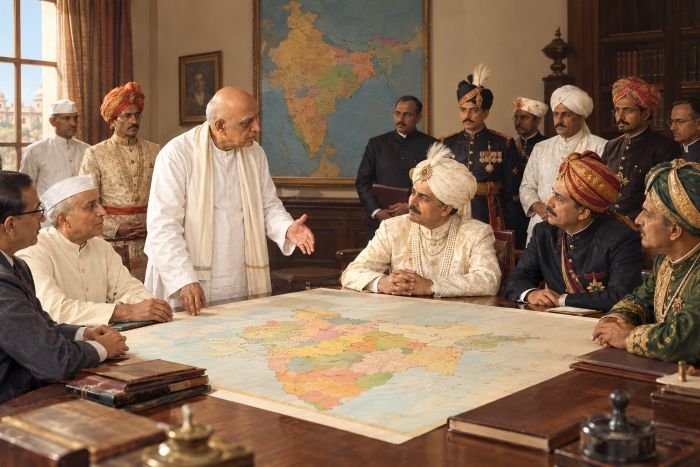
Who played a major role in the integration of princely states?
Answer:
Sardar Vallabhbhai Patel played a major role in the integration of princely states into the Indian Union.
Question 9.
How did Hyderabad merge with India?
Answer:
The Nizam of Hyderabad refused to join the Indian Union and wanted to remain independent. In 1948, the Indian Army intervened and defeated the Nizam, paving the way for the merger of Hyderabad with India.
Question 10.
How did Junagadh merge with India?
Answer:
The ruler of Junagadh wanted to merge his state with Pakistan. Following protests by the people, the ruler fled. At the request of the Diwan, the Indian government sent its army to establish peace. Junagadh merged with India in 1949.
Multiple-Choice Questions (MCQs) with Answers
1. Who was the first Prime Minister of independent India?
A) Sardar Vallabhbhai Patel
B) Jawaharlal Nehru
C) Dr. B. R. Ambedkar
D) Dr. Rajendra Prasad
Answer:
B) Jawaharlal Nehru
2. Who was known as the Iron Man of India?
A) Mahatma Gandhi
B) Subhas Chandra Bose
C) Sardar Vallabhbhai Patel
D) Jawaharlal Nehru
Answer:
C) Sardar Vallabhbhai Patel
3. When did the Indian Constitution come into effect?
A) 15 August 1947
B) 26 January 1950
C) 26 November 1949
D) 1 November 1956
Answer:
B) 26 January 1950
4. Who was the Chairman of the Constitution Drafting Committee?
A) Dr. Rajendra Prasad
B) Jawaharlal Nehru
C) Sardar Vallabhbhai Patel
D) Dr. B. R. Ambedkar
Answer:
D) Dr. B. R. Ambedkar
5. Which was the first state formed on a linguistic basis in 1953?
A) Karnataka
B) Kerala
C) Andhra Pradesh
D) Maharashtra
Answer:
C) Andhra Pradesh
6. Who was the Chairman of the State Reorganisation Commission?
A) K. M. Panikkar
B) Justice Fazal Ali
C) H. N. Kunzru
D) Dr. B. R. Ambedkar
Answer:
B) Justice Fazal Ali
7. In which year did Hyderabad merge with India?
A) 1947
B) 1948
C) 1949
D) 1950
Answer:
B) 1948
8. In which year did Junagadh merge with India?
A) 1947
B) 1948
C) 1949
D) 1953
Answer:
C) 1949
9. When was Goa liberated from Portuguese rule?
A) 1954
B) 1956
C) 1961
D) 1962
Answer:
C) 1961
10. In which year was Mysore State renamed Karnataka?
A) 1953
B) 1956
C) 1962
D) 1973
Answer:
D) 1973
11. Who undertook a 58-day fast demanding the formation of Vishalandhra?
A) Potti Sriramulu
B) Sheikh Abdullah
C) Sardar Vallabhbhai Patel
D) Dr. Rajendra Prasad
Answer:
A) Potti Sriramulu
12. When was Pondicherry declared a Union Territory?
A) 1954
B) 1956
C) 1961
D) 1962
Answer:
D) 1962
13. What was a privy purse?
A) A tax collected from farmers
B) A payment given to former princely rulers
C) A fund for refugees
D) A government loan
Answer:
B) A payment given to former princely rulers
14. Who was the first President of India?
A) Dr. B. R. Ambedkar
B) Jawaharlal Nehru
C) Dr. Rajendra Prasad
D) Sardar Vallabhbhai Patel
Answer:
C) Dr. Rajendra Prasad
15. Which foreign policy did India follow after Independence?
A) Colonial policy
B) Non-Alignment policy
C) Divide and Rule policy
D) Imperialist policy
Answer:
B) Non-Alignment policy
16. Who was the first Governor-General of independent India?
A) Lord Mountbatten
B) C. Rajagopalachari
C) Dr. Rajendra Prasad
D) Jawaharlal Nehru
Answer:
A) Lord Mountbatten
17. When did the French territories join India, according to the textbook?
A) 1947
B) 1950
C) 1954
D) 1961
Answer:
C) 1954
18. In which year was the State Reorganisation Act implemented?
A) 1950
B) 1953
C) 1956
D) 1962
Answer:
C) 1956
19. Which amendment added the words ‘Socialist’ and ‘Secular’ to the Preamble of the Indian Constitution?
A) 24th Amendment
B) 42nd Amendment
C) 44th Amendment
D) 52nd Amendment
Answer:
B) 42nd Amendment
20. Which movement demanded the integration of Kannada-speaking areas into one state?
A) Quit India Movement
B) All Karnataka State Formation Movement
C) Swadeshi Movement
D) Civil Disobedience Movement
Answer:
B) All Karnataka State Formation Movement