
Class 10 Social Question and Answer: The Freedom Struggle
Looking for SSLC Class 10 Social Science Studies textbook answers? You can download Chapter 7: The Freedom Struggle Questions and Answers PDF, Notes, and Additional Q&A here. SSLC Social Science solutions follow the Karnataka State Board Syllabus, making it easier for students to revise and score higher in exams.
Karnataka SSLC Social History Textbook Answers—Reflections Chapter 7
The Freedom Struggle Questions and Answers, Notes, and Additional Q&A
Class 10 History Chapter 7
The Freedom Struggle
I. Fill in the blanks with suitable words
- The Indian National Congress was established in the year 1885.
- The person who talked about the ‘Drain Theory’ was Dadabhai Naoroji.
- ‘Swaraj is my birthright’ was declared by Bal Gangadhar Tilak.
- The Ali brothers started the Khilafat movement.
- A separate nation for Muslims was proposed by Mohammad Ali Jinnah.
- The Lahore Session of the Indian National Congress that took place in 1929 was presided over by Jawaharlal Nehru.
- The Mahad Tank and Kalaram Temple movements were organised by Dr. B. R. Ambedkar.
- The Jhansi Regiment of the Indian National Army was headed by Captain Lakshmi Sehgal.
- The place where Gandhiji carried out the Salt Satyagraha was Dandi.
- The Quit India Movement was carried out in the year 1942.
II. Fill in the blanks with the given alternatives
1. Founder of the Indian National Congress was
a) Mahatma Gandhi
b) A. O. Hume
c) Bal Gangadhar Tilak
d) Gopal Krishna Gokhale
Answer:
b) A. O. Hume
2. The publisher of the ‘Maratha’ paper was
a) Jawaharlal Nehru
b) Ras Bihari Bose
c) Bal Gangadhar Tilak
d) V. D. Savarkar
Answer:
c) Bal Gangadhar Tilak
3. The Swaraj Party was established in the year
a) 1924
b) 1923
c) 1929
d) 1906
Answer:
b) 1923
4. President of the Indian National Congress at the Lahore Session of 1929 was
a) Sardar Vallabhbhai Patel
b) Dr. B. R. Ambedkar
c) Lala Lajpat Rai
d) Jawaharlal Nehru
Answer:
d) Jawaharlal Nehru
5. The Iron Man of India was
a) Bhagat Singh
b) Chandrashekhar Azad
c) Abul Kalam Azad
d) Sardar Vallabhbhai Patel
Answer:
d) Sardar Vallabhbhai Patel
III. Discuss the following in groups and answer them:
Question 1.
Which were the organizations in India before the establishment of the Indian National Congress?
Answer:
The organizations established in India before the Indian National Congress were the Hindu Mela, the East India Association, the Poona Sarvajanik Sabha and the Indian Association.
Question 2.
What were the demands put forward by moderates to the British?
Answer:
The moderates demanded the development of industries, reduction of military expenses, improvement in educational standards and measures to study and reduce poverty in India.
Question 3.
Analyse the Drain Theory.
Answer:
Dadabhai Naoroji explained the Drain Theory. According to him, Indian wealth was transferred to England through the payment of salaries, pensions and administrative expenses of British officials. The British encouraged imports and reduced exports, which adversely affected the Indian economy. This led to the drain of wealth from India to England.
Question 4.
Name the revolutionaries in the freedom movement.
Answer:
The prominent revolutionaries in the Indian freedom movement were V. D. Savarkar, Aurobindo Ghosh, Shyamji Krishna Varma, Madam Cama, Khudiram Bose, Ramaprasad Bismil, Bhagat Singh and Chandrashekhar Azad.
Question 5.
Explain the role of Balagangadhar Tilak in the freedom struggle.
Answer:
Bal Gangadhar Tilak was a prominent extremist leader of the Indian freedom movement. He declared, “Swaraj is my birthright and I will get it at any cost.” He encouraged nationalism through the celebrations of Ganesha and Shivaji festivals. He used his newspapers Kesari in Marathi and Maratha in English to spread nationalist ideas and encourage people to participate actively in the freedom struggle. He was imprisoned for his revolutionary writings and wrote Geetha Rahasya in jail.
Question 6.
What were the reasons for withdrawing the partition of Bengal?
Answer:
The British government withdrew the partition of Bengal in 1911 due to widespread protests by the extremists and people across the country. The Swadeshi Movement and the strong opposition to the British policy of ‘Divide and Rule’ forced the government to cancel the partition.
Question 7.
Describe the Chowri-Chowra incident.
Answer:
The Chowri-Chowra incident took place in Uttar Pradesh in 1922 during the Non-Cooperation Movement. The police used force against peaceful protesters. In response, the angry protesters set fire to a police station, killing about 22 policemen. Disturbed by this violent incident, Gandhiji withdrew the Non-Cooperation Movement.
Question 8.
Describe the Salt Satyagraha.
Answer:
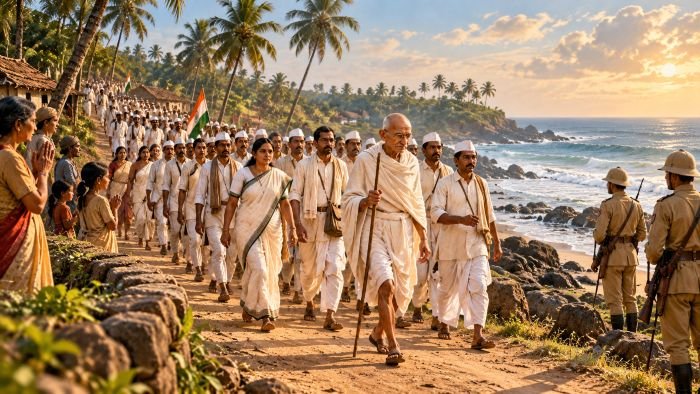
In 1930, Gandhiji started the Salt Satyagraha as part of the Civil Disobedience Movement. He marched on foot from Sabarmati Ashram to Dandi in Gujarat with his followers and made salt from seawater in protest against the British salt tax. This event is known as the Dandi March. Thousands of people across the country participated in the movement, and many leaders were arrested by the British government.
Question 9.
What were the reasons for the failure of the Quit India Movement?
Answer:
The Quit India Movement faced several difficulties. The British government arrested Gandhiji and other prominent Congress leaders at the beginning of the movement. The absence of major leaders made it difficult to organise the movement effectively. The British government suppressed the protests through strict measures, arrests and the use of force. As a result, the movement could not achieve immediate independence.
Question 10.
Name the revolutionaries who took part in the Indian freedom struggle.
Answer:
The prominent revolutionaries who took part in the Indian freedom struggle were V. D. Savarkar, Aurobindo Ghosh, Shyamji Krishna Varma, Madam Cama, Khudiram Bose, Ramaprasad Bismil, Bhagat Singh and Chandrashekhar Azad.
Question 11.
What was the result of the Second Round Table Conference?
Answer:
The Second Round Table Conference was held in 1931. Gandhiji and Dr. B. R. Ambedkar participated in it. Differences of opinion arose between Gandhiji and Ambedkar regarding separate electorates for the depressed classes. The conference ended without any conclusion. Later, the Poona Pact was signed, providing reserved seats for the depressed classes instead of separate electorates.
Question 12.
Give an account of the achievements of Subhash Chandra Bose in the independence struggle.
Answer:
Subhash Chandra Bose was popularly known as Netaji. He resigned from the Indian Civil Services and joined the freedom struggle. He established the Forward Bloc after leaving the Congress. He organised Indians living abroad and took leadership of the Indian National Army (INA). He gave the slogans “Delhi Chalo” and “Give me blood, I will give you freedom.” He also formed the women’s Jhansi Regiment under Captain Lakshmi Sehgal to fight against British rule.
Question 13.
Describe the tribal revolts in the Indian freedom struggle.
Answer:
The tribal revolts were mainly caused by the British land revenue policies and forest laws. The Santala revolt and the Munda movement were prominent tribal revolts. The Santhals revolted against the exploitation of landlords, moneylenders and the British government. In Karnataka, the Halagali Hunters’ rebellion was noteworthy. In the north-eastern region, Jadonang and Rani Gaidinliu led tribal resistance against the British. These revolts contributed to the Indian freedom struggle.
Additional Questions and Answers
Question 1.
Who established the Indian National Congress, and when?
Answer:
A. O. Hume established the Indian National Congress in 1885.
Question 2.
What was the main aim of the Swadeshi Movement?
Answer:
The main aim of the Swadeshi Movement was to boycott foreign goods and encourage the use of Indian-made goods.
Question 3.
What was the main principle of Gandhiji’s freedom struggle?
Answer:
The main principles of Gandhiji’s freedom struggle were truth, non-violence and Satyagraha.
Question 4.
Who was popularly known as Netaji?
Answer:
Subhash Chandra Bose was popularly known as Netaji.
Question 5.
When did India attain independence, and which two nations were formed during partition?
Answer:
India attained independence on 15 August 1947. The two nations formed during partition were India and Pakistan.
Multiple-Choice Questions (MCQs)
1. Who established the Indian National Congress in 1885?
a) Mahatma Gandhi
b) A. O. Hume
c) Bal Gangadhar Tilak
d) Jawaharlal Nehru
Answer:
b) A. O. Hume
2. Who explained the Drain Theory?
a) Gopal Krishna Gokhale
b) Dadabhai Naoroji
c) Lala Lajpat Rai
d) Subhash Chandra Bose
Answer:
b) Dadabhai Naoroji
3. Who declared, “Swaraj is my birthright”?
a) Mahatma Gandhi
b) Bhagat Singh
c) Bal Gangadhar Tilak
d) Sardar Vallabhbhai Patel
Answer:
c) Bal Gangadhar Tilak
4. In which year was Bengal partitioned by the British?
a) 1905
b) 1911
c) 1919
d) 1920
Answer:
a) 1905
5. Who started the Khilafat Movement in India?
a) The Ali brothers
b) The Nehru brothers
c) The Bose brothers
d) The Savarkar brothers
Answer:
a) The Ali brothers
6. Where did the Jallianwala Bagh massacre take place?
a) Delhi
b) Lahore
c) Amritsar
d) Mumbai
Answer:
c) Amritsar
7. In which year did the Non-Cooperation Movement begin?
a) 1919
b) 1920
c) 1922
d) 1930
Answer:
b) 1920
8. Who led the Dandi March in 1930?
a) Jawaharlal Nehru
b) Subhash Chandra Bose
c) Mahatma Gandhi
d) Sardar Vallabhbhai Patel
Answer:
c) Mahatma Gandhi
9. Who was the commander of the Jhansi Regiment of the Indian National Army?
a) Sarojini Naidu
b) Captain Lakshmi Sehgal
c) Madam Cama
d) Kasturba Gandhi
Answer:
b) Captain Lakshmi Sehgal
10. Who was the president of the Indian National Congress at the Lahore Session of 1929?
a) Mahatma Gandhi
b) Jawaharlal Nehru
c) Motilal Nehru
d) C. R. Das
Answer:
b) Jawaharlal Nehru
11. The Quit India Movement was launched in which year?
a) 1930
b) 1935
c) 1942
d) 1947
Answer:
c) 1942
12. Who was popularly known as the Iron Man of India?
a) Bhagat Singh
b) Sardar Vallabhbhai Patel
c) Chandrashekhar Azad
d) Abul Kalam Azad
Answer:
b) Sardar Vallabhbhai Patel
13. Who chaired the Drafting Committee of the Indian Constitution?
a) Dr. B. R. Ambedkar
b) Dr. Rajendra Prasad
c) Jawaharlal Nehru
d) Mahatma Gandhi
Answer:
a) Dr. B. R. Ambedkar
14. In which year was the Swaraj Party established?
a) 1905
b) 1919
c) 1923
d) 1930
Answer:
c) 1923
15. When did India attain independence?
a) 26 January 1930
b) 15 August 1947
c) 26 January 1950
d) 9 August 1942
Answer:
b) 15 August 1947