
Class 10 Social Question and Answer: Social and Religious Reform Movements
Looking for SSLC Class 10 Social Science Studies textbook answers? You can download Chapter 5: Social and Religious Reform Movements Questions and Answers PDF, Notes, and Additional Q&A here. SSLC Social Science solutions follow the Karnataka State Board Syllabus, making it easier for students to revise and score higher in exams.
Karnataka SSLC Social History Textbook Answers—Reflections Chapter 5
Social and Religious Reform Movements Questions and Answers, Notes, and Additional Q&A
Class 10 Social History Chapter 5
Social and Religious Reform Movements
Scroll Down to Download Social and Religious Reform Movements PDF
I. Fill in the blanks with suitable words
- The 19th Century is called the period of Indian Renaissance.
- Raja Ram Mohan Roy started the newspaper Samvada Kaumudi.
- The founder of Prarthana Samaj was Atmaram Panduranga.
- Freedom was the basic necessity of every individual was believed by Jyotiba Phule
- Swami Vivekananda’s guru was Ramakrishna Paramahamsa.
- Henry Louis Vivian Derozio started the Young Bengal Movement.
II Discuss the following in groups and write the answers:
Question 1.
What were the preachings of the Brahmo Samaj?
Answer:
The preachings of the Brahmo Samaj are:
- Opposed idol worship.
- Opposed the exploitation of women.
- Supported the prohibition of Sati.
- Encouraged monotheism (belief in one God).
- Opposed the priestly class.
- Condemned the performance of yagas and religious rituals.
Question 2.
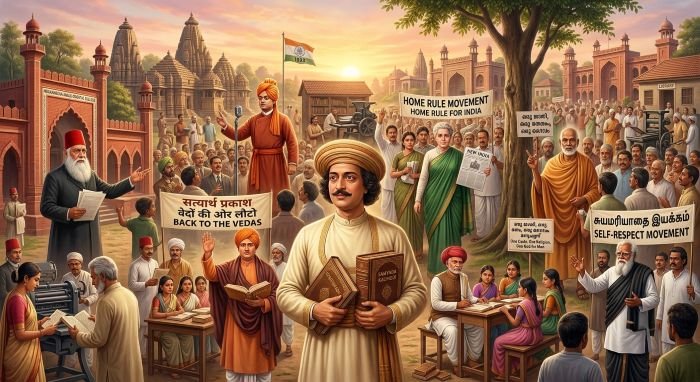
Analyse the call of Dayananda Saraswati to return to the Vedas.
Answer:
- Dayananda Saraswati realized that the remedies to the various problems of India were present in the Vedas.
- He urged people to study the Vedas and other ancient sacred texts and follow their teachings.
- He believed that the caste system and superstitions had driven many people towards other religions.
- Therefore, he gave the call “Back to the Vedas” to reform and strengthen Hindu society.
- He was regarded as more of a Renaissance leader than a reformer.
Question 3.
Discuss the reforms advocated by the Satyashodhak Samaj.
Answer:
The reforms propagated by the Satyashodhak Samaj are:
- It propagated that freedom was the basic necessity of every individual, and no one could express their ideas without freedom.
- It urged the prohibition of liquor.
- It opposed gender inequality and the denial of human rights.
- It opposed the exploitation of people.
- It opposed the practice of untouchability.
- It started a movement for social justice.
- It advocated free and compulsory education to bring about social reform.
- Jyotiba Phule condemned slavery.
- He gave special importance to girls’ education and started a school for girls.
Question 4.
Analyse the objectives of the Aligarh Movement.
Answer:
The Aligarh Movement was started under the leadership of Sir Syed Ahmed Khan. Its objectives were:
- Sir Syed Ahmed Khan believed that social and intellectual development was impossible without an open mind.
- He opposed the purdah system for Muslim women.
- He did not support polygamy.
- In 1875, he founded the Mohammadan Anglo-Oriental College at Aligarh.
- He used this institution to spread Western scientific and cultural ideas along with modern education.
- This institution later became Aligarh Muslim University.
- He preached religious tolerance.
- He worked for unity between Hindus and Muslims.
Question 5.
Explain the vision of Ramakrishna Mission.
Answer:
The Ramakrishna Mission was founded by Swami Vivekananda. The vision of the Mission was to emphasize the importance of loving life and recognizing the significance of every individual, their presence, and their abilities. It taught that social service is necessary for attaining salvation (Moksha). The Mission aimed to nurture culture through education and social service. It also preached tolerance of all religions and believed that all religions are true and deserve equal respect.
Question 6.
Which were the reforms brought about by Annie Besant?
Answer:
Annie Besant aroused pride in Indian culture through her lectures. She attempted to establish equality, universal brotherhood, and harmony in society. She gave her full support to the Indian freedom struggle and, as a part of this effort, started the Home Rule Movement in 1916. She also contributed immensely to Indian philosophy and the Indian freedom struggle.
Question 7.
Explain the contributions of Sri Narayana Guru Dharma Paripalana Yogam.
Answer:
Sri Narayana Guru (1854–1928) started the Sree Narayana Dharma Paripalana Yogam in 1903 in Kerala. This movement aimed at strengthening the backward and exploited communities. During that period, caste discrimination was very severe in Kerala, and the lower castes were denied access to public facilities such as roads and tanks. They were also not allowed to wear footwear, and women faced restrictions on their dress.
These communities were deprived of their basic human rights. To overcome these social evils, Sri Narayana Guru started the Dharma Paripalana Yogam. He preached the principle of “One Caste, One Religion and One God for human beings.“ He declared that education was the only path to social progress and built temples for the backward communities who were denied entry into existing temples.
Question 8.
List out the highlights of Periyar movement.
Answer:
The non-Brahmin movement took a new shape under the Justice Party and became more radical. The Self-Respect Movement, led by E.V. Ramaswami Naicker (Periyar), emerged as a powerful social reform movement. After leaving the Congress in 1925, Periyar started the Self-Respect League in 1926. He believed that the Congress supported the Varna system and therefore started a movement based on Dravidian identity.
Periyar was born in Erode into a wealthy family. He opposed caste discrimination, gender inequality, and the idea of Brahminical supremacy. He said that Tamil was the language of the Dravidians and opposed the dominance of Sanskrit. He participated in the Vaikom Temple Entry Movement in Kerala and became the President of the Justice Party in 1939. He founded the Dravida Kazhagam and started the English magazine Revolt. His life’s goal was to establish an equal society free from discrimination based on caste, religion, and gender.
Question 9.
Which were the principles advocated by Direjio?
Answer:
Henry Louis Vivian Direjio advocated the principles of rational thinking, free enquiry, and humanism. He believed that only rational thinking could free people from superstitions and social discrimination. He encouraged discussions and debates on topics such as nature, God, and humanism. Direjio also supported women’s rights, opposed caste-based discrimination, and worked to promote modern education through the Young Bengal Movement.
Question 10.
What are the contributions of Swami Vivekananda to society?
Answer:
Swami Vivekananda founded the Ramakrishna Mission to spread the teachings of his guru, Ramakrishna Paramahamsa. He emphasized the importance of loving life, self-confidence, and recognizing the abilities of every individual. He taught that social service is as important as prayer and yoga for attaining salvation. He worked to eradicate casteism, poverty, illiteracy, and social evils through education and service. At the 1893 Chicago Parliament of Religions, he introduced the greatness of Indian culture to the world by preaching religious tolerance and the equality of all religions. His teachings inspired the youth and many national leaders to work for the progress of society and the nation.
Additional Questions and Answers
Question 1.
Who is known as the Father of Indian Renaissance?
Answer:
Raja Ram Mohan Roy is known as the Father of Indian Renaissance.
Question 2.
Why is the 19th century called the period of Indian Renaissance?
Answer:
The 19th century is called the period of Indian Renaissance because English education, rational thinking, and Western ideas inspired Indians to fight social evils, reform society, and promote equality, freedom, and nationalism.
Question 3.
Who founded the Arya Samaj and what was its main slogan?
Answer:
Arya Samaj was founded by Dayananda Saraswati. Its main slogan was “Back to the Vedas.”
Question 4.
Who founded the Young Bengal Movement?
Answer:
The Young Bengal Movement was founded by Henry Louis Vivian Derozio.
Question 5.
What was the main objective of the Prarthana Samaj?
Answer:
The main objective of the Prarthana Samaj was to reform society by promoting education, widow remarriage, women’s education, social equality, and religious harmony.
Question 6.
Who established the Satyashodhak Samaj?
Answer:
The Satyashodhak Samaj was established by Jyotiba Phule.
Multiple Choice Questions (MCQs)
1. The 19th century is known as the period of:
A) Industrial Revolution
B) Indian Renaissance ✅
C) Green Revolution
D) Scientific Revolution
2. Who is called the Father of Indian Renaissance?
A) Swami Vivekananda
B) Raja Ram Mohan Roy ✅
C) Dayananda Saraswati
D) Jyotiba Phule
3. Which newspaper was started by Raja Ram Mohan Roy?
A) Kesari
B) New India
C) Samvada Kaumudi ✅
D) Revolt
4. The Young Bengal Movement was started by:
A) Swami Vivekananda
B) Henry Louis Vivian Derozio ✅
C) Annie Besant
D) Periyar
5. Arya Samaj was founded by:
A) Raja Ram Mohan Roy
B) Dayananda Saraswati ✅
C) M.G. Ranade
D) Sir Syed Ahmed Khan
6. The slogan “Back to the Vedas” was given by:
A) Swami Vivekananda
B) Dayananda Saraswati ✅
C) Periyar
D) Jyotiba Phule
7. Who founded the Prarthana Samaj?
A) M.G. Ranade
B) Atmaram Panduranga ✅
C) Annie Besant
D) Ramakrishna Paramahamsa
8. Satyashodhak Samaj was established by:
A) Periyar
B) M.G. Ranade
C) Jyotiba Phule ✅
D) Narayana Guru
9. The Aligarh Movement was led by:
A) Raja Ram Mohan Roy
B) Dayananda Saraswati
C) Sir Syed Ahmed Khan ✅
D) Swami Vivekananda
10. Ramakrishna Mission was established in:
A) 1875
B) 1885
C) 1897 ✅
D) 1903
11. The guru of Swami Vivekananda was:
A) Dayananda Saraswati
B) Ramakrishna Paramahamsa ✅
C) Periyar
D) Narayana Guru
12. Who started the Home Rule Movement in 1916?
A) Sarojini Naidu
B) Annie Besant ✅
C) M.G. Ranade
D) Bal Gangadhar Tilak
13. Sree Narayana Dharma Paripalana Yogam was founded in:
A) 1897
B) 1903 ✅
C) 1916
D) 1926
14. The motto “One Caste, One Religion and One God” was given by:
A) Periyar
B) Sri Narayana Guru ✅
C) Jyotiba Phule
D) Annie Besant
15. The Self-Respect Movement was led by:
A) Sir Syed Ahmed Khan
B) Swami Vivekananda
C) E.V. Ramaswami Naicker (Periyar) ✅
D) Raja Ram Mohan Roy