
Class 10 Social Question and Answer: The Impact of British Rule in India
Looking for SSLC Class 10 Social Science Studies textbook answers? You can download Chapter 3: The Impact of British Rule in India Questions and Answers PDF, Notes, and Additional Q&A here. SSLC Social Science solutions follow the Karnataka State Board Syllabus, making it easier for students to revise and score higher in exams.
Karnataka SSLC Social History Textbook Answers—Reflections Chapter 3
The Impact of British Rule in India Questions and Answers, Notes, and Additional Q&A
Class 10 Social History Chapter 3
The Impact of British Rule in India
Scroll Down to Downlaod The Impact of British Rule in India PDF
I. Fill in the following blanks with suitable answers
- Diwani Adalat in civil court was introduced by Warren Hastings.
- The post of Superintendent of Police was created by Lord Cornwallis.
- The Permanent Zamindari System was implemented in Bengal and Bihar provinces in 1793.
- The land tax system implemented by Alexander Reed is Ryotwari System.
- The British officer who supported Modern Education in India is Lord William Bentinck.
- The Regulating Act was implemented in the year 1773.
II. Discuss and answer the following questions:
Question 1.
Illustrate the judicial system formulated through the East India Company.
Answer:
A new judicial system started taking shape when the British rule replaced the Mughal rule. After the Battle of Buxar, the Mughal Emperor Shah Alam II handed over the Diwani Rights (the authority to collect land taxes) to the British. As a result, Dual Administration (Dual Governance) was introduced in the Bengal region. Under this system, the authority to collect land taxes, civil administration, and judicial functions was given to Indian officials, while the British retained control over the revenue collected.
Later, the British introduced a centralized judicial system to strengthen their authority. This helped them replace the Mughal judicial system and establish their supremacy in India.
According to the administrative plan introduced by Warren Hastings in 1772, two types of courts were established in every district:
- Diwani Adalat (Civil Court) to deal with civil cases.
- Faujdari (Nizamat) Adalat (Criminal Court) to deal with criminal cases.
In the Diwani Adalat, Hindus were given justice according to Hindu scriptures, while Muslims were judged according to the Shariat. Gradually, British legal procedures were introduced in the criminal courts. The civil courts were administered by European officers, while the criminal courts remained under the control of Qazis, functioning under the supervision of European officers. This judicial system strengthened British control over India.
Question 2.
What were the measures undertaken at the time of the British in Police system?
Answer:
The police were responsible for maintaining internal law and order. Lord Cornwallis introduced an efficient Police System in India for the first time. He created the post of Superintendent of Police (SP) and divided each district into several police stations, placing each station under a Kotwal. Every village was placed under the care of a Chowkidar. The Kotwal was held responsible for thefts, crimes, and other law-and-order problems in his area.
The severe drought of 1770 weakened the law-and-order situation. Therefore, the entire police system was brought under the control of British officers. In 1781, the system of appointing British Magistrates was introduced, and the police worked under their authority.
The police system continued to undergo changes. In 1861, the Indian Police Act was implemented, which became the foundation of modern police administration in India. However, Indians were not appointed to higher police officer posts. In 1902, the Police Commission recommended the appointment of qualified Indians as police officers. Despite these reforms, discrimination against Indians continued during British rule.
Question 3.
British land tax system made the Indian farmers to “born in debt, lived in debt and died in debt”. How?
Answer:
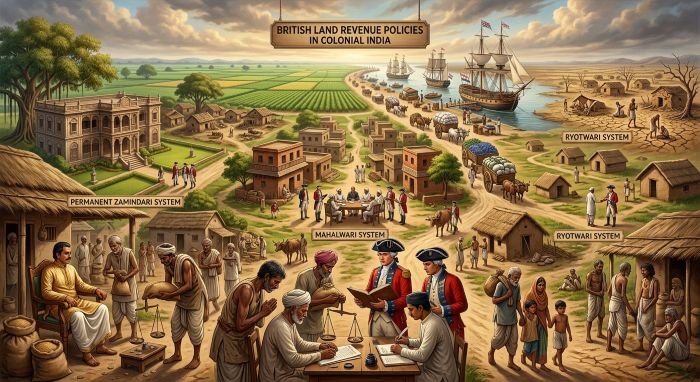
The British introduced heavy land tax policies such as the Permanent Zamindari System, Mahalwari System, and Ryotwari System to increase their revenue. Farmers had to pay high land taxes regardless of the success or failure of their crops.
When crops failed due to floods, droughts, or famine, farmers were forced to borrow money from moneylenders to pay the taxes. Unable to repay these loans, many mortgaged or sold their lands and became landless labourers. The harsh methods used by British officials to collect taxes further increased their hardships.
As a result:
- Farmers remained burdened with heavy land taxes.
- They depended on moneylenders and fell into debt.
- Many lost their land and livelihood.
- Agriculture became commercialized to meet the needs of British industries.
Therefore, Charles Metcalfe rightly remarked that “Indian farmers were born in debt, lived in debt, and died in debt” because of the oppressive British land tax policies.
Question 4.
What were the main aspects of Ryotwari system?
Answer:
The Ryotwari System was first implemented in the Baramahal region by Alexander Reed in 1792. It was later
in the Madras and Mysore regions by Thomas Munro in 1801. By then, most of these regions had become part of the British Empire.
Under this system:
- There was a direct relationship between the farmer (Ryot) and the British East India Company.
- The tiller of the land was recognized as the owner of the land.
- The owner had to pay 50% of the produce as land tax to the Company Government.
- The land tax settlement was fixed for a period of 30 years, after which it could be be revised.
Although small farmers were given ownership rights, they suffered because of heavy land taxes. The officials used punitive measures to collect taxes. When crops failed, farmers had to borrow money from moneylenders. If they could not repay the loans, they were forced to sell their lands. Thus, although the Company claimed that the Ryotwari System benefited farmers, in reality many farmers lost their lands due to its implementation.
Question 5.
What were the effects of the British Land Tax System?
Answer:
The following were the effects of the British Land Tax System:
- A new class of Zamindars who exploited the farmers was created.
- The farmers, who were subjected to the exploitation of the Zamindars, gradually became landless.
- Land became a commodity, and loans could be raised by mortgaging the land.
- Many Zamindars also had to mortgage their lands to pay the land taxes.
- The agriculture sector became commercialized and was forced to grow raw materials required by industries in England.
- The moneylenders became powerful because farmers depended on them for loans.
Question 6.
Make a list of the effects of British Education in India.
Answer:
The traditional education system of India continued for many years. During British rule, Warren Hastings promoted modern education by establishing the Calcutta Madrasa in 1781, and Jonathan Duncan started the Sanskrit College at Banaras in 1792. Charles Grant strongly supported the expansion of British education in India.
The effects of British Education in India were:
- Indians developed modernity, secularism, democratic attitudes, rational thinking, and nationalistic ideals.
- It gave an impetus to local literature and languages, creating unity in the thinking of the educated class.
- Periodicals and newspapers emerged, which examined government policies and helped Indians develop critical opinions.
- New social and religious reform movements came into existence.
- The ideas of thinkers like J. S. Mill, Rousseau, and Montesquieu inspired educated Indians with new ways of thinking.
- Freedom movements in different parts of the world influenced Indians.
- Indians began to understand and appreciate their rich cultural heritage and traditions.
Thus, the British Education System created a new generation of Indians with progressive attitudes and new cultural awareness.
Question 7.
What were the restrictions imposed in Regulating Act?
Answer:
The following were the restrictions imposed under the Regulating Act of 1773:
- Before the Act, there were three Presidencies under British rule—Bengal, Madras, and Bombay. All three were independent administrative units. Under the Regulating Act, the Bengal Presidency gained control over the other two Presidencies.
- The Governor of Bengal became the Governor-General of all the three Presidencies.
- The Governor-General was authorized to direct, control, and supervise the other two Presidencies.
- The Bombay and Madras Presidencies could not declare war or enter into peace agreements without the prior approval of the Governor-General of Bengal and the Board of Directors of the East India Company. Only during emergencies were they allowed to act independently.
- According to this Act, the Supreme Court of Judicature was established at Calcutta, consisting of one Chief Justice and three ordinary judges.
Question 8.
What were the important features of the Indian government act of 1858?
Answer:
The important features of the Government of India Act, 1858 are:
- The license of the East India Company was cancelled, and India was brought under the direct administration of the British Queen (Crown).
- The post of Governor-General was changed to Viceroy. Lord Canning became the first Viceroy of India.
- A new post called the Secretary of State for India was created in the British Government. The Secretary was a member of the British Cabinet and was responsible for the administration of India.
- A Council of India consisting of 15 members was created to assist the Secretary of State for India in administering the country.
Question 9.
How did the Government of India Act of 1935 become the basis of the Indian Constitution?
Answer:
The Government of India Act of 1935 became the basis of the Indian Constitution because most of the provisions of the Indian Constitution were based on this Act. It provided for the formation of a fully responsible government by Indians and was applicable to both the Indian Princely States and the British-ruled regions.
The important features of this Act were:
- A federal system consisting of Indian Princely States, British-governed regions, and dominion states was formed.
- The Reserve Bank of India (RBI) was established.
- Dyarchy was introduced at the Centre.
- Dyarchy was abolished at the provincial (regional) level, and Provincial Autonomy was granted.
- A Federal Court was established.
Thus, many provisions of the Government of India Act, 1935 were incorporated into the Constitution of India, making it the foundation of the Indian Constitution.
Question 10.
What were the important features of 1919 Act?
Answer:
The following are the important features of the Government of India Act, 1919 (Montagu–Chelmsford Reforms Act):
- The Act introduced a bicameral legislature, consisting of a Lower House and an Upper House.
- Dyarchy was introduced in the Provincial (Regional) Governments.
- A High Commissioner was appointed for India.
- It promised to improve local self-government.
- The Provincial Budget was separated from the Central Budget.
- The Separate Electorate was extended to Muslims, Sikhs, Anglo-Indians, and Europeans.
Additional Questions and Answers
Question 1.
Who introduced the Civil Services in India?
Answer:
Lord Cornwallis introduced the Civil Services in India.
Question 2.
Why was the Regulating Act of 1773 passed?
Answer:
The Regulating Act of 1773 was passed to control corruption among the officials of the British East India Company and regulate its administration in India.
Question 3.
Who established Fort William College and why?
Answer:
Lord Wellesley established Fort William College in Calcutta in 1801 to educate candidates aspiring to join the Civil Services.
Question 4.
What was the Dual Government in Bengal?
Answer:
After the Battle of Buxar, Shah Alam II granted the Diwani Rights to the British. Under the Dual Government, Indian officials managed civil administration and justice, while the British controlled revenue collection.
Question 5.
Who introduced the Permanent Zamindari System?
Answer: Lord Cornwallis introduced the Permanent Zamindari System in 1793.
Multiple Choice Questions (MCQs)
- Who introduced the Civil Services in India?
A) Warren Hastings
B) Lord Wellesley
C) Lord Cornwallis ✅
D) Lord Dalhousie - The Regulating Act was passed in:
A) 1765
B) 1773 ✅
C) 1784
D) 1793 - The first Governor-General of Bengal under the Regulating Act was:
A) Lord Cornwallis
B) Warren Hastings ✅
C) Lord Wellesley
D) Lord Canning - The Permanent Zamindari System was introduced in:
A) 1784
B) 1801
C) 1793 ✅
D) 1833 - Who introduced the Permanent Zamindari System?
A) Thomas Munro
B) Alexander Reed
C) Lord Cornwallis ✅
D) Warren Hastings - The Ryotwari System was first introduced by:
A) Thomas Munro
B) Alexander Reed ✅
C) James Thomson
D) Lord Cornwallis - The Ryotwari System was later introduced in Madras and Mysore by:
A) Warren Hastings
B) Lord Wellesley
C) Thomas Munro ✅
D) Charles Grant - The Mahalwari System was introduced by:
A) Thomas Munro and Alexander Reed
B) Lord Cornwallis and Warren Hastings
C) M. Bird and James Thomson ✅
D) Macaulay and Charles Wood - The Education Report of 1835 was prepared by:
A) Charles Grant
B) William Bentinck
C) Lord Macaulay ✅
D) Charles Wood - Wood’s Dispatch was issued in:
A) 1833
B) 1813
C) 1854 ✅
D) 1858 - Which universities were established following Wood’s Dispatch?
A) Delhi, Bombay, Madras
B) Calcutta, Bombay, Madras ✅
C) Calcutta, Delhi, Banaras
D) Bombay, Mysore, Madras - Which Act abolished the rule of the East India Company?
A) Regulating Act, 1773
B) Pitts India Act, 1784
C) Government of India Act, 1858 ✅
D) Charter Act, 1833 - Who became the first Viceroy of India?
A) Lord Dalhousie
B) Warren Hastings
C) Lord Canning ✅
D) Lord Curzon - The Indian Councils Act of 1909 is also known as:
A) Montagu-Chelmsford Reforms
B) Government of India Act
C) Minto-Morley Reforms ✅
D) Pitts India Act - The Government of India Act of 1919 introduced:
A) Federal Court
B) RBI
C) Bicameral Legislature ✅
D) Permanent Settlement - Separate Electorates were first introduced under:
A) Government of India Act, 1919
B) Indian Councils Act, 1909 ✅
C) Charter Act, 1833
D) Government of India Act, 1935 - The Government of India Act, 1935 provided for:
A) Dual Government in Bengal
B) Permanent Settlement
C) Provincial Autonomy ✅
D) Doctrine of Lapse - Which institution was established under the Government of India Act, 1935?
A) Supreme Court of India
B) Planning Commission
C) Federal Court ✅
D) Election Commission - The post of Superintendent of Police (SP) was created by:
A) Warren Hastings
B) Lord Cornwallis ✅
C) Lord Dalhousie
D) Lord Curzon - The Supreme Court at Calcutta was established under:
A) Pitts India Act, 1784
B) Charter Act, 1833
C) Regulating Act, 1773 ✅
D) Government of India Act, 1858