
Class 10 Social Question and Answer: The Advent of Europeans to India
Looking for SSLC Class 10 Social Science Studies textbook answers? You can download Chapter 1: The Advent of Europeans to India Questions and Answers PDF, Notes, and Additional Q&A here. SSLC Social Science solutions follow the Karnataka State Board Syllabus, making it easier for students to revise and score higher in exams.
Karnataka SSLC Social History Textbook Answers—Reflections Chapter 1
The Advent of Europeans to India Questions and Answers, Notes, and Additional Q&A
Class 10 Social Sicence History Chapter 1
The Advent of Europeans to India
Scroll Down to Downlaod The Advent of Europeans to India PDF
I. Complete the following blanks with suitable answers:
- In 1453, the Ottoman Turks occupied
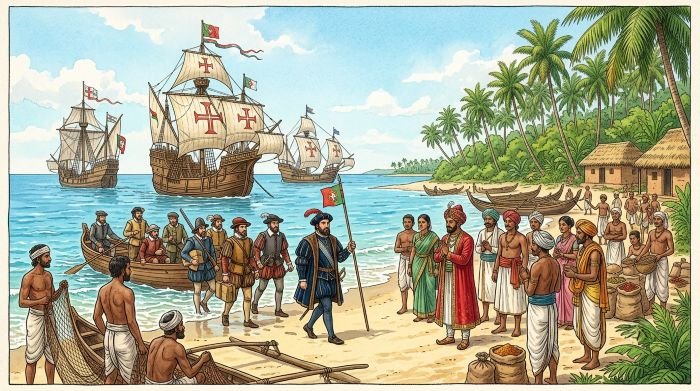
- The sea route between India and Europe was discovered by Vasco da Gama.
- In 1741, the Dutch declared war on
- The capital of the French in India was Pondicherry (Puducherry).
- The war that broke out between Siraj-ud-Daulah and Robert Clive in 1757 was the Battle of Plassey.
- The Diwani rights over Bengal were handed over to the British East India Company by Shah Alam II.
- The Dual Government policy was implemented by Robert Clive in Bengal.
II. Discuss in groups and answer the following questions:
Question 1.
How did trade take place between India and Europe during the Middle Ages?
Answer:
During the Middle Ages, the Arab merchants carried Asian goods from India and other Asian countries to Constantinople, the capital of the Eastern Roman (Byzantine) Empire. Italian merchants bought these goods from Constantinople and sold them in various European countries. There was a great demand in Europe for Indian spices such as pepper, cardamom, ginger, cinnamon, and cumin. Thus, Constantinople became the centre of international trade and was known as the “Gateway of European Trade.” The Arab merchants enjoyed a monopoly over trade with Asia, while the Italian merchants controlled trade in Europe. As a result, the Asian merchandise brought huge profits to the Italian merchants.
Question 2.
Discuss the reasons that resulted in the discovery of a new sea route to India.
Answer:
Trade and commerce between Asia and Europe were carried on through the city of Constantinople. In 1453, the Ottoman Turks captured Constantinople, bringing all the trade routes under their control. They imposed heavy taxes on goods passing through these routes, making trade expensive and unprofitable.
At the same time, Spain and Portugal wanted to break the monopoly of the Arab and Italian traders. They encouraged brave sailors to discover a new sea route to India. The inventions of the compass, astrolabe, and gunpowder further encouraged long sea voyages. As a result, Vasco da Gama discovered a new sea route to India in 1498.
Question 3.
List the Europeans who came to India for trade.
Answer:
The following European powers came to India for trade:
- Portuguese: The Portuguese were the first Europeans to arrive in India for trade. They were also the last to leave India by the sea route.
- Dutch: The Dutch, from Holland (Netherlands), established the Dutch East India Company in 1602 to trade with Eastern countries. They set up trading centres in India, Java, Sumatra, Indonesia, and the Spice Islands.
- English: On 31 December 1600, Queen Elizabeth I granted a royal charter to the British East India Company, authorizing it to trade with the Eastern countries for fifteen years.
- French: The French East India Company was established in 1664 as a government-owned company. It started its first factory at Surat in 1668 and later established trading centres in other parts of India.
Thus, the Portuguese, Dutch, English, and French were the major Europeans who arrived in India for trade.
Question 4.
Explain how Marthanda Varma checked the Dutch.
Answer:
Marthanda Varma ruled Travancore from 1729 to 1758. He opposed the Dutch, who wanted to monopolize the spice trade. He strengthened his kingdom and united the neighbouring rulers against the Dutch.
In 1741, the Dutch declared war on Travancore with the support of Kottarakara and other local rulers. Marthanda Varma defeated the Dutch army and captured important trading centres such as Nedumangad and Kottarakara. The Dutch suffered heavy losses.
Finally, on 15 August 1753, a treaty was signed, and the Dutch surrendered their power to Travancore. Thus, Marthanda Varma successfully checked the Dutch and ended their influence in Kerala.
Question 5.
Explain the Second Carnatic War.
Answer:
The Second Carnatic War (1749–1754) was fought between the English and the French to establish political supremacy in South India.
In the changed circumstances, the French made Salabath Jung, another son of Asaf Jha, the Nizam of Hyderabad. An officer named Bussy was stationed in Hyderabad by the French for his protection. In the Carnatic, Chanda Saheb became the Nawab with the support of the French.
Robert Clive of the British East India Company attacked Arcot, the capital of Carnatic, and defeated Chandasaheb. Chanda Saheb was captured and later killed. The English then appointed Mohammad Ali, the son of Anwaruddin, as the Nawab of Carnatic.
The war ended with the Treaty of Pondicherry, and Dupleix was recalled to France. This war brought victory and prestige to the English, while the French suffered a major political setback.
Question 6.
Explain the causes and results of the battle of Plassey.
Answer:
Battle of Plassey (1757):
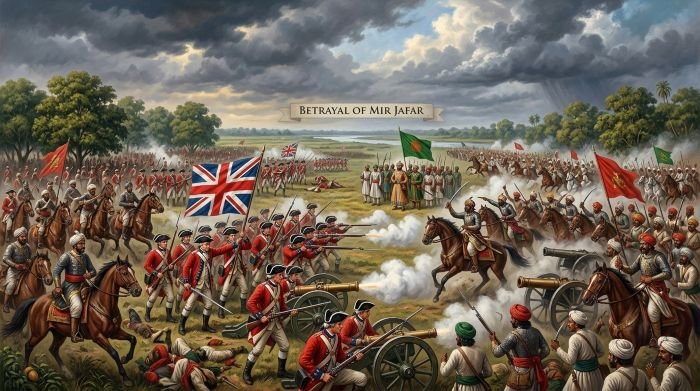
Ali Vardi Khan, the Nawab of Bengal, died in 1756, and his grandson Siraj-ud-Daulah became the Nawab. The Battle of Plassey was fought between Siraj-ud-Daulah and the British East India Company on 23 June 1757.
Reasons:
- Misuse of Dastaks: Siraj-ud-Daulah was angry because the British officials misused the Dastaks (duty-free trade permits), causing heavy losses to the Bengal treasury.
- Repair of Fort William without permission: The British repaired Fort William at Calcutta and placed cannons there without the Nawab’s permission. When Siraj-ud-Daulah ordered them to remove the cannons, they refused.
- Black Hole Tragedy: Siraj-ud-Daulah captured Fort William and imprisoned 146 Englishmen in a small room, of whom 123 died. This incident, known as the Black Hole Tragedy, enraged Robert Clive, who marched to Bengal with a large army.
Results:
- The battle exposed the lack of unity among Indians, the greed of Indian businessmen, and the treachery of some Indian leaders.
- Mir Jaffar became the Nawab of Bengal.
- The British East India Company obtained exclusive trading rights in Bengal.
- Mir Jaffar paid ₹17 crore and 70 lakh as war indemnity to the British East India Company.
- Later, the British declared Mir Jaffar inefficient and replaced him with Mir Qasim as the Nawab of Bengal.
Question 7.
What were the results of the Battle of Buxar?
Answer:
The Battle of Buxar was fought in 1764 between the combined forces of Mir Qasim, Shah Alam II, and Shuja-ud-Daula and the British East India Company led by Hector Munro. Mir Qasim was defeated and fled from the battlefield, while Shah Alam II surrendered. The combined forces failed to stop the British.
Results:
- Shah Alam II granted the Diwani rights of Bengal, Bihar, and Odisha to the British East India Company.
- Shah Alam II handed over all rights over Bengal to the British in return for an annual payment of ₹26 lakh.
- Shuja-ud-Daula, the Nawab of Awadh, was forced to pay a war indemnity of ₹50 lakh to the British East India Company.
- After the death of Mir Jaffar, the British East India Company paid a pension to his son and took over the entire administration of Bengal.
- The Battle of Buxar established the British East India Company as the real political power in Bengal, Bihar, and Odisha.
Additional Questions & Answers
Question 1.
Why was Constantinople called the “Gateway of European Trade”?
Answer:
Constantinople was the main centre through which Asian goods reached Europe. Arab merchants brought goods there, and Italian merchants sold them across Europe.
Question 2.
Who discovered the new sea route to India and when?
Answer:
Vasco da Gama, a Portuguese sailor, discovered the new sea route to India in 1498.
Question 3.
Where did Vasco da Gama first land in India?
Answer:
He landed at Kappad near Calicut (Kozhikode) on the west coast of India.
Question 4.
Who introduced the Blue Water Policy?
Answer:
Francisco de Almeida introduced the Blue Water Policy.
Question 5.
Who is known as the real founder of Portuguese power in India?
Answer:
Alfonso de Albuquerque is known as the real founder of Portuguese power in India.
Question 6.
Which city became the headquarters of the Portuguese in India?
Answer:
Goa became the headquarters of the Portuguese administration in India.
Question 7.
What was the aim of the Blue Water Policy?
Answer:
Its aim was to establish Portuguese supremacy over the sea rather than over land.
Question 8.
When was the Dutch East India Company established?
Answer:
The Dutch East India Company was established in 1602.
Question 9.
Who granted permission to the English to establish a factory at Surat?
Answer:
Mughal Emperor Jahangir granted permission.
Question 10.
Who came to Jahangir’s court as the English ambassador?
Answer:
Sir Thomas Roe.
Question 11.
Name the three Presidency towns of the British.
Answer:
- Bombay
- Madras
- Calcutta
Question 12.
What was Fort St. George?
Answer:
It was the British fort built at Madras in 1639.
Question 13.
What was Fort William?
Answer:
It was the British fort built at Calcutta.
Question 14.
When was the French East India Company established?
Answer:
It was established in 1664.
Question 15.
Who was Dupleix?
Answer:
Dupleix was the Governor-General of the French settlements in India.
Multiple Choice Questions (MCQs)
1. In which year did the Ottoman Turks capture Constantinople?
A) 1498
B) 1453
C) 1600
D) 1757
Answer:
B) 1453
2. Who discovered the sea route to India?
A) Columbus
B) Vasco da Gama
C) Magellan
D) Cook
Answer:
B) Vasco da Gama
3. Vasco da Gama reached India in
A) 1453
B) 1498
C) 1505
D) 1600
Answer:
B) 1498
4. Vasco da Gama landed at
A) Goa
B) Surat
C) Kappad
D) Madras
Answer:
C) Kappad
5. The first Europeans to arrive in India were
A) Dutch
B) English
C) Portuguese
D) French
Answer:
C) Portuguese
6. Who introduced the Blue Water Policy?
A) Vasco da Gama
B) Robert Clive
C) Francisco de Almeida
D) Dupleix
Answer:
C) Francisco de Almeida
7. Goa was captured by
A) Vasco da Gama
B) Almeida
C) Albuquerque
D) Clive
Answer:
C) Albuquerque
8. The Dutch East India Company was established in
A) 1600
B) 1602
C) 1613
D) 1664
Answer:
B) 1602
9. Which Mughal emperor allowed the English to establish a factory at Surat?
A) Akbar
B) Shah Jahan
C) Jahangir
D) Aurangzeb
Answer:
C) Jahangir
10. Who came as the English ambassador to Jahangir’s court?
A) Robert Clive
B) Sir Thomas Roe
C) James I
D) Bussy
Answer:
B) Sir Thomas Roe
11. The French East India Company was established in
A) 1600
B) 1602
C) 1664
D) 1757
Answer:
C) 1664
12. The capital of the French settlements in India was
A) Goa
B) Pondicherry
C) Surat
D) Madras
Answer:
B) Pondicherry
13. Who was the Governor-General of the French in India?
A) Bussy
B) Dupleix
C) Lally
D) Clive
Answer:
B) Dupleix
14. How many Carnatic Wars were fought?
A) One
B) Two
C) Three
D) Four
Answer:
C) Three
15. Who attacked Arcot during the Second Carnatic War?
A) Lally
B) Robert Clive
C) Bussy
D) Dupleix
Answer:
B) Robert Clive
16. The decisive Battle of Wandiwash was fought in
A) 1757
B) 1760
C) 1763
D) 1746
Answer:
B) 1760
17. The Battle of Plassey was fought in
A) 1746
B) 1757
C) 1764
D) 1765
Answer:
B) 1757
18. The Battle of Plassey was fought between
A) Hyder Ali and British
B) Siraj-ud-Daulah and British
C) Mir Qasim and British
D) French and British
Answer:
B) Siraj-ud-Daulah and British
19. After the Battle of Plassey, the Nawab of Bengal became
A) Mir Qasim
B) Shah Alam II
C) Mir Jaffar
D) Shuja-ud-Daula
Answer:
C) Mir Jaffar
20. The Battle of Buxar was fought in
A) 1757
B) 1760
C) 1764
D) 1765
Answer:
C) 1764