
Class 10 Geography Question and Answer : India – Forest Resources
Looking for SSLC Class 10 Social Science Studies textbook answers? You can download Chapter 4: India – Forest Resources Questions and Answers PDF, Notes, and Additional Q&A here. SSLC Social Science solutions follow the Karnataka State Board Syllabus, making it easier for students to revise and score higher in exams.
Karnataka SSLC Social Geography Textbook Answers—Reflections Chapter 4
India – Forest Resources Questions and Answers, Notes, and Additional Q&A
Class 10 Geography Chapter 4
India – Forest Resources
Scroll Down to Download India Forest Resources PDF
I. Fill in the blanks with suitable words:
- The forests found in Assam and Meghalaya are Evergreen forests.
- The Himalayas have Alpine Kind of forests.
- The Ganga river delta is also called Sunderbans.
- Jim Corbett National Park is in Uttarakhand
- According to the National Forest Policy, 33% of forest area is required for a healthy environment.
II. Answer the following question in brief:
Question 1.
What is natural vegetation?
Answer:
The total plant life growing naturally in an area is called natural vegetation. It is influenced by factors such as temperature, rainfall, landforms and soil.
Question 2.
What is the total forest area of India?
Answer:
According to the India State of Forest Report 2021 (ISFR), India has 7,13,789 sq. km of forest area.
Question 3.
What are the types of forests of India?
Answer:
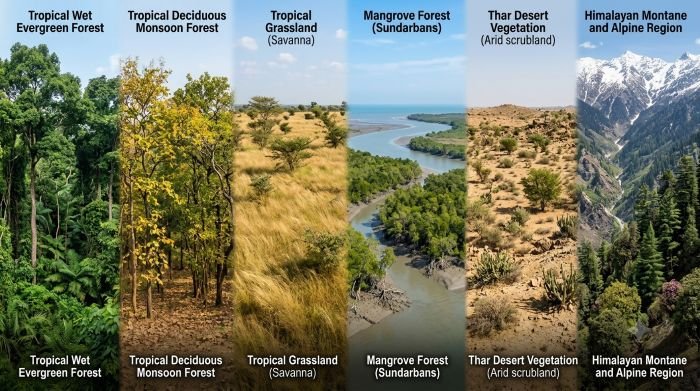
The six main types of natural vegetation in India are:
- Evergreen forests
- Deciduous monsoon forests
- Tropical grasslands
- Mangrove forests
- Desert vegetation
- Alpine forests of the Himalayas
Question 4.
Explain the characteristics and distribution of deciduous ?
Answer:
Monsoon forests in India.
Deciduous monsoon forests are found in areas receiving 75 to 250 cm of rainfall. They are the most widely distributed forests in India and form about 65.5% of the total forest area. The trees shed their leaves during the dry winter season.
Question 5.
What are the importance of forests?
Answer:
The importance of forests are:
- They provide pure air, food and fodder.
- They help in bringing rainfall.
- They control soil erosion.
- They provide shelter for animals and birds.
- They provide medicinal plants.
- They attract tourists.
- They provide employment opportunities.
- They help maintain ecological balance.
Question 6.
List out the reasons for destruction of forests?
Answer:
The main reasons for the destruction of forests are:
- Expansion of agriculture.
- Animal grazing.
- Construction of roads and railway lines.
- Irrigation projects.
- Forest fires.
- Mining activities.
- Illegal cutting of trees.
Question 7.
What is conservation of forests?
Answer:
Protection of forests from human beings, animals and natural disasters is called conservation of forests.
Question 8.
List out your suggestions of conservation of forests in the country?
Answer:
The following measures can be taken to conserve forests:
- Cut down dried and dead trees that may cause forest fires.
- Protect trees from diseases.
- Plant more saplings and sow seeds.
- Prevent illegal cutting of trees.
- Avoid grazing of domestic animals in forests.
- Create awareness among people about the importance of forests.
- Encourage people to plant and protect trees.
- Implement social forestry projects effectively.
III. Additional Questions and Answers
Question 1.
What factors influence natural vegetation?
Answer:
Natural vegetation is influenced by temperature, rainfall, landforms and soil.
Question 2.
Which type of forest is widely distributed in India?
Answer:
Deciduous monsoon forests are widely distributed in India.
Question 3.
Where are evergreen forests found in India?
Answer:
Evergreen forests are found in the Western Ghats, North-Eastern states and Andaman and Nicobar Islands.
Question 4.
What is the main characteristic of evergreen forests?
Answer:
The trees remain green throughout the year, so they are called evergreen forests.
Question 5.
Where are tropical grasslands found?
Answer:
Tropical grasslands are found in the central parts of the Peninsular Plateau and the areas west of the Aravalli Hills.
Question 6.
Where are mangrove forests found?
Answer:
Mangrove forests are found along river deltas, coastal regions and estuaries affected by tides.
Question 7.
Why are the forests of the Ganga delta called Sunderbans?
Answer:
They are called Sunderbans because Sundari trees are found in abundance there.
Question 8.
What type of vegetation is found in desert regions?
Answer:
Thorny shrubs and deep-rooted plants are mainly found in desert regions.
Question 9.
Why does vegetation change with height in the Himalayas?
Answer:
As height increases, the climate changes from tropical to polar, resulting in different types of vegetation.
Question 10.
Which state has the largest forest area in India?
Answer:
Madhya Pradesh has the largest forest area in India.
Question 11.
Which state has the least forest area according to the chapter?
Answer:
Haryana has the least forest area according to the chapter.
Question 12.
What is the importance of wildlife sanctuaries?
Answer:
Wildlife sanctuaries are established to protect animals in their natural habitat.
Question 13.
Which was the first national park established in India?
Answer:
Jim Corbett National Park was the first national park established in India.
Question 14.
Which is the first Biosphere Reserve of India?
Answer:
The Nilgiri Biosphere Reserve is the first Biosphere Reserve of India.
Question 15.
Why are Biosphere Reserves established?
Answer:
Biosphere Reserves are established to preserve biodiversity and protect flora and fauna.
Multiple-Choice Questions
- Which of the following is a type of natural vegetation in India?
a) Tundra forests
b) Evergreen forests
c) Mediterranean forests
d) Coniferous grasslands
Answer:
b) Evergreen forests - Evergreen forests are mainly found in areas receiving rainfall of more than:
a) 50 cm
b) 75 cm
c) 150 cm
d) 250 cm
Answer:
d) 250 cm - Deciduous monsoon forests receive rainfall between:
a) 10–25 cm
b) 25–50 cm
c) 75–250 cm
d) Above 300 cm
Answer:
c) 75–250 cm - Which forests form about 65.5% of the total forest area according to the chapter?
a) Evergreen forests
b) Deciduous monsoon forests
c) Mangrove forests
d) Alpine forests
Answer:
b) Deciduous monsoon forests - Mangrove forests are mainly found in:
a) Mountain slopes
b) Desert regions
c) River deltas and coastal areas
d) Dry plateaus
Answer:
c) River deltas and coastal areas - Which tree is abundant in the Ganga delta?
a) Teak
b) Sundari
c) Sal
d) Pine
Answer:
b) Sundari - Desert vegetation is mainly made up of:
a) Tall evergreen trees
b) Thorny shrubs
c) Mangrove trees
d) Broad-leaved trees
Answer:
b) Thorny shrubs - Which state has the largest forest area in India according to the chapter?
a) Karnataka
b) Rajasthan
c) Madhya Pradesh
d) Haryana
Answer:
c) Madhya Pradesh - Which of the following is a cause of forest destruction?
a) Afforestation
b) Social forestry
c) Mining
d) Wildlife protection
Answer:
c) Mining - Protection of forests from human beings, animals and natural disasters is called:
a) Afforestation
b) Conservation of forests
c) Social forestry
d) Deforestation
Answer:
b) Conservation of forests - Which of the following helps in conserving forests?
a) Illegal cutting of trees
b) Overgrazing
c) Planting saplings
d) Forest fires
Answer:
c) Planting saplings - Wildlife sanctuaries are established mainly to:
a) Promote mining
b) Protect animals in their natural habitat
c) Build industries
d) Increase agriculture
Answer:
b) Protect animals in their natural habitat - Jim Corbett National Park is located in:
a) Gujarat
b) Assam
c) Uttarakhand
d) Maharashtra
Answer:
c) Uttarakhand - The first Biosphere Reserve of India is:
a) Nilgiri
b) Panna
c) Nokrek
d) Sunderbans
Answer:
a) Nilgiri - Forests help in controlling:
a) Soil erosion
b) Earthquakes
c) Volcanoes
d) Tides
Answer
a) Soil erosion