
Class 10 Geography Question and Answer : India – Soil
Looking for SSLC Class 10 Social Science Studies textbook answers? You can download Chapter 3: India – Soil Questions and Answers PDF, Notes, and Additional Q&A here. SSLC Social Science solutions follow the Karnataka State Board Syllabus, making it easier for students to revise and score higher in exams.
Karnataka SSLC Social Geography Textbook Answers—Reflections Chapter 3
India – Soil Questions and Answers, Notes, and Additional Q&A
Class 10 Geography Chapter 3
India Soil
Scroll Down to Download India – Soil PDF
I. Fill in the blanks with suitable words.
- The soil deposited by rivers is called alluvial soil.
- Black soil area is called Deccan Trap.
- In Rajasthan, desert soil is mainly found.
- The widely spread soil in India is alluvial soil.
- For growing ragi and oil seeds, red soil is suitable.
II. Answer the following questions in brief:
Question 1.
What are the types of soils found in India?
Answer:
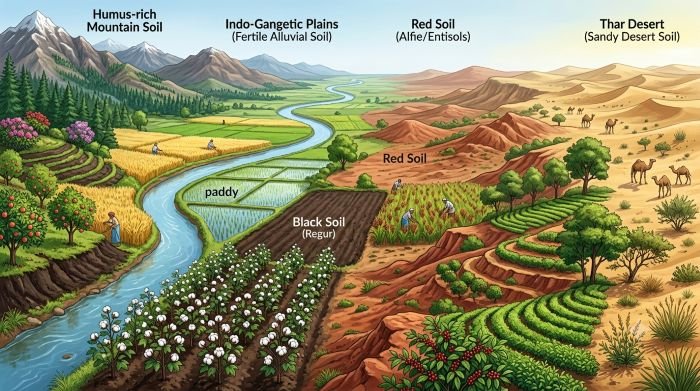
The six main types of soils found in India are:
- Alluvial soil
- Black soil
- Red soil
- Laterite soil
- Desert soil
- Mountain soil
Question 2.
What is meant by soil conservation? List out its methods.
Answer:
Prevention of soil erosion and protection of soil fertility is known as soil conservation.
Methods of soil conservation:
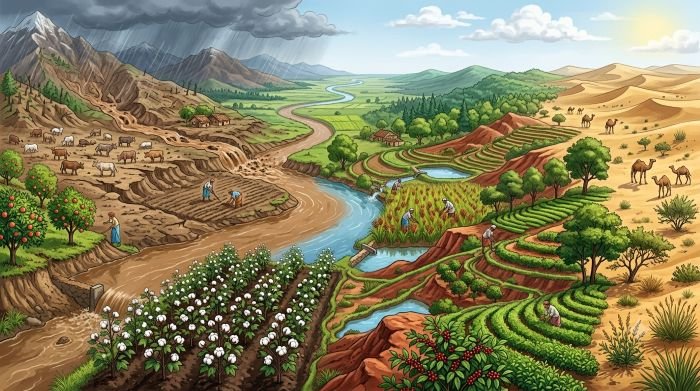
- Contour ploughing.
- Construction of bunds around agricultural land.
- Development of terraced fields.
- Prevention of deforestation.
- Encouragement of afforestation.
- Control of livestock grazing.
- Planned use of water.
- Construction of check dams.
Question 3.
What is soil erosion? What are the reasons for it?
Answer:
The transportation of surface soil by natural forces is called soil erosion.
Reasons for soil erosion:
- Deforestation
- Overgrazing
- Unscientific methods of cultivation.
- Over-irrigation.
- Fast-flowing water and floods.
- Use of topsoil for manufacturing bricks, tiles and pots.
Question 4.
What are the effects of soil erosion?
Answer:
The major effects of soil erosion are:
- Loss of soil fertility and decrease in agricultural productivity.
- Silting causes floods, changes the course of rivers and reduces the storage capacity of reservoirs.
- The groundwater level and soil moisture decrease.
- Vegetation dries up and droughts increase.
- The economy suffers a setback.
Question 5.
Which types of soils are found in the Himalayan mountains?
Answer:
Mountain soils (forest soils) are found in the Himalayan mountains. They are rich in humus and organic matter from forest vegetation.
Additional Questions and Answers
Answer the following questions.
Question 1.
Why is alluvial soil important for agriculture?
Answer:
Alluvial soil is fertile and suitable for growing crops such as wheat, paddy, sugarcane, cotton and jute.
Question 2.
Why is black soil called black cotton soil?
Answer:
Black soil is called black cotton soil because it is highly suitable for cotton cultivation.
Question 3.
What is another name for black soil?
Answer:
Black soil is also known as Regur soil.
Question 4.
How is laterite soil formed?
Answer:
Laterite soil is formed in regions with high temperature and heavy rainfall, which wash away soluble minerals from the soil.
Question 5.
Why is laterite soil less fertile?
Answer:
Laterite soil is less fertile because it lacks nitrogen and many essential minerals.
Question 6.
Where is desert soil mainly found in India?
Answer:
Desert soil is mainly found in north-western Rajasthan, adjoining areas of Punjab and Haryana, and western Gujarat.
Question 7.
Which crops are grown in desert soil?
Answer:
Bajra (sajje) and dates are grown in desert soil.
Question 8.
What are the main characteristics of mountain soil?
Answer:
Mountain soil contains plenty of humus and organic matter. It is suitable for growing plantation crops, spices and fruits.
Question 9.
Mention any four causes of soil erosion.
Answer:
The four main causes of soil erosion are:
- Deforestation
- Overgraging
- Unscientific methods of cultivation.
- Over-irrigation.
Question 10.
How does soil erosion affect rivers and reservoirs?
Answer:
Soil erosion causes silt to accumulate in riverbeds, leading to floods and changes in river courses. It also reduces the storage capacity of reservoirs and lakes.
Question 11.
What is afforestation?
Answer:
Afforestation is the planting of trees over an area to increase forest cover and help prevent soil erosion.
Question 12.
What is contour ploughing?
Answer:
Contour ploughing is the practice of ploughing along the contour lines of a slope to reduce the flow of water and prevent soil erosion.
Question 13.
Mention the major crops grown in black soil.
Answer:
Cotton, jowar, wheat, onion, chilli, tobacco, oilseeds, lemon and grapes are grown in black soil.
Question 14.
Why is soil conservation necessary?
Answer:
Soil conservation is necessary to prevent soil erosion, preserve soil fertility and maintain agricultural productivity.
Question 15.
Mention any four methods of soil conservation.
Answer:
The four methods of soil conservation are contour ploughing, construction of bunds, afforestation and construction of check dams.
Multiple-Choice Questions (MCQs)
1. Which is the most widely distributed soil in India?
a) Black soil
b) Alluvial soil
c) Desert soil
d) Laterite soil
Answer:
b) Alluvial soil
2. Black soil is also known as:
a) Forest soil
b) Regur soil
c) Desert soil
d) Laterite soil
Answer:
b) Regur soil
3. Which soil is best suited for cotton cultivation?
a) Red soil
b) Mountain soil
c) Black soil
d) Desert soil
Answer:
c) Black soil
4. Laterite soil develops in regions with:
a) Low rainfall and low temperature
b) High temperature and heavy rainfall
c) Snowfall throughout the year
d) Very low humidity
Answer:
b) High temperature and heavy rainfall
5. Which soil is rich in organic matter in mountainous regions?
a) Desert soil
b) Black soil
c) Mountain soil
d) Alluvial soil
Answer:
c) Mountain soil
6. Which of the following is a major cause of soil erosion?
a) Afforestation
b) Contour ploughing
c) Deforestation
d) Terrace farming
Answer:
c) Deforestation
7. Which method helps prevent soil erosion on hill slopes?
a) Overgrazing
b) Terrace farming
c) Deforestation
d) Over-irrigation
Answer:
b) Terrace farming
8. Which crops are commonly grown in alluvial soil?
a) Wheat and paddy
b) Dates and sajje only
c) Coffee and tea only
d) Rubber and cocoa only
Answer:
a) Wheat and paddy
9. Desert soil is mainly found in:
a) Assam
b) Kerala
c) North-western Rajasthan
d) West Bengal
Answer:
c) North-western Rajasthan
10. Which crop is suitable for laterite soil?
a) Coffee
b) Wheat only
c) Jute only
d) Dates only
Answer:
a) Coffee
11. The transportation of surface soil by natural forces is called:
a) Weathering
b) Soil erosion
c) Afforestation
d) Irrigation
Answer:
b) Soil erosion
12. Which of the following helps reduce soil erosion?
a) Overgrazing
b) Deforestation
c) Contour ploughing
d) Removal of topsoil
Answer:
c) Contour ploughing
13. Soil formed from sediments deposited by rivers is called:
a) Red soil
b) Black soil
c) Alluvial soil
d) Mountain soil
Answer:
c) Alluvial soil
14. Which of the following contributes to soil erosion?
a) Construction of check dams
b) Planting trees
c) Overgrazing
d) Afforestation
Answer:
c) Overgrazing
15. Soil erosion reduces the storage capacity of:
a) Reservoirs and lakes
b) Forests
c) Mountains
d) Agricultural tools
Answer:
a) Reservoirs and lakes