
Class 10 Geography Question and Answer : India – Seasons
Looking for SSLC Class 10 Social Science Studies textbook answers? You can download Chapter 2: India – Seasons Questions and Answers PDF, Notes, and Additional Q&A here. SSLC Social Science solutions follow the Karnataka State Board Syllabus, making it easier for students to revise and score higher in exams.
Karnataka SSLC Social Geography Textbook Answers—Reflections Chapter 2
India – Seasons Questions and Answers, Notes, and Additional Q&A
Class 10 Geography Chapter 2
India – Seasons
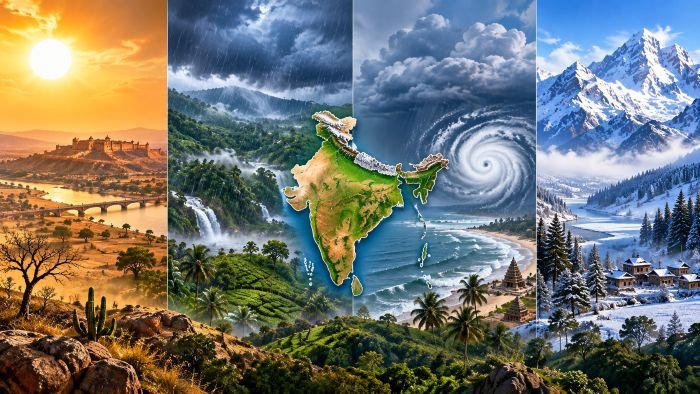
Scroll Down to Download India – Seasons PDF
I. Fill in the blanks
- Highest temperature region in the country is Ganganagar of Rajasthan.
- Due to local temperature and convectional currents, rainfall occurs.
- The area receiving very less rainfall in our country is Ruyli of Jaisalmer district, Rajasthan.
- The area receiving the highest rainfall in our country is Mawsynram, Meghalaya.
II. Answer the following questions in brief.
Question 1.
Which type of climate is experienced by India?
Answer:
India experiences a tropical monsoon type of climate.
Question 2.
What causes cyclonic winds to occur in India during the withdrawal of monsoons?
Answer:
Differences in temperature and pressure between land and sea cause tropical cyclones to occur in the Bay of Bengal during the withdrawal of monsoons.
Question 3.
Which factors influence the climate of India?
Answer:
The climate of India is influenced by latitude, altitude, distance from the sea, direction of winds, mountain ranges and ocean currents.
Question 4.
Indian agriculture gambling with the monsoon winds.’ Discuss.
Answer:
Indian agriculture depends mainly on the South-West monsoon rainfall. If the monsoon fails or rainfall is insufficient, droughts may occur. If the rainfall is excessive, it may cause floods and damage to crops and property. Therefore, Indian agriculture is often called a “gamble with the monsoons.”
III. Match the following
A | B |
i. Kalabaisaki | e. West Bengal |
ii. Andhis | a. Uttar Pradesh |
iii. Coffee blossom | b. Karnataka |
iv. Mango showers | c. Kerala |
Additional Questions and Answers
Question 1.
What is meant by the term ‘Monsoon’?
Answer:
The word Monsoon is derived from the Arabic word ‘Mausim’, which means seasons.
Question 2.
Name the four climatic seasons of India.
Answer:
- Summer season – March to May
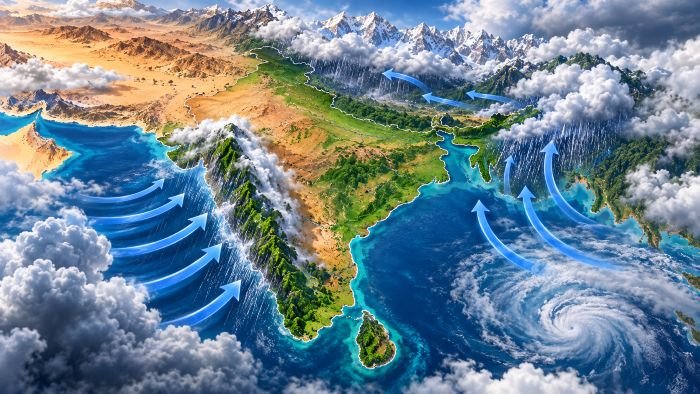
- South-West Monsoon season – June to September
- Retreating Monsoon season – October to November
- Winter season – December to February
Question 3.
Which season receives the highest amount of rainfall in India?
Answer:
The South-West Monsoon season receives the highest rainfall, about 75% of the annual rainfall.
Question 4.
Name the two branches of the South-West Monsoon.
Answer:
- Arabian Sea branch
- Bay of Bengal branch
Question 5.
Why does the western side of the Western Ghats receive heavy rainfall?
Answer:
The South-West Monsoon winds are obstructed by the Western Ghats, causing heavy rainfall on their western side.
Question 6.
What are rain-shadow regions?
Answer:
The areas lying on the eastern side of the Western Ghats, which receive less rainfall as the monsoon winds lose much of their moisture, are called rain-shadow regions.
Question 7.
What is convectional rainfall?
Answer:
Rainfall that occurs due to local heating and convectional currents during April and May is called convectional rainfall.
Question 8.
Name the local names of convectional rainfall.
Answer:
- Kalabaisaki – West Bengal
- Andhis – Uttar Pradesh
- Coffee blossoms – Karnataka
- Mango showers – Kerala
Question 9.
Which place records the highest temperature in India?
Answer:
Ganganagar in Rajasthan records the highest temperature, reaching about 52°C in summer.
Question 10.
Why is the temperature moderate in South India during summer?
Answer:
South India is surrounded by water on three sides, so its temperature remains comparatively moderate.
Question 11.
What percentage of annual rainfall does India receive during winter?
Answer:
India receives about 2% of its annual rainfall during winter.
Question 12.
What is the average annual rainfall of India?
Answer:
The average annual rainfall of India is about 118 cm.
Question 13.
Which place receives the least annual rainfall in India?
Answer:
Ruyli in Jaisalmer district of Rajasthan receives the least annual rainfall, about 8.3 cm.
Question 14.
Which place receives the highest rainfall in India?
Answer:
Mawsynram in Meghalaya receives the highest rainfall in India.
Question 15.
What happens when the monsoon rainfall fails?
Answer:
Failure of monsoon rainfall leads to drought.
Question 16.
What happens when the monsoon rainfall is excessive?
Answer:
Excessive monsoon rainfall causes floods, which can damage life, property and crops.
Multiple Choice Questions
1. India has which type of climate?
a) Equatorial climate
b) Tropical monsoon climate
c) Mediterranean climate
d) Desert climate
Answer:
b) Tropical monsoon climate
2. The word ‘Monsoon’ is derived from which language?
a) Latin
b) Greek
c) Arabic
d) French
Answer:
c) Arabic
3. ‘Mausim’ means:
a) Rain
b) Wind
c) Seasons
d) Climate
Answer:
c) Seasons
4. The summer season in India lasts from:
a) January to March
b) March to May
c) June to September
d) October to December
Answer:
b) March to May
5. The South-West Monsoon season lasts from:
a) March to May
b) June to September
c) October to November
d) December to February
Answer:
b) June to September
6. About what percentage of India’s annual rainfall occurs during the South-West Monsoon?
a) 10%
b) 25%
c) 50%
d) 75%
Answer:
d) 75%
7. The South-West Monsoon has how many main branches?
a) One
b) Two
c) Three
d) Four
Answer:
b) Two
8. The two branches of the South-West Monsoon are:
a) Arabian Sea and Bay of Bengal
b) Indian Ocean and Arabian Sea
c) Bay of Bengal and Pacific Ocean
d) Arabian Sea and Indian Ocean
Answer:
a) Arabian Sea and Bay of Bengal
9. The Western Ghats cause heavy rainfall on their:
a) Eastern side
b) Western side
c) Northern side
d) Southern side
Answer:
b) Western side
10. The eastern side of the Western Ghats is known as the:
a) Flood region
b) Rain-shadow region
c) Desert region
d) Cyclonic region
Answer:
b) Rain-shadow region
11. Kalabaisaki is associated with:
a) Kerala
b) Karnataka
c) West Bengal
d) Rajasthan
Answer:
c) West Bengal
12. ‘Andhis’ are associated with:
a) Uttar Pradesh
b) Karnataka
c) Kerala
d) Meghalaya
Answer:
a) Uttar Pradesh
13. ‘Coffee blossoms’ are associated with:
a) Rajasthan
b) Karnataka
c) West Bengal
d) Assam
Answer:
b) Karnataka
14. ‘Mango showers’ are associated with:
a) Kerala
b) Punjab
c) Rajasthan
d) Uttar Pradesh
Answer:
a) Kerala
15. Which place records about 52°C during summer?
a) Mawsynram
b) Ganganagar
c) Bengaluru
d) Mumbai
Answer:
b) Ganganagar
16. India receives about how much of its annual rainfall during summer?
a) 2%
b) 10%
c) 13%
d) 75%
Answer:
b) 10%
17. The retreating monsoon season occurs during:
a) March–May
b) June–September
c) October–November
d) December–February
Answer:
c) October–November
18. Tropical cyclones frequently occur in the:
a) Arabian Sea
b) Bay of Bengal
c) Indian Ocean
d) Red Sea
Answer:
b) Bay of Bengal
19. India receives about what percentage of annual rainfall during the retreating monsoon?
a) 2%
b) 10%
c) 13%
d) 75%
Answer:
c) 13%
20. Which season receives the least rainfall?
a) Summer
b) South-West Monsoon
c) Retreating Monsoon
d) Winter
Answer:
d) Winter
21. India’s average annual rainfall is approximately:
a) 80 cm
b) 100 cm
c) 118 cm
d) 200 cm
Answer:
c) 118 cm
22. Ruyli is located in:
a) Meghalaya
b) Rajasthan
c) Karnataka
d) Assam
Answer:
b) Rajasthan
23. Ruyli receives approximately:
a) 8.3 cm of rainfall
b) 50 cm of rainfall
c) 118 cm of rainfall
d) 250 cm of rainfall
Answer:
a) 8.3 cm of rainfall
24. Which place receives the highest rainfall in India?
a) Ganganagar
b) Ruyli
c) Mawsynram
d) Ladakh
Answer:
c) Mawsynram
25. Indian agriculture is called a “gamble with the”:
a) Rivers
b) Soil
c) Monsoons
d) Mountains
Answer:
c) Monsoons