
Class 10 Social Question and Answer: Rural Development
Looking for SSLC Class 10 Social Science Studies textbook answers? You can download Chapter 2: Rural Development Questions and Answers PDF, Notes, and Additional Q&A here. SSLC Social Science solutions follow the Karnataka State Board Syllabus, making it easier for students to revise and score higher in exams.
Karnataka SSLC Social Economics Textbook Answers—Reflections Chapter 2
Rural Development Questions and Answers, Notes, and Additional Q&A
Class 10 Economics Chapter 2
Rural Development
Scroll Down to Download Rural Development PDF
I. Fill in the blanks
- The true development of India is the development of its villages. This was said by Mahatma Gandhi.
- After the 73rd Amendment Act to the Constitution, three levels of Panchayat Raj institutions have come into existence.
- Panchayat institutions operate under democracy principles.
- In order to bring together poor rural women and make them financially independent Women Self-Help Groups have been brought into existence.
II. Answer in one sentence each
Question 1.
Explain the meaning of Rural Development.
Answer:
Rural development is the improvement of the social and economic status of rural people by properly utilizing locally available natural and human resources.
Question 2.
What is meant by Decentralisation of Power?
Answer:
Providing administrative power and the responsibility of developing the village to its own people is called decentralisation of power.
Question 3.
Name the three levels of Panchayat Raj institutions.
Answer:
The three levels are Grama Panchayat, Taluk Panchayat and Zilla Panchayat.
Question 4.
Mention any two housing programmes.
Answer:
Pradhan Mantri Awas Yojana and Basava Vasathi Yojana are two housing programmes.
Question 5.
Which work of women is not considered labour?
Answer:
The household chores performed by women at home are not considered labour and are not paid wages.
III. Answer the following questions in five to six sentences each:
Question 1.
How is the economic situation in the rural areas of India?
Answer:
- Rural areas suffer from deprivation and backwardness, as nearly one-third of the rural population lives in poverty.
- Development programmes and plans have failed to improve the socio-economic conditions of rural areas adequately.
- Rural industries have declined and cottage industries are disappearing.
- Agriculture is non-remunerative and employment is not regular.
- Hence, rural people continue to migrate to cities.
- Though nearly 60% of the people work in the primary sector, its contribution to national income is very low and declining.
- Due to this, the gap between urban and rural areas is widening.
Question 2.
Explain briefly the significance of rural development.
Answer:
Rural development consists of a broad set of activities including improvement of literacy, health, infrastructure, land reforms and irrigation, apart from taking specific measures for ameliorating the conditions of the disadvantaged people in the rural areas. Hence, if we are to make a list of activities that are essential for rural development, then they are as follows:
- Development of human resources including:
- literacy, especially, female literacy, education and skill development,
- health, addressing both sanitation and public health;
- Land reforms,
- Development of the productive resources of each locality,
- Infrastructure development like electricity, irrigation, credit, marketing, transport facilities including construction of village roads and feeder roads, facilities for agriculture research and extension, and information dissemination; and
- Specific programs of alleviation of poverty
Question 3.
Explain Gandhiji’s concept of ‘Grama Swarajya’ in the light of decentralization.
Answer:
- Providing administrative power and the responsibility of developing the village to its own people is called decentralization.
- It is a process through which power-sharing takes place and people participate in decision-making.
- It aims at planning and development from the grassroots level.
- Mahatma Gandhi called this process ‘Grama Swarajya’.
- Decentralization reduces exploitation, upholds human independence and dignity, and promotes human values like compassion and cooperation.
Question 4.
What is the role of Panchayat Raj institutions in rural development ?
Answer:
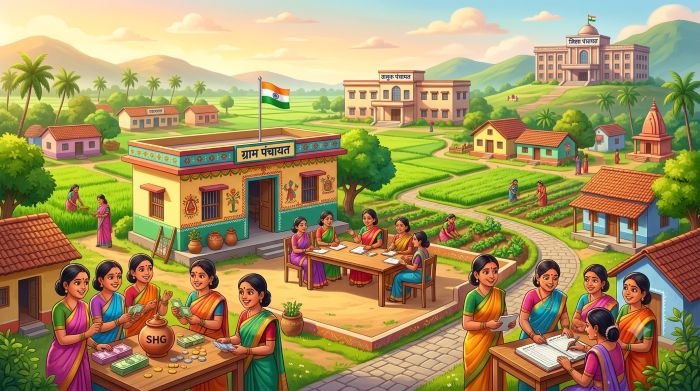
- Panchayat Raj institutions play an important role in enabling rural people to participate in rural development.
- They implement various schemes related to poverty alleviation and livelihood security.
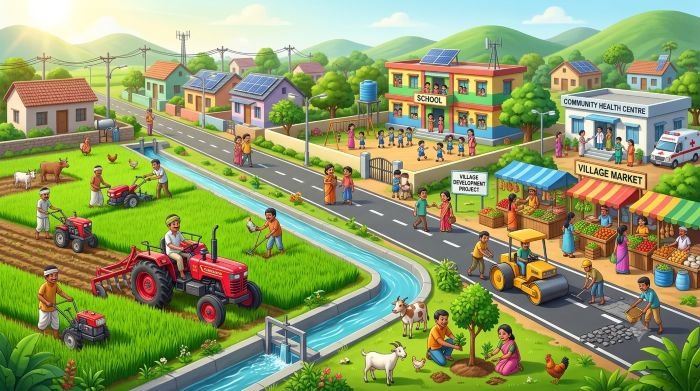
- They provide basic facilities like roads, drains, drinking water, streetlights, toilets, schools, hospitals and market-yards.
- They promote primary and middle school education, adult education, technical and vocational training, health and hygiene facilities.
- Development programmes are discussed and decided in the Gram Sabha.
- Programmes like Mahatma Gandhi National Rural Employment Guarantee Scheme (MGNREGS) are implemented to generate employment and reduce poverty.
- They implement housing programmes like Pradhan Mantri Awas Yojana, Ambedkar-Valmiki Housing Programme and Ashraya Yojana.
- They strengthen the Public Distribution System and ensure that poor people receive essential food grains.
- They encourage women’s self-help groups, rural and cottage industries, employment opportunities and social welfare programmes.
- They promote social and cultural activities through village fairs and festivals.
Additional Important Questions and Answers
Question 1.
What are the major problems faced by rural people?
Answer:
Rural people face several problems such as poverty, unemployment, illiteracy, poor health facilities, lack of sanitation, inadequate transport and communication facilities.
Question 2.
How does rural development help to reduce migration?
Answer:
Rural development creates employment opportunities, improves agricultural activities, promotes cottage industries and provides basic facilities. This helps rural people find better livelihood opportunities in their villages and reduces migration to cities.
Question 3.
What is the importance of agricultural allied activities?
Answer:
Agricultural allied activities like cattle-rearing, poultry, fisheries, silk industry and horticulture provide additional income and employment opportunities to rural people.
Question 4.
How can the productivity of rural areas be increased?
Answer:
Rural productivity can be increased by providing electricity, irrigation, transport, communication, market facilities, modern technology and agricultural training.
Question 5.
What is the importance of food-processing units in villages?
Answer:
Food-processing units help convert raw agricultural products into finished goods. They increase the value of agricultural products, create employment and improve the income of rural people.
Question 6.
How do Panchayat Raj institutions strengthen democracy?
Answer:
Panchayat Raj institutions encourage rural people to participate in decision-making and village development. They promote decentralisation, public participation and democratic values at the village level.
Question 7.
What is the importance of the Gram Sabha?
Answer:
The Gram Sabha provides a platform for villagers to participate in discussions and decision-making regarding village development programmes and local needs.
Question 8.
How do self-help groups help rural women?
Answer:
Self-help groups encourage savings, provide easy access to loans and support income-generating activities. They help women become financially independent and fight against social evils.
Question 9.
What are the four major links under the PURA model?
Answer:
The four major links are:
- Physical Link
- Knowledge Link
- Electronic Link
- Economic Link
Question 10.
How do Panchayats help in poverty alleviation?
Answer:
Panchayats implement employment generation schemes, housing programmes, public distribution systems and social welfare programmes to reduce poverty in rural areas.
Multiple Choice Questions (MCQs)
- Who said that the development of villages is the true development of India?
A) Jawaharlal Nehru
B) Mahatma Gandhi
C) Dr. B.R. Ambedkar
D) Sardar Patel
Answer:
B) Mahatma Gandhi
- According to the 2011 Census, what percentage of India’s population lived in villages?
A) 50.5%
B) 60.5%
C) 68.84%
D) 75.5%
Answer:
C) 68.84%
- Rural development mainly aims to improve the ______ status of rural people.
A) Political
B) Social and economic
C) Industrial
D) Urban
Answer:
B) Social and economic
- Who called decentralisation ‘Grama Swarajya’ ?
A) Mahatma Gandhi
B) Jawaharlal Nehru
C) Dr. Rajendra Prasad
D) Dr. A.P.J. Abdul Kalam
Answer:
A) Mahatma Gandhi
- Which Constitutional Amendment introduced the Panchayat Raj system?
A) 42nd Amendment
B) 44th Amendment
C) 73rd Amendment
D) 74th Amendment
Answer:
C) 73rd Amendment
- The 73rd Constitutional Amendment came into force in which year?
A) 1990
B) 1991
C) 1993
D) 1995
Answer:
C) 1993
- How many tiers are there in the Panchayat Raj system?
A) One
B) Two
C) Three
D) Four
Answer:
C) Three
- Which is the village-level institution in the Panchayat Raj system?
A) Zilla Panchayat
B) Taluk Panchayat
C) Grama Panchayat
D) Municipal Corporation
Answer:
C) Grama Panchayat
- Who conceptualized the PURA project?
A) Mahatma Gandhi
B) Dr. A.P.J. Abdul Kalam
C) Sardar Patel
D) Jawaharlal Nehru
Answer:
B) Dr. A.P.J. Abdul Kalam
- What is the full form of PURA?
A) Providing Urban Amenities in Rural Areas
B) Public Urban Resources Association
C) Providing Useful Resources for Agriculture
D) Planning Urban Regions and Areas
Answer:
A) Providing Urban Amenities in Rural Areas
- Which of the following is NOT a link in the PURA model?
A) Physical Link
B) Knowledge Link
C) Electronic Link
D) Political Link
Answer:
D) Political Link
- Which link in PURA provides modern telephone and telecommunication services ?
A) Physical Link
B) Knowledge Link
C) Electronic Link
D) Economic Link
Answer:
C) Electronic Link
- Which programme aims to generate employment in rural areas?
A) MGNREGS
B) Digital India
C) Make in India
D) Smart Cities Mission
Answer:
A) MGNREGS
- Which of the following is a rural housing programme?
A) Pradhan Mantri Awas Yojana
B) Green India Mission
C) Digital India
D) Skill India
Answer:
A) Pradhan Mantri Awas Yojana
- Which groups help rural women become financially independent?
A) Trade unions
B) Women’s Self-Help Groups
C) Political parties
D) Industrial associations
Answer:
B) Women’s Self-Help Groups
- Which activity is encouraged to improve the rural economy?
A) Cottage industries
B) Foreign trade only
C) Urban migration
D) Import of goods
Answer:
A) Cottage industries
- Which of the following is an agriculture-related activity?
A) Poultry
B) Banking
C) Software development
D) Mining
Answer:
A) Poultry
- What is the main purpose of the Economic Link under PURA?
A) Establishing market-yards
B) Building schools
C) Providing electricity
D) Providing telephone services
Answer:
A) Establishing market-yards
- Which institution encourages rural people to participate in village development?
A) Parliament
B) Panchayat Raj institutions
C) Supreme Court
D) Reserve Bank of India
Answer:
B) Panchayat Raj institutions
- Women’s unpaid household work is generally ______ in national income.
A) Included
B) Doubled
C) Not included
D) Taxed
Answer:
C) Not included