
1st PUC Geography Question and Answer – Interior Of The Earth
Looking for 1st PUC Geography textbook answers? You can download Chapter 3: Interior Of The Earth Questions and Answers PDF, Notes, and Summary here. 1st PUC Geography solutions follow the Karnataka State Board Syllabus, making it easier for students to revise and score higher in exams.
Karnataka 1st PUC Geography Textbook Answers—Reflections Chapter 3
Interior Of The Earth Questions and Answers, Notes, and Summary
1st PUC Geography Chapter 3
Interior Of The Earth
Scroll Down to Download Interior of the Earth PDF
I. Answer the following in a word or a sentence each:
Question 1.
What is Continental Crust?
Answer:
Continental Crust is the uppermost layer of the Earth and the crust, with a mean thickness of about 30 km.
Question 2.
Why the inner core is called ‘Solid Core’?
Answer:
The inner core is called the solid core because the materials remain in a solid state due to extremely high pressure and temperature.
Question 3.
Name the instrument used to record seismic waves ?
Answer:
Seismograph is used to record seismic waves.
Question 4.
Which is the most destructive earthquake wave?
Answer:
Surface waves (long period waves) are the most destructive earthquake waves.
Question 5.
Define Tsunami.
Answer:
A large sea wave caused by an underwater or sub-marine earthquake is called Tsunami.
Question 6.
What is Homo-seismal line?
Answer:
Homo-seismal lines are drawn on a map to show places recording the same time of occurrence of an earthquake.
Question 7.
Mention the region which records more seismic activities in the world.
Answer:
The Circum-Pacific belt records the maximum seismic activities in the world.
Question 8.
What is Volcano?
Answer:
A volcano is an opening in the Earth’s crust through which magma, gases and lava are ejected.
Question 9.
Name any one volcano of India.
Answer:
Barren Island volcano.
Question 10.
Which is a famous active Volcano in USA?
Answer:
Mount St. Helens.
Question 11.
What is ‘Ring of Fire’?
Answer:
The Circum-Pacific belt of active volcanoes and earthquakes is called the Ring of Fire.
Question 12.
Define Petrology.
Answer:
Petrology is the scientific study of rocks.
Question 13.
Give an example for Plutonic rock.
Answer:
Granite.
Question 14.
Why are secondary rocks called Aqueous rocks?
Answer:
Because they are formed by the action of water.
Question 15.
How is Carbonaceous rock formed?
Answer:
Carbonaceous rock is formed by the decay and decomposition of plants and vegetation.
Question 16.
What is Metamorphism?
Answer:
Metamorphism is the process by which rocks change in form due to heat and pressure.
Question 17.
What is a Mineral?
Answer:
A mineral is a natural inorganic substance with definite chemical and physical properties.
Question 18.
Which mineral covers the largest area of the Earth’s crust?
Answer:
Feldspar.
Question 19.
Give an example for non-ferrous mineral.
Answer:
Bauxite.
II. Answer the following in two or three sentences each.
Question 1.
Mention any two features of Oceanic Crust.
Answer:
The lower part of the crust is known as Oceanic Crust and its thickness is around 5 km.
It is rich in silica and magnesium (Sima) and has a mean density of about 2.95 gm/cm³.
Question 2.
Why is the Mantle very important in the Earth’s interior?
Answer:
The mantle lies below the crust and extends from 60 km to 2,900 km.
It contains semi-molten magma rich in iron and magnesium and is the source of volcanic activity and earthquakes.
Question 3.
State the difference between Focus and Epicentre.
Answer:
The Focus is the point inside the Earth where earthquake tremors originate.
The Epicentre is the point on the Earth’s surface directly above the focus where the earthquake is felt first.
Question 4.
Name any two causes for earthquakes.
Answer:
Earthquakes are caused by folding and faulting of rocks in the Earth’s crust.
They may also occur due to volcanic activity and human activities like mining and nuclear explosions.
Question 5.
Distinguish between Iso-seismal and Co-seismal lines.
Answer:
Iso-seismal lines join places experiencing the same intensity of an earthquake.
Co-seismal lines join places experiencing the same intensity and same time of occurrence.
Question 6.
Which scales are used to measure the intensity of an earthquake?
Answer:
The Richter Scale and Mercalli Scale are used to measure earthquakes.
Richter scale measures magnitude, while Mercalli scale measures intensity.
Question 7.
Mention any two causes of a Volcano.
Answer:
Increase in temperature inside the Earth with depth leads to the formation of magma.
Movement and breaking of tectonic plates also cause volcanic eruptions.
Question 8.
Distinguish between Active and Extinct volcanoes.
Answer:
Active volcanoes erupt frequently and eject lava, ash and gases, e.g. Mt. Etna and Mauna Loa.
Extinct volcanoes have not erupted for a long time and have no possibility of future eruption, e.g. Narcondum Island.
Question 9.
Name any two active volcanoes of the world.
Answer:
Mount Etna (Italy) and Mauna Loa (Hawaii) are active volcanoes.
Question 10.
Name any two countries which come under the Circum-Pacific belt.
Answer:
Japan and the United States of America come under the Circum-Pacific belt.
Question 11.
How are Igneous rocks formed? Give examples.
Answer:
Igneous rocks are formed by the cooling and solidification of magma or lava.
Examples include Granite (acid igneous) and Gabbro (basic igneous).
Question 12.
What are Dormant volcanoes?
Answer:
Dormant volcanoes are those which remain inactive for a long period but may erupt again in the future.
Example: Mt. Fujiyama (Japan).
Question 13.
Distinguish between Arenaceous and Argillaceous rocks.
Answer:
Arenaceous rocks are formed from sand grains, are porous, and can hold water, e.g. Sandstone.
Argillaceous rocks are formed from fine clay particles and are non-porous, e.g. Shale.
Question 14.
How is contact metamorphism different from regional metamorphism?
Answer:
Contact metamorphism occurs due to heat from magma and affects small areas, e.g. Limestone → Marble.
Regional metamorphism occurs due to heat and pressure over large areas during mountain building, e.g. Clay → Slate.
Question 15.
Give four examples of Metamorphic rocks.
Answer:
Marble, Slate, Quartzite and Gneiss are metamorphic rocks.
Question 16.
What are metallic and non-metallic minerals?
Answer:
Metallic minerals contain metals, e.g. Iron ore and Bauxite.
Non-metallic minerals do not contain metals, e.g. Mica and Sulphur.
III. Answer the following.
Question 1.
Explain the structure and composition of the Earth with a neat diagram.
Answer:
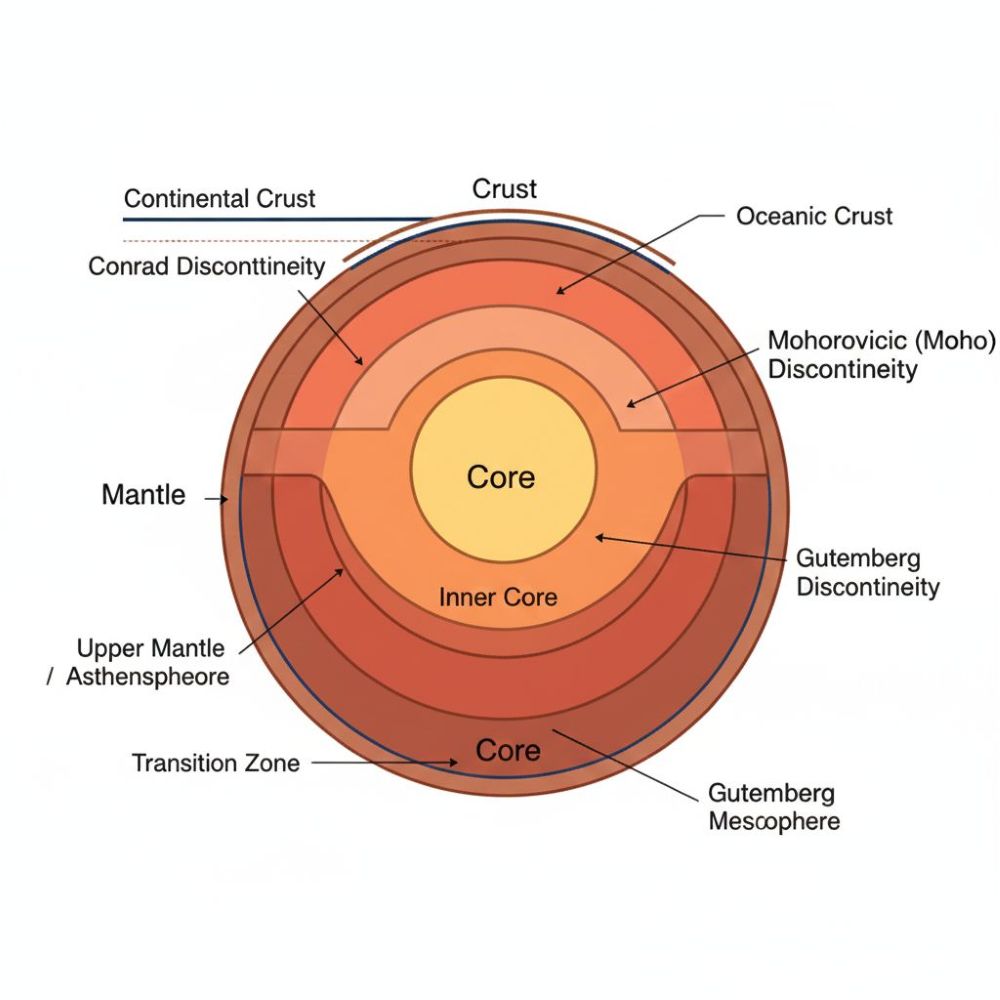
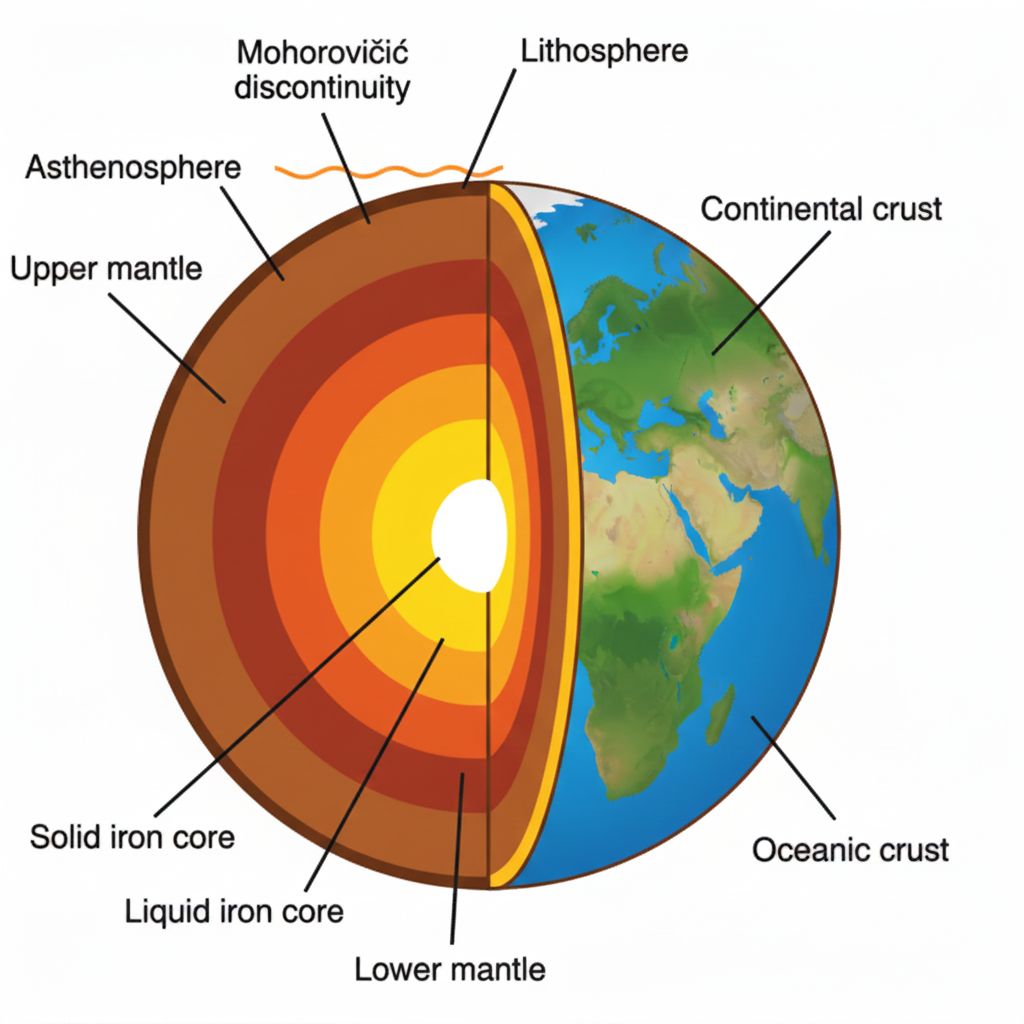
Based on the physical and chemical properties of materials, density, temperature, and the behaviour of seismic waves, the Earth’s interior is divided into three concentric layers. They are (1) Crust, (2) Mantle, and (3) Core.
1) The Crust
The crust is the outermost layer of the Earth. It is solid, thin and the lightest part of the Earth. Its thickness varies from 5 km under oceans to about 60 km under continents. The crust has two layers.
- a) Continental Crust (Sial):
The upper part of the crust is called continental crust. It mainly consists of sedimentary and granitic rocks and forms the continents. It is rich in silica and aluminium, hence called Sial. Its average thickness is about 30 km. - b) Oceanic Crust (Sima):
The lower part of the crust is called oceanic crust. Its thickness is about 5 km. It is rich in silica and magnesium, therefore known as Sima. The mean density of this layer is about 2.95 gm/cm³.
The Conrad discontinuity separates Sial and Sima, and the Mohorovicic (Moho) discontinuity separates the crust and mantle.
2) The Mantle
The mantle lies below the crust and above the core. It extends from about 60 km to 2,900 km depth. It is composed mainly of basic silicates rich in iron and magnesium. The density of the mantle ranges from 3.3 to 5.7 gm/cm³.
The mantle is divided into two parts.
- a) Upper Mantle (Asthenosphere):
This is the upper layer of the mantle and is partially molten. Most earthquakes and volcanic activities originate in this layer. - b) Lower Mantle (Mesosphere):
This is the lower part of the mantle and is in a solid state.
The Repetti discontinuity lies between the asthenosphere and mesosphere, and the Gutenberg (Oldham) discontinuity separates the mantle and the core.
3) The Core
The core is the innermost layer of the Earth. It extends from 2,900 km to about 6,371 km. It is composed mainly of nickel and iron, hence called Nife. It is the densest layer of the Earth.
- a) Outer Core:
The outer core consists of molten materials and extends from 2,900 km to 4,980 km. - b) Inner Core:
The inner core lies between 4,980 km and 6,371 km. Due to extremely high temperature and pressure, the materials remain in a solid state, hence it is called the Solid Core.
The Lehmann / Bullen (Transition) discontinuity separates the outer core and inner core.
Question 2
What is an Earthquake? Describe the causes and effects of earthquakes.
Answer:
An earthquake is a sudden vibration or oscillation of the Earth’s crust caused by the release of energy in the form of seismic waves.
The place inside the Earth where the earthquake originates is called the Focus, and the point on the Earth’s surface directly above the focus, which receives the maximum intensity of seismic waves, is called the Epicentre.
Causes of Earthquakes:
On the basis of their origin, earthquakes can be classified into the following types:
- Tectonic Earthquakes:
These are caused due to folding, faulting, and displacement of rock blocks in the Earth’s crust because of tectonic forces. They are the most frequent, intense, and destructive earthquakes. - Volcanic Earthquakes:
These earthquakes are associated with volcanic activities and occur due to the movement of magma beneath the Earth’s surface. They are generally low in intensity and cause comparatively less damage. - Man-made Earthquakes:
These are caused by human activities such as underground nuclear explosions, mining, drilling, and the construction of large dams.
Examples: Koyna Dam (India – 1967), Hoover Dam (USA – 1935), Mangla Dam (Pakistan).
Effects of Earthquakes:
- Earthquakes cause severe destruction in the epicentral region.
- Cracks and fissures develop on the Earth’s surface.
- Earthquake vibrations may trigger landslides in mountainous regions, blocking rivers.
- Vertical and horizontal displacement of land may occur, forming lakes or depressions.
- Dams may develop deep cracks, as seen in the Koyna Dam earthquake.
- River beds may rise or change course, for example, the Brahmaputra River during the Assam earthquake.
- Large-scale destruction of houses, roads, railway lines, bridges, factories, dams, and airports, leading to loss of life and property.
- Underground water systems are disturbed, affecting wells and springs.
Question 3.
How does a Volcano erupt? Explain the types of Volcanoes.
Answer:
A volcano is an opening in the Earth’s crust through which heated materials such as magma, lava, gases, hot water, ash, and rock fragments are ejected from the interior of the Earth.
Deep inside the Earth, intense heat melts rocks to form magma. Due to high pressure and temperature, this magma rises through cracks and weak zones in the crust. When it reaches the surface, it erupts violently through an opening called a vent.
The funnel-shaped hollow at the top of the volcanic cone is called a crater. A large basin-shaped crater with steep sides is known as a caldera.
Types of Volcanoes:
On the basis of periodicity or frequency of eruption, volcanoes are classified into three types:
- Active Volcanoes:
Volcanoes which erupt frequently and continuously eject lava, ash, and gases are called active volcanoes.
Examples: Mount Etna (Sicily), Stromboli (Italy), Mauna Loa (Hawaii). - Dormant Volcanoes:
Volcanoes which remain inactive for a long period but may erupt suddenly and violently in the future are called dormant volcanoes. They often cause great destruction to life and property.
Example: Mount Vesuvius. - Extinct Volcanoes:
Volcanoes which have not erupted for a very long time and show no signs of future eruption are called extinct or dead volcanoes.
Examples: Narcondam, Krakatoa.
Question 4.
What is a rock? Describe the different types of rocks.
Answer:
A rock refers to the hard and resistant materials of the Earth’s crust. Scientifically, the term rock includes both hard and soft materials such as granite, chalk, clay, etc. Thus, a rock is any natural solid material, hard or soft, that forms the Earth’s crust.
Rocks do not have the same chemical composition, whereas minerals have definite chemical composition and physical properties. The Earth’s crust is composed of various types of rocks.
Types of Rocks:
On the basis of origin or mode of formation, rocks are classified into three major groups:
- Igneous Rocks:
The term igneous is derived from the Latin word “Ignis”, meaning fire. Igneous rocks are formed by the cooling and solidification of molten magma. They are called primary rocks because they were the first rocks to be formed and are the parent rocks from which other rocks are derived.
Igneous rocks are classified into two types:
- Intrusive Igneous Rocks:
When magma cools and solidifies inside the Earth’s crust, it forms intrusive igneous rocks. These rocks cool slowly and are coarse-grained.
Examples: Granite, Dolerite.
Intrusive rocks are of two types:
- Plutonic rocks: Formed at great depth inside the Earth due to slow cooling of magma.
- Hypabyssal rocks: Formed in cracks, fissures, and crevices at shallow depths.
- Extrusive Igneous Rocks:
When magma reaches the Earth’s surface as lava and cools rapidly, it forms extrusive igneous rocks.
Example: Basalt.
- Sedimentary Rocks:
Sedimentary rocks are formed by the deposition, accumulation, compaction, and cementation of sediments derived from older rocks, plants, and animal remains by rivers, wind, glaciers, and sea waves. As they are formed in layers, they are also called stratified rocks.
Sedimentary rocks are classified into three types:
- Mechanically Formed Rocks:
These rocks are formed from rock fragments transported and deposited by rivers, glaciers, winds, or waves and cemented together.
They are classified into:
- Rudaceous rocks
- Arenaceous rocks
- Argillaceous rocks
- Chemically Formed Rocks:
These rocks are formed by the evaporation and deposition of minerals dissolved in water.
Examples: Rock salt, Gypsum.
- Organically Formed Rocks:
These rocks are formed from the remains of plants and animals.
They are of two types:
- Calcareous rocks: Contain calcium carbonate or lime.
Examples: Limestone, Chalk. - Carbonaceous rocks: Formed from plant remains under heat and pressure.
Example: - Metamorphic Rocks:
Rocks which undergo change in form or composition without disintegration due to heat and pressure are called metamorphic rocks. These rocks are formed from igneous or sedimentary rocks.
The intense heat and pressure inside the Earth alter the structure and composition of rocks partially or completely to form new rocks.
Examples: Marble, Quartzite, Diamond, Ruby, Emerald.
Question 5.
What is a mineral? Explain the types of minerals.
Answer:
A mineral is a natural, inorganic substance found in the Earth’s crust, having a definite chemical composition and distinct physical properties. The scientific study of minerals is known as Mineralogy. Minerals are very important natural resources and are widely used by human beings for various economic and industrial activities.
Types of Minerals:
Minerals are classified into different types based on their nature, composition, and use. The important types are:
- Metallic Minerals:
Metallic minerals contain metals and are sources of metal extraction. These minerals have metallic lustre and are good conductors of heat and electricity.
They are of two types:
- Ferrous minerals: Minerals which contain iron.
Example: Iron ore. - Non-ferrous minerals: Minerals which do not contain iron.
Examples: Copper, Bauxite, Zinc, Lead.
- Non-Metallic Minerals:
These minerals do not contain metals and do not yield metal on processing. They are mainly used in industries and for domestic purposes.
Examples: Mica, Asbestos, Sulphur, Phosphate, Limestone.
- Precious Minerals:
These minerals are rare and valuable and are mainly used for making ornaments and decorative items.
Examples: Gold, Silver, Platinum, Diamond.