
1st PUC Geography Question and Answer – Geography as a Discipline
Looking for 1st PUC Geography textbook answers? You can download Chapter 1: Geography as a Discipline Questions and Answers PDF, Notes, and Summary here. 1st PUC Geography solutions follow the Karnataka State Board Syllabus, making it easier for students to revise and score higher in exams.
Karnataka 1st PUC Geography Textbook Answers—Reflections Chapter 1
Geography as a Discipline Questions and Answers, Notes, and Summary
1st PUC Geography Chapter 1
Geography as a Discipline
Scroll Down to Download Geography as a Discipline PDF Notes
I. Answer the following in a word or a sentence each.
Question 1
Define Geography ?
Answer:
Geography is the scientific study of the Earth’s surface, its climates, natural resources and human activities.
Question 2
What is Modern Geography?
Answer:
Modern Geography deals with the interaction between the Earth and human activities.
Question 3
Which branch of Geography studies about heavenly bodies?
Answer:
Astronomical Geography is the branch of Geography that studies the heavenly bodies of space.
Question 4
What is Bio-Geography?
Answer:
Bio-Geography is the scientific study of the distribution of plants and animals on the Earth.
Question 5
Name any one branch of Physical Geography.
Answer:
Geomorphology, Climatology, Meteorology and Paedology are the major branches of Physical Geography.
II. Answer the following in two or three sentences each.
Question 1.
Why is Geography called as the ‘Science of Earth’?
Answer:
Geography is called Earth Science because it describes the Earth and its surface features. It studies natural factors such as landforms, mountains, water bodies, climate, soils, minerals and natural vegetation.
Question 2.
How is Geography a discipline of synthesis?
Answer:
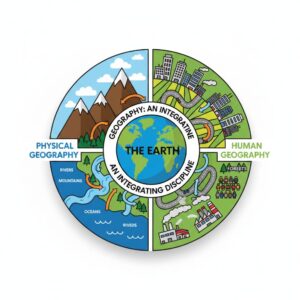
Geography is a discipline of synthesis because it acts as a liaison subject between Natural Sciences and Social Sciences. It recognizes the interdependency between physical environment and human activities.
Question 3.
What is Oceanography?
Answer:
Oceanography is a branch of Physical Geography which deals with seas and oceans. It studies the relief of the ocean floor and the physical and biological properties of ocean water.
Question 4.
Name any two branches of Human Geography
Answer:
The four branches of Human Geography are Cultural Geography, Historical Geography, Economic Geography and Agricultural Geography. These branches study different aspects of human activities and their spatial distribution.
Question 5.
What is the main focus of Physical Geography?
Answer:
The main focus of Physical Geography is the life layer or biosphere of the Earth. It studies the physical factors that make land and oceans suitable for plant, animal and human life.
III. Answer the following five Sentences.
Question 1.
Explain the important branches of Geography.
Answer:
Physical Geography deals with the study of the Earth’s physical environment and the natural processes operating on it. The important branches of Physical Geography are:
- Geomorphology:
It is the systematic study of landforms such as mountains, plateaus, plains and valleys, and the processes that shape them. - Climatology:
Climatology studies the structure of the atmosphere, elements of climate, climatic types and climatic regions of the world. - Meteorology:
It is the scientific study of weather conditions and atmospheric phenomena. - Pedology (Soil Geography):
Pedology deals with the formation, structure, texture, composition and distribution of soils and their influence on plant growth. - Hydrology:
Hydrology studies the distribution and movement of water on the Earth’s surface such as rivers, lakes and groundwater. - Oceanography:
Oceanography deals with the study of oceans, relief of the ocean floor, waves, tides and ocean currents. - Seismology:
It is the study of earthquakes, their causes, effects and distribution. - Volcanology:
Volcanology is the scientific study of volcanoes and volcanic activities.
Thus, Physical Geography helps in understanding the natural environment and the processes shaping the Earth’s surface.
Additionally Question and Answer
One Mark Questions and Answers:
Question 1.
What does ‘Geo’ mean?
Answer:
Geo means Earth.
Question 2.
What does ‘Graphos’ mean?
Answer:
Graphos means description or study.
Question 3.
Why is Geography called the ‘Home of Man’?
Answer:
Because Earth provides all basic resources needed for human life.
Question 4.
What is Bio-Geography?
Answer:
It is the study of the distribution of plants and animals.
Question 5.
Name any one branch of Human Geography.
Answer:
Economic Geography.
Question 6.
What is Population Geography?
Answer:
It studies the distribution and growth of population.
Question 7.
What is Mathematical Geography?
Answer:
It studies latitudes, longitudes, shape and size of the Earth.
Question 8.
What is meant by spatial distribution?
Answer:
It is the arrangement of features over the Earth’s surface.
Question 9.
Name any one branch of Physical Geography.
Answer:
Geomorphology.
Question 10.
Why is Geography called the ‘Mother of all Sciences’?
Answer:
Because many sciences have developed from Geography.
Two Mark Questions and Answers
Question 1.
Define Geography.
Answer:
Geography is the scientific study of the Earth’s surface, its physical features, climate, natural resources and human activities.
Question 2.
Why is Geography called Earth Science?
Answer:
Geography studies the Earth and its surface features. It explains natural factors like landforms, climate, soils and vegetation.
Question 3.
What is meant by Geography as a discipline of synthesis?
Answer:
Geography integrates Natural and Social Sciences. It studies the inter-relationship between environment and human activities.
Question 4.
Mention any two branches of Human Geography.
Answer:
Economic Geography and Political Geography.
Question 5.
What is Oceanography?
Answer:
Oceanography is the study of oceans, ocean floor relief, waves, tides and currents.
Question 6.
What is Bio-Geography?
Answer:
It studies the distribution of plants and animals on the Earth.
Question 7.
How is Geography related to History?
Answer:
History studies people of different times, while Geography studies people of different places.
Five Mark Questions and Answers
Question 1.
Explain Geography as an integrating discipline.
Answer:
Geography is an integrating discipline because it connects Natural Sciences and Social Sciences. It studies the interaction between physical environment and human activities. Geography recognizes the interdependency of land, water, climate, plants, animals and human life. It acts as a liaison subject by combining physical, biological and social aspects. Thus, Geography provides a holistic understanding of the Earth.
Question 2.
Explain the branches of Geography.
Answer:
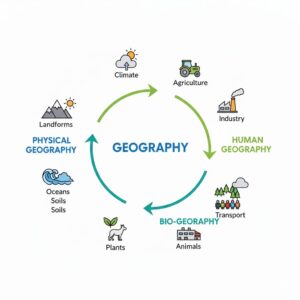
Geography is broadly divided into the following branches:
- Physical Geography:
It studies the natural environment such as landforms, climate, soils and water bodies. - Human Geography:
It deals with human activities like agriculture, industry, transport, trade and population. - Bio-Geography:
It studies the distribution of plants and animals on the Earth.
These branches help in understanding the relationship between nature and human life.
Question 3.
Explain the importance of Geography.
Answer:
Geography helps us to understand the Earth and its environment. It explains the distribution of natural resources and human activities. Geography helps in proper utilization of resources and sustainable development. It also helps in understanding environmental problems and planning human activities effectively.