
Class 10 Social Question and Answer: Bank Transactions
Looking for SSLC Class 10 Social Science Studies textbook answers? You can download Chapter 1: Bank Transactions Questions and Answers PDF, Notes, and Additional Q&A here. SSLC Social Science solutions follow the Karnataka State Board Syllabus, making it easier for students to revise and score higher in exams.
Karnataka SSLC Social Business Studies Textbook Answers—Reflections Chapter 1
Bank Transactions Questions and Answers, Notes, and Additional Q&A
Class 10 Business Studies Chapter 1
Bank Transactions
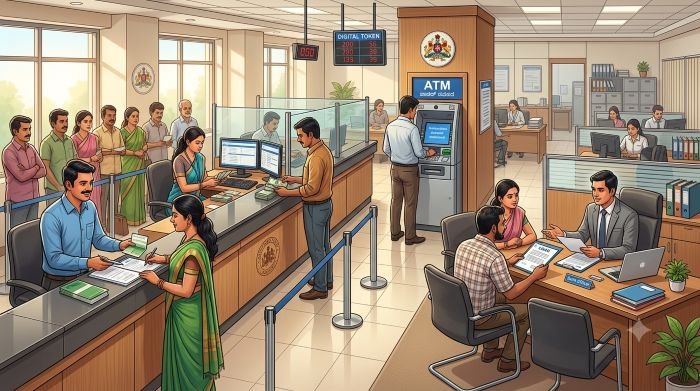
Scroll Down to Download Bank Transactions PDF
I. Fill in the blanks with suitable words:
- The word ‘Bank’ has been derived from the French word Banque.
- The Banker’s Bank is Reserve Bank of India (RBI).
- An example for Nationalised bank is Canara Bank.
- The National Savings Certificates are issued by the Post Office.
- The type of account where any number of transactions can be made with the Bank is Current Account.
- The deposits for a fixed term can be deposited in Term deposit
II. Answer the following questions after discussion with your friends.
Question 1.
What is a bank?
Answer:
The term bank is derived from the Italian word “Banco” or the French word “Banque”, both of which mean a “bench” or “money exchange table.”
Question 2.
List out the characteristics relating to bank transactions.
Answer:
The main characteristics of banks are:
- Dealing with money.
- Acceptance of deposits.
- Lending loans.
- Payment and withdrawal facilities.
- Agency and utility services.
- Profit and service orientation.
- Ever-increasing functions.
- Connecting link between depositors and borrowers.
- Banking business.
- Name identity.
Question 3.
What are the functions of a bank?
Answer:
The main functions of a bank are as follows:
- Accepting deposits from the public.
- Lending money to the public and other institutions.
- Transferring money from one place to another.
- Collecting money through cheques, drafts and bills.
- Discounting bills.
- Providing safe deposit lockers.
- Conducting foreign exchange transactions.
- Keeping valuables in safe custody.
- Issuing letters of credit and guarantees.
- Conducting government transactions.
Question 4.
Explain the relation between the bank and its customers.
Answer:
The relationship between a banker and a customer falls under two broad categories:
- General Relationship:
- Primary relationship – Debtor and creditor.
- Subsidiary relationship – Trustee and beneficiary.
- Agent and principal relationship.
- Special Relationship:
- Obligation to honour cheques.
- Obligation to maintain secrecy of accounts.
Question 5.
“The number of saving bank account holders is increasing” – Give reasons.
Answer:
The reasons for the increase in the number of savings bank account holders are:
- Banks provide safe custody of money.
- Savings accounts encourage people to save money.
- Money can be easily deposited and withdrawn.
- Banks provide cheque and ATM facilities.
- Account holders can make payments easily.
- Banks provide loans and other banking services to customers.
Question 6.
What are the advantages of opening a bank account?
Answer:
The advantages of opening a bank account are as follows:
- It provides safe custody of money.
- It helps in making payments.
- It helps in collecting money.
- Account holders can obtain advances and loans.
- It facilitates smooth financial transactions.
- It provides safe deposit locker facilities.
III. Additional Questions and Answers
Question 1.
What is banking?
Answer:
Banking refers to the services provided by banks, including accepting deposits, lending money and facilitating financial transactions.
Question 2.
What is the meaning of a bank account?
Answer:
A bank account is an account maintained by a bank to record the deposits, withdrawals and other transactions of a customer.
Question 3.
What are the different types of bank accounts?
Answer:
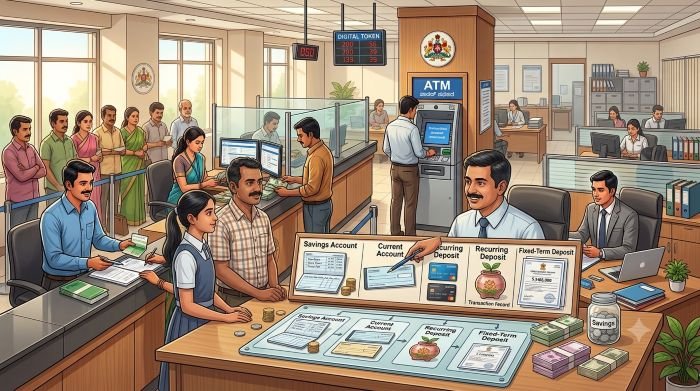
The four main types of bank accounts are:
- Savings Bank Account
- Current Account
- Recurring Deposit Account
- Term Deposit Account
Question 4.
What is a savings bank account?
Answer:
A savings bank account is opened by individuals to save money and earn interest on their deposits.
Question 5.
What is a current account?
Answer:
A current account is generally opened by business people who make frequent deposits and withdrawals. Banks usually charge service fees and do not pay interest on these accounts.
Question 6.
What is a recurring deposit account?
Answer:
A recurring deposit account allows customers to deposit a fixed amount regularly, usually every month, and receive the accumulated amount with interest at maturity.
Question 7.
What is a term deposit account?
Answer:
A term deposit account is opened by depositing a fixed sum of money for a specified period at an agreed rate of interest.
Question 8.
What is a joint account?
Answer:
A joint account is a bank account opened and operated by two or more persons.
Question 9.
What is the role of the Reserve Bank of India (RBI)?
Answer:
The Reserve Bank of India is the central bank of India. It regulates the banking system and formulates monetary policy.
Question 10.
What is the main difference between a savings account and a current account?
Answer:
A savings account encourages individuals to save money and generally earns interest. A current account is mainly used by businesses for frequent transactions and generally does not earn interest.
Question 11.
What is the purpose of an ATM card?
Answer:
An ATM card enables customers to withdraw money from their bank accounts through Automated Teller Machines.
Question 12.
What is a cheque?
Answer:
A cheque is a written instruction to a bank to pay a specified amount of money from the account holder’s account to the person named on it.
Question 13.
What is a bank loan?
Answer:
A bank loan is money lent by a bank to an individual or organisation, which must be repaid according to agreed terms, usually with interest.
Question 14.
What are remittances?
Answer:
Remittances refer to the transfer of money from one place or person to another.
Question 15.
Mention any four services offered by banks.
Answer:
Banks offer personal loans, home loans, vehicle loans and credit card facilities.
Multiple-Choice Questions (MCQs)
1. The word ‘Bank’ is derived from the French word.
a) Banco
b) Banque
c) Banko
d) Banc
Answer:
b) Banque
2. Which is known as the Banker’s Bank in India?
a) Canara Bank
b) State Bank of India
c) Reserve Bank of India
d) Union Bank
Answer:
c) Reserve Bank of India
3. Which of the following is a nationalised bank?
a) Canara Bank
b) A private finance company
c) A cooperative society
d) A post office
Answer:
a) Canara Bank
4. Which type of account is generally opened by salaried persons?
a) Current account
b) Savings bank account
c) Loan account
d) Trading account
Answer:
b) Savings bank account
5. Which account is suitable for business people who make frequent transactions?
a) Savings account
b) Recurring deposit account
c) Current account
d) Term deposit account
Answer:
c) Current account
6. Which account allows regular monthly deposits for future needs?
a) Current account
b) Recurring deposit account
c) Loan account
d) Savings account
Answer:
b) Recurring deposit account
7. A term deposit account is opened for:
a) An indefinite period
b) A fixed period
c) One day only
d) Unlimited withdrawals
Answer:
b) A fixed period
8. National Savings Certificates are available through which institution?
a) Railway station
b) Post Office
c) School
d) Hospital
Answer:
b) Post Office
9. An account opened by two or more persons is called a:
a) Savings account
b) Current account
c) Joint account
d) Term deposit account
Answer:
c) Joint account
10. Which instrument is used to instruct a bank to pay a specified amount?
a) Passbook
b) Cheque
c) Locker
d) Deposit receipt
Answer:
b) Cheque
11. The transfer of money from one place to another is called:
a) Remittance
b) Withdrawal
c) Deposit
d) Discounting
Answer:
a) Remittance
12. Which facility allows customers to withdraw cash electronically?
a) Safe deposit locker
b) ATM
c) Passbook
d) Fixed deposit receipt
Answer:
b) ATM
13. Which of the following is an advantage of opening a bank account?
a) Unsafe custody of money
b) Difficulty in making payments
c) Safe custody of money
d) Loss of financial records
Answer:
c) Safe custody of money
14. Banks generally lend money to customers and charge:
a) Rent
b) Interest
c) Salary
d) Commission only
Answer:
b) Interest
15. Which relationship represents the primary relationship between a banker and a customer?
a) Buyer and seller
b) Debtor and creditor
c) Teacher and student
d) Employer and employee
Answer:
b) Debtor and creditor
16. Which bank account generally does not earn interest and may incur service charges?
a) Savings account
b) Current account
c) Recurring deposit account
d) Term deposit account
Answer:
b) Current account
17. Which service helps customers keep valuables safe?
a) Remittance
b) Credit card
c) Safe deposit locker
d) Cheque collection
Answer:
c) Safe deposit locker
18. Which of the following is a function of a bank?
a) Accepting deposits
b) Lending loans
c) Transferring money
d) All of the above
Answer:
d) All of the above
19. Which card is commonly used to withdraw money from a bank account through an ATM?
a) Identity card
b) Debit card
c) Library card
d) Membership card
Answer:
b) Debit card
20. Banks contribute to the economic development of a country by:
a) Preventing savings
b) Stopping business activities
c) Providing loans to agriculture and industries
d) Avoiding financial transactions
Answer:
c) Providing loans to agriculture and industries