
Class 10 Social Question and Answer: Economy and Government
Looking for SSLC Class 10 Social Science Studies textbook answers? You can download Chapter 1: Economy and Government Questions and Answers PDF, Notes, and Additional Q&A here. SSLC Social Science solutions follow the Karnataka State Board Syllabus, making it easier for students to revise and score higher in exams.
Karnataka SSLC Social Economics Textbook Answers—Reflections Chapter 1
Economy and Government Questions and Answers, Notes, and Additional Q&A
Class 10 Economics Chapter 1
Economy and Government
Scroll Down to Download Economy and Government PDF
I. Fill in the blanks.
- In the 20th century, governments brought economic planning into practice to enable economic development.
- The organization which formulates the Five-Year Plans in India is National Planning Commission.
- In the 11th Five-Year Plan, inclusive growth was given priority.
- The pioneer of the Green Revolution was M. S. Swaminathan.
- The government encourages organic and natural farming in order to enable farmers to adopt environment-friendly and stable farming systems.
- NITI Aayog was started on 1st January 2015.
II. Answer the following in one sentence each:
Question 1.
What is economic planning?
Answer:
Economic planning is the conscious and wise process through which the government utilizes the country’s resources systematically to achieve specific objectives and maximum welfare of the people.
Question 2.
Who is the ‘Father of Indian Economic Planning’?
Answer:
Sir M. Visvesvaraya is regarded as the Father of Indian Economic Planning.
Question 3.
Which is the organization that approves Five-Year Plans?
Answer:
The National Development Council (NDC) approves the Five-Year Plans.
Question 4.
What is Green Revolution?
Answer:
The Green Revolution refers to the rapid increase in food-grain production in India during 1967–70 through the use of high-yielding variety seeds and improved agricultural technology.
Question 5.
What is Post-Harvest Technology?
Answer:
Post-Harvest Technology is the improved technology used to procure, process, store and market agricultural produce.
Question 6.
Who is the Present Chairman of NITI Aayog?
Answer:
The Prime Minister of India is the Chairman of NITI Aayog.
III. Answer the following in 5–6 sentences:
Question 1.
How has the role of government increased in welfare states?
Answer:
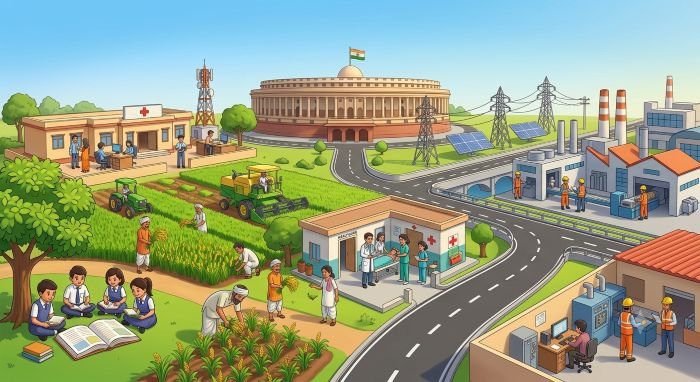
With the rise of welfare states in the 20th century, the role of government expanded beyond national security, justice and maintenance of law and order. The government began providing basic facilities such as food, clothing, shelter, education, health, hygiene, transport and communication.
It also became involved in solving problems like poverty, unemployment and unequal distribution of income and wealth. The government works to provide basic amenities and improve the standard of living of people. It also promotes economic development, economic stability and social justice. Thus, the government plays an important role in promoting the welfare of the people.
Question 2.
What are the objectives of Five-Year Plans?
Answer:
The main objective of the Five-Year Plans was to eradicate poverty and improve the standard of living of the people. They aimed to increase production to the maximum extent possible. They also aimed to increase employment opportunities and reduce economic disparities. Ensuring economic stability was another important objective. The plans also focused on modernising the economy. Thus, the Five-Year Plans aimed at the overall economic development of the country.
Question 3.
List out the achievements of Five-Year Plans.
Answer:
The Five-Year Plans helped India achieve self-sufficiency in food-grain production. Employment opportunities increased with the expansion of the industrial and service sectors. There was considerable progress in science and technology. Life expectancy and literacy rates improved, while infant mortality and death rates declined. Agricultural, industrial and service sectors witnessed significant development. The plans also contributed to improvements in the overall standard of living.
Question 4.
What are the factors that led to the Green Revolution?
Answer:
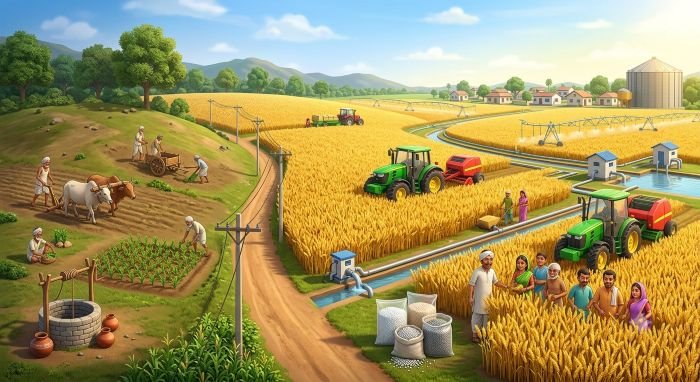
The Green Revolution was mainly achieved through the use of high-yielding variety (HYV) seeds. The use of chemical fertilizers and pesticides increased agricultural production. Expansion of irrigation facilities also played an important role. Improved agricultural technology and scientific methods were adopted by farmers. The government provided subsidies, equipment and low-interest loans to farmers. The contribution of agricultural scientist Dr. M. S. Swaminathan was also significant.
Question 5.
What are the remedies for the problems faced by the agricultural sector?
Answer:
The government promotes organic and natural farming to address problems in the agricultural sector. Farmers are provided with subsidies for fertilizers and agricultural equipment. Banks and cooperative organizations provide loans at low interest rates. Agricultural markets are improved to ensure fair prices for farmers’ produce. Facilities such as granaries and cold-storage warehouses are developed to store surplus produce. Modern pre-harvest and post-harvest technologies are also encouraged.
Question 6.
What are the objectives of NITI Aayog?
Answer:
NITI Aayog aims to develop a shared vision of national development priorities, sectors and strategies with the active involvement of states. It aims to promote co-operative federalism between the Centre and the states. It provides continuous support and encourages the participation of states in development. It works towards strengthening states as an important part of national development. It also provides strategic policy guidance and promotes research, innovation and knowledge sharing.
Additional Questions and Answers
Question 1.
Why is government intervention necessary in developing countries?
Answer:
Government intervention is necessary to solve problems such as poverty, unemployment, agricultural backwardness and unequal distribution of income and wealth. It also helps provide basic amenities like education, health, electricity, transport and communication.
Question 2.
Who is regarded as the Father of Economic Planning in India?
Answer:
Sir M. Visvesvaraya is regarded as the Father of Economic Planning in India.
Question 3.
When was the National Planning Commission established in India?
Answer:
The National Planning Commission was established in 1950.
Question 4.
Who is the Chairman of the National Planning Commission?
Answer:
The Prime Minister of India was the Chairman of the National Planning Commission.
Question 5.
When was the National Development Council established?
Answer:
The National Development Council was established in 1952.
Question 6.
What is economic stability?
Answer:
Economic stability means an economy moves towards progress without extreme fluctuations in national income, production, employment, investment and prices.
Question 7.
What is social justice?
Answer:
Social justice means the income and wealth generated in the country should be distributed as equally as possible without discrimination.
Question 8.
When did India’s First Five-Year Plan come into effect?
Answer:
India’s First Five-Year Plan came into effect on 1st April 1951.
Question 9.
What was the main objective of the Five-Year Plans?
Answer:
The main objective was to eradicate poverty and improve the standard of living of the people.
Question 10.
What is inclusive growth?
Answer:
Inclusive growth means ensuring that everyone participates in and benefits from the process of economic growth.
Question 11.
What is meant by Green Revolution?
Answer:
Green Revolution refers to the rapid increase in food-grain production in India during 1967–70 through high-yielding seeds and improved agricultural technology.
Question 12.
Who is known as the Father of the Indian Green Revolution?
Answer:
Dr. M. S. Swaminathan is known as the Father of the Indian Green Revolution.
Question 13.
What is Pre-Harvest Technology?
Answer:
Pre-Harvest Technology refers to improved technology used in agricultural production before harvesting, including HYV seeds, fertilizers, pesticides and irrigation.
Question 14.
What is Rainbow Revolution?
Answer:
The enormous increase in production from agriculture and agro-based activities is called the Rainbow Revolution.
Question 15.
Name any four revolutions included in the Rainbow Revolution.
Answer:
They are Green Revolution – food grains, Blue Revolution – fish, White Revolution – milk, and Yellow Revolution – oilseeds.
Question 16.
What is Post-Harvest Technology?
Answer:
It is the improved technology used to procure, process, store and market agricultural produce.
Question 17.
When was NITI Aayog started?
Answer:
NITI Aayog was started on 1st January 2015.
Question 18.
What does NITI Aayog stand for?
Answer:
NITI Aayog stands for National Institution for Transforming India.
Multiple-Choice Questions
1. Who is regarded as the Father of Economic Planning in India?
a) Dr. M. S. Swaminathan
b) Sir M. Visvesvaraya
c) Dr. Norman Borlaug
d) Mahatma Gandhi
Answer:
b) Sir M. Visvesvaraya
2. The National Planning Commission was established in:
a) 1947
b) 1949
c) 1950
d) 1952
Answer:
c) 1950
3. The First Five-Year Plan came into effect on:
a) 15 August 1947
b) 26 January 1950
c) 1 April 1951
d) 1 January 1952
Answer:
c) 1 April 1951
4. Which organization was established in 1952?
a) NITI Aayog
b) National Development Council
c) RBI
d) Planning Board
Answer:
b) National Development Council
5. Which of the following was a major objective of the Five-Year Plans?
a) Increasing economic disparities
b) Reducing employment
c) Eradicating poverty
d) Reducing production
Answer:
c) Eradicating poverty
6. Inclusive growth was given priority in the:
a) First Five-Year Plan
b) Fifth Five-Year Plan
c) Eleventh and Twelfth Five-Year Plans
d) Second Five-Year Plan
Answer:
c) Eleventh and Twelfth Five-Year Plans
7. The Green Revolution in India began mainly during:
a) 1947–50
b) 1951–55
c) 1967–70
d) 1980–85
Answer:
c) 1967–70
8. Who is known as the Father of the Indian Green Revolution?
a) Sir M. Visvesvaraya
b) Dr. M. S. Swaminathan
c) Dr. Norman Borlaug
d) Jawaharlal Nehru
Answer:
b) Dr. M. S. Swaminathan
9. Green Revolution mainly resulted in increased production of:
a) Fish
b) Milk
c) Food grains
d) Fruits
Answer:
c) Food grains
10. Blue Revolution is associated with the production of:
a) Milk
b) Fish
c) Eggs
d) Oilseeds
Answer:
b) Fish
11. White Revolution is associated with the production of:
a) Milk
b) Meat
c) Fruits
d) Fish
Answer:
a) Milk
12. Yellow Revolution is associated with the production of:
a) Food grains
b) Oilseeds
c) Milk
d) Eggs
Answer:
b) Oilseeds
13. NITI Aayog was started on:
a) 1 January 2014
b) 1 January 2015
c) 15 August 2015
d) 26 January 2016
Answer:
b) 1 January 2015
14. NITI Aayog replaced the:
a) National Development Council
b) Reserve Bank of India
c) Planning Commission
d) Finance Commission
Answer:
c) Planning Commission
15. The Chairman of NITI Aayog is the:
a) President of India
b) Prime Minister of India
c) Finance Minister
d) Vice-President of India
Answer:
b) Prime Minister of India