
2nd PUC Biology Question and Answer: Environmental Issues
Looking for 2nd PUC Biology textbook answers? You can download Chapter 16: Environmental Issues Questions and Answers PDF, Notes, and Summary here. 2nd PUC Biology solutions follow the Karnataka State Board Syllabus, making it easier for students to revise and score higher in exams.
Karnataka 2nd PUC Biology Textbook Answers—Reflections Chapter 16
Environmental Issues Questions and Answers, Notes, and Summary
2nd PUC Biology Chapter 16
Environmental Issues
Scroll Down to Download Environmental Issues PDF
Question and Answer:
Question 1.
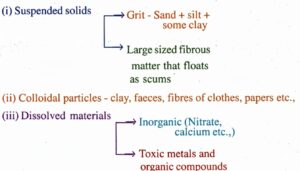
What are the various constituents of domestic sewage? Discuss the effects of sewage discharge on a river.
Answer:
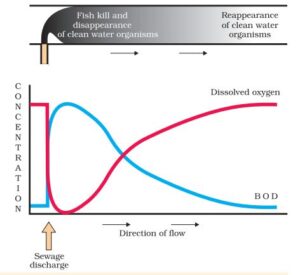
Domestic waste – Waste that is produced from our homes and passed down into sewer system matter that floats . Effects of sewage on river. Quality of water is decreased . So it becomes unsuitable for bathing, domestic uses etc.
B.O.D- [Biological oxygen demand] – More waste in water, more decomposers come into action, much larger amount of O2 utilized so, B.O.D. increases and dissolved oxygen becomes less.
Question 2.
List all the wastes that you generate, at home, school or during your trips to other places. Could you very easily reduce the generation of these wastes? Which would be difficult or rather impossible to reduce?
Answer:
At home, in school, or during trips, we generate wastes such as plastic containers, paper, electronic waste, leftover food, food packets, disposable cups and plates, polythene bags, excreta, and soap/detergent waste.
Many of these wastes can be easily reduced by changing our habits—for example, using reusable bottles, reducing paper use, avoiding disposable items, and buying products with less packaging.
However, some wastes are difficult or almost impossible to reduce, such as polythene bags and other plastic materials, because they are non-biodegradable. These materials do not decompose naturally and must be recycled to avoid pollution.
Question 3.
Discuss the causes and effects of global warming. What measures need to be taken to control global warming?
Answer:
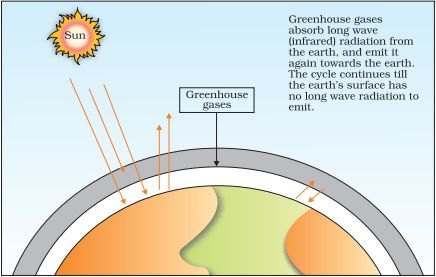
Global warming is caused by the enhanced greenhouse effect, which is the gradual warming of the earth’s atmosphere due to the increased concentration of greenhouse gases such as carbon dioxide, methane, nitrous oxide, and chlorofluorocarbons (CFCs). These gases allow short-wave solar radiation to reach the earth but trap the long-wave infrared radiation, preventing it from escaping back into space. This disturbs the natural energy balance of the earth and leads to a rise in global temperature.
Effects of Global Warming
(i) Changes in Climate and Weather Patterns
- Warming of the atmosphere increases its moisture-holding capacity.
- The troposphere warms, but the stratosphere cools, causing disturbances in atmospheric circulation.
- This leads to changes in rainfall patterns and an increase in the frequency of droughts, floods, storms, and cyclones.
- Tropical and subtropical countries may face increased risks of diseases due to the spread of vectors and water-borne pathogens.
(ii) Rise in Sea Level
- Due to thermal expansion of ocean water and melting of glaciers, sea levels rise.
- Even a 0.5 meter rise can severely affect human populations, nearly one-third of whom live close to coastlines.
- Low-lying islands may get submerged, and coastal wetlands like salt marshes and estuaries may disappear.
- Loss of these habitats can endanger many species of birds and fishes that use them as breeding grounds.
Measures to Control Global Warming
- Replace chlorofluorocarbons (CFCs) with ozone-friendly substitutes that do not contribute to global warming.
- Increase forest cover to absorb atmospheric CO₂ through photosynthesis.
- Reduce the use of nitrogen fertilizers and rely more on natural nitrogen fixation.
- Reduce dependence on fossil fuels by developing and using alternative energy sources.
- Promote renewable and non-polluting energy sources such as solar energy, wind energy, and hydropower.
- Encourage energy conservation, waste reduction, and sustainable lifestyles.
Question 4.
Match the items given in column A and B:
Column A Column B
(a) Catalytic converter (i) Particulate matter
(b) Electrostatic precipitator (ii) Carbon monoxide and nitrogen oxides
(c) Earmuffs (iii) High noise level
(d) Landfills (iv) Solid wastes
Answer:
(a) – (ii)
(b) – (i)
(c) – (iii)
(d) – (iv)
Question 5.
Write critical notes on the following:
(a) Eutrophication
(b) Biological magnification
(c) Groundwater depletion and ways for its replenishment
Answer:
(a) Eutrophication
Eutrophication is the nutrient enrichment of a water body that leads to dense growth of plant and animal life. It mainly occurs due to run-off from fertilized fields, lawns, feedlots, and detergent-rich sewage entering lakes or ponds.
Excess organic matter increases organic loading. Rapid growth of algae (algal bloom) blocks sunlight from reaching submerged plants. When algae die, their decomposition consumes oxygen, causing a sharp decline in dissolved oxygen.
Blue-green algae also release toxins, making the water harmful.
Both toxicity and low oxygen levels result in the death of aquatic animals and deterioration of water quality.
(b) Biological Magnification
Biological magnification (biomagnification) is the increase in concentration of toxic, non-biodegradable substances at successive trophic levels of a food chain. These toxins enter water through industrial and domestic wastes.
Examples include DDT, mercury, and PCBs.
As these chemicals move through the food chain—water → zooplankton → small fish → large fish → birds—their concentration increases dramatically.
Example (DDT levels):
- Birds – 25 ppm
- Large fish – 2 ppm
- Small fish – 5 ppm
- Zooplankton – 04 ppm
- Water – 003 ppm
This illustrates how toxins become highly concentrated in top-level consumers.
Biomagnification also contributes to environmental issues such as eutrophication.
(c) Groundwater Depletion and Ways for Its Replenishment
Groundwater depletion occurs when excessive withdrawal takes place, especially in areas where surface water is insufficient—such as urban regions, hilly areas, arid zones, and states like Punjab, Tamil Nadu, and Rajasthan. Tube wells and pumps extract large quantities of groundwater, causing the water table to fall.
Replenishment Measures:
- Reduce consumption of groundwater, avoiding its overuse for irrigation, cleaning, and domestic purposes.
- Rainwater harvesting – collecting rainwater from rooftops and directing it into the ground through recharge pits, pipes, or tanks. This helps restore the groundwater table and provides an alternative water source.
Question 6.
Why does ozone hole form over Antarctica? How will enhanced ultraviolet radiation affect us?
Answer:
A large amount of ozone-depleting substances (ODS) such as CFCs, N₂O, halons, SO₂, CH₄, and chlorine compounds are released mainly by industrially advanced countries. These gases reach the stratosphere and gradually drift towards the poles before winter.
During the Antarctic winter, the temperature falls to around –85°C, forming polar stratospheric ice clouds (PSCs). There is also no sunlight in this period. PSCs help convert inactive chlorine compounds into active chlorine.
When sunlight returns in the spring season (September–October), active chlorine reacts with ozone and rapidly converts O₃ → O₂, leading to severe ozone depletion, forming the ozone hole.
In summer, when air circulation becomes normal and mixing of air occurs, the ozone hole gradually disappears.
(b) Effects of Enhanced Ultraviolet (UV-B) Radiation
Increased UV-B radiation reaching the earth’s surface causes several harmful effects:
- Snow blindness or inflammation of the cornea
- Damage to skin cells, leading to skin cancer
- Damage to nucleic acids (DNA) and proteins
- Reduced immunity and higher susceptibility to infections
- Increase in cataract formation in humans
Question 7.
Discuss the role of women and communities in protection and conservation of forests.
Answer:
In 1731, a Bishnoi woman, Amrita Devi, displayed great courage by hugging a tree to stop it from being cut. Her three daughters and hundreds of Bishnoi community members followed her example. All of them were killed by the soldiers of the King of Jodhpur, but their sacrifice forced the king to stop the cutting of trees.
Later, the Chipko Movement was started in the 1970s by Sunderlal Bahuguna, Gaura Devi, and other villagers in the Garhwal region. They protected forests by hugging the trees and preventing contractors from felling them. This movement highlighted the crucial role of women and local communities in conserving forests.
Question 8.
What measures, as an individual, would you take to reduce environmental pollution?
Answer:
As an individual, I can take several measures to reduce environmental pollution:
Measures to prevent air pollution
- Plant more trees to increase oxygen levels.
- Use clean and renewable fuels such as CNG, LPG, and biofuels.
- Reduce the use of fossil fuels by using public transport, carpooling, or cycling.
- Ensure vehicles use catalytic converters to reduce harmful emissions.
Measures to prevent water pollution
- Use water carefully and avoid wastage.
- Reuse kitchen wastewater for gardening or cleaning.
- Avoid throwing detergents, oils, and chemicals into drains.
Measures to control noise pollution
- Avoid burning firecrackers during festivals like Diwali.
- Plant more trees, as they act as natural sound barriers.
Measures to reduce solid waste
- Segregate waste into biodegradable and non-biodegradable categories.
- Recycle and reuse items like paper, plastic, and glass.
- Compost kitchen waste at home.
- Reduce the use of plastic bags and prefer cloth or jute bags.
Question 9.
Discuss briefly the following:
(a) Radioactive wastes
(b) Defunct ships and e-wastes
(c) Municipal solid wastes
Answer:
(a) Radioactive Wastes
Radioactive wastes are hazardous wastes produced from nuclear power plants, nuclear tests, medical procedures (like X-rays, radiotherapy), and research labs.
They emit harmful radiation such as alpha, beta, and gamma rays, which can cause:
- Genetic mutations
- Cancer and other health disorders
- Damage to soil, water, and living organisms
Radioactive wastes must be safely stored in sealed containers and buried deep underground or in specially designed facilities to prevent leakage.
(b) Defunct Ships and E-wastes
Defunct ships (ship-breaking waste):
Old ships contain toxic substances like asbestos, oil sludge, heavy metals (lead, mercury) and plastic, which are released when ships are dismantled. Ship-breaking yards (e.g., Alang in Gujarat) create major environmental and health hazards for workers.
E-wastes (Electronic wastes):
Discarded electronic items like computers, mobiles, TVs, refrigerators, and batteries form e-waste.
They contain toxic materials such as:
- Lead
- Mercury
- Cadmium
- Brominated flame retardants
Improper handling contaminates soil and water and affects human health. Safe recycling and proper disposal are necessary.
(c) Municipal Solid Wastes
Municipal solid wastes are daily wastes generated from homes, offices, shops, markets, and schools. These include:
- Kitchen waste
- Paper and plastics
- Glass and metal scraps
- Textiles
- Construction debris
Improper disposal causes foul smell, breeding of insects and rodents, water pollution, and landfill overflow.
Management steps include:
- Segregation into biodegradable and non-biodegradable waste
- Composting of organic waste
- Recycling of plastics, paper, and metals
- Sanitary landfills for safe disposal
Question 10.
What initiatives were taken for reducing vehicular air pollution in Delhi? Has air quality improved in Delhi?
Answer:
Delhi has been listed among the most polluted cities in the world. The rapid increase in vehicles, along with the burning of fossil fuels, has severely polluted the air. To reduce vehicular air pollution, several important measures were taken:
- Introduction of CNG (Compressed Natural Gas):
Following the Supreme Court’s order, all buses and many other vehicles were converted to CNG by 2006. CNG is a clean fuel that releases fewer unburnt hydrocarbons and particulate matter. - Phasing out old vehicles:
Older, highly polluting vehicles were removed from the roads. - Use of unleaded petrol:
Lead-free petrol was introduced to reduce toxic lead emissions. - Use of low-sulphur petrol and diesel:
Lower sulphur content reduces the formation of harmful sulphur oxides. - Installation of catalytic converters:
Modern vehicles were required to use catalytic converters to reduce carbon monoxide, nitrogen oxides, and hydrocarbons. - Stricter emission norms:
Bharat Stage emission standards (equivalent to Euro norms) were implemented to regulate vehicular pollution. Bharat Stage I and later stages were made mandatory in major Indian cities.
Has the air quality improved?
The introduction of CNG and strict vehicle norms initially improved Delhi’s air quality, resulting in reduced levels of CO₂ and SO₂.
However, despite these improvements:
- Suspended Particulate Matter (SPM)
- Respirable Suspended Particulate Matter (RSPM)
continue to remain high due to increasing vehicles, construction dust, and other pollution sources.
Question 11.
Discuss briefly the following:
(a) Greenhouse gases
(b) Catalytic converter
(c) Ultraviolet B
Answer:
(a) Greenhouse Gases
Greenhouse gases are gases in the atmosphere that allow short-wave solar radiation to pass through but absorb long-wave heat radiation reflected from the Earth’s surface.
Examples: CO₂, CH₄ (methane), N₂O, CFCs, ozone (O₃).
These gases trap heat and produce the greenhouse effect, which keeps the Earth warm at about +15°C.
Without greenhouse gases, the Earth’s average temperature would be around –18°C, making life impossible.
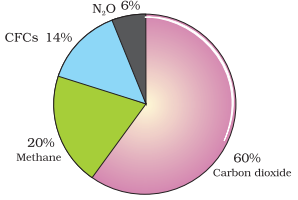
However, excessive increase in greenhouse gases causes enhanced greenhouse effect → global warming, leading to:
- Climate change
- Melting of glaciers
- Sea-level rise
- Extreme weather events
(b) Catalytic Converter
A catalytic converter is a device used in automobiles to reduce harmful exhaust emissions.
- It contains platinum, palladium, and rhodium as catalysts.
- When exhaust gases pass through it:
- NO → N₂ + O₂
- CO → CO₂
- Unburnt hydrocarbons → CO₂ + H₂O
It works effectively only with unleaded petrol, because lead poisons the catalyst and makes it inactive.
(c) Ultraviolet-B (UV-B) Radiation
UV-B is a component of ultraviolet radiation (280–315 nm).
Normally, the ozone layer absorbs most UV-B, preventing it from reaching Earth.
Due to ozone depletion, more UV-B now reaches the surface and causes:
- Skin cancer
- Corneal damage / snow blindness
- Suppressed immune system
- Mutations in DNA
- Reduced photosynthesis in plants → fall in crop productivity
- Damage to phytoplankton, reducing aquatic food productivity
Additional Questions and Answers
Question 1.
What is photochemical smog? How is it formed?
Answer:
Photochemical smog is a type of air pollution formed when sunlight reacts with pollutants such as nitrogen oxides (NOx) and hydrocarbons (HCs) released from vehicles and industries.
This leads to the formation of ozone, peroxyacetyl nitrate (PAN) and other oxidants.
Effects:
- Eye irritation
- Breathing problems
- Reduced visibility
- Damage to plants and rubber
Question 2.
What is Particulate Matter (PM)? Why is it harmful?
Answer:
Particulate matter (PM) refers to tiny solid particles or liquid droplets suspended in air (PM₁₀, PM₂.₅).
Harmful effects:
- Causes asthma, bronchitis
- PM₂.₅ enters blood and affects the heart
- Reduces visibility
- Causes smog formation
Question 3.
What are the main sources of noise pollution?
Answer:
- Vehicles, airplanes, trains
- Loudspeakers, DJ systems
- Construction sites
- Industrial machinery
- Household equipment (mixers, vacuum cleaners)
Effects:
Hearing loss, sleep disturbance, stress, hypertension.
Question 4.
Differentiate between biodegradable and non-biodegradable pollutants.
Answer:
Biodegradable | Non-biodegradable |
Broken down by microorganisms | Cannot be decomposed |
Do not accumulate | Accumulate and cause biomagnification |
Examples: Sewage, paper | Plastic, DDT, metals |
Question 5.
What is the Montreal Protocol?
Answer:
The Montreal Protocol (1987) is an international agreement aimed at reducing and phasing out the production of Ozone-Depleting Substances (ODS) such as:
- CFCs
- Halons
- Carbon tetrachloride
It is considered one of the most successful environmental agreements.
Question 6.
Define reforestation and afforestation.
Answer:
- Reforestation: Replanting trees in a forest where trees have been cut or destroyed.
- Afforestation: Planting trees in areas where no forest existed previously.
Both help restore ecological balance.
Question 7.
What is BOD? Why is it important?
Answer:
Biological Oxygen Demand (BOD) is the amount of oxygen required by microorganisms to decompose organic matter in water.
- High BOD → polluted water
- Low BOD → clean water
Question 8.
What is the difference between primary and secondary sewage treatment?
Answer:
Primary treatment
- Physical process
- Removal of large particles by sedimentation and filtration
Secondary treatment
- Biological process
- Aerobic microbes degrade organic matter
- Reduces BOD significantly
Question 9.
What is biomethanation?
Answer:
Biomethanation is the anaerobic digestion of organic waste by methanogenic bacteria to produce:
- Biogas (methane-rich fuel)
- Sludge used as manure
Question 10.
What are the common methods of waste disposal?
Answer:
- Landfills
- Composting
- Incineration
- Recycling
- Vermicomposting
- Sewage treatment