
2nd PUC Biology Question and Answer: Biodiversity and Conservation
Looking for 2nd PUC Biology textbook answers? You can download Chapter 15: Biodiversity and Conservation Questions and Answers PDF, Notes, and Summary here. 2nd PUC Biology solutions follow the Karnataka State Board Syllabus, making it easier for students to revise and score higher in exams.
Karnataka 2nd PUC Biology Textbook Answers—Reflections Chapter 15
Biodiversity and Conservation Questions and Answers, Notes, and Summary
2nd PUC Biology Chapter 15
Biodiversity and Conservation
Scroll Down to Downlaod Biodiversity and Conservation PDF
Question and Answer:
Question 1.
Name the three important components of biodiversity.
Answer:
The three important components of biodiversity are:
- Genetic Diversity – Variation of genes within a species.
- Species Diversity – Variety of different species present in a region.
- Ecosystem Diversity – Diversity of different ecosystems (forests, deserts, oceans, etc.) present on Earth.
Question 2.
How do ecologists estimate the total number of species present in the world?
Answer:
Ecologists estimate the total number of species on Earth by comparing the species richness of well-studied groups, especially insects, in both temperate and tropical regions. They then extrapolate these observed ratios to other, less-studied groups of plants and animals. This method helps them arrive at a broad global estimate of total species diversity on the planet.
Question 3.
Give three hypotheses for explaining why tropics show greatest levels of species richness.
Answer:
a. Long evolutionary time:
Tropical regions have remained geographically and climatically stable for millions of years, allowing uninterrupted evolution, speciation, and diversification of organisms.
- Stable and predictable climate:
The tropics experience less seasonal variation, providing a constant and favourable environment that supports the survival of a larger number of species. - High solar energy and productivity:
The tropics receive abundant sunlight, leading to high primary productivity, which in turn supports larger and more diverse populations across trophic levels.
Question 4.
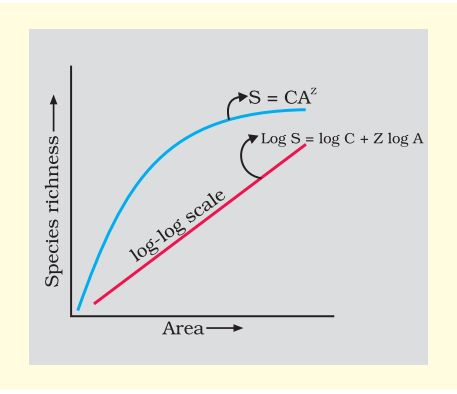
What is the significance of the slope of regression in a species relationship? Area
Answer:
In a species–area relationship, the slope of the regression line (represented as ‘z’) indicates how species richness increases with increasing area.
- For small areas, the value of z is small (0.1–0.2) and remains similar across taxa and regions.
- For large areas such as continents, z is much higher (0.6–1.2), meaning species richness increases more steeply with area.
- A higher slope indicates greater biodiversity gain with increase in area.
Question 5.
What are the major causes of species losses in a geographical region?
Answer:
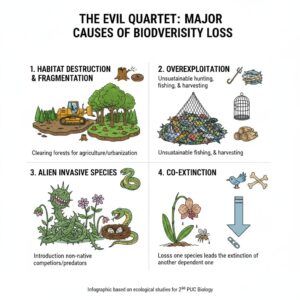
The major causes of species losses are collectively known as the Evil Quartet. These are:
- Habitat loss and fragmentation:
Destruction of natural habitats due to deforestation, urbanization, agriculture, and mining leads to the disappearance of many species. - Over-exploitation:
Excessive hunting, fishing, logging, and harvesting of plants and animals causes rapid population decline. - Alien species invasions:
Introduction of non-native species often leads to competition, predation, or diseases that threaten native species. - Co-extinctions:
When one species becomes extinct, species dependent on it (like parasites, pollinators, or symbiotic partners) may also disappear.
Question 6.
How is biodiversity important for ecosystem functioning?
Answer:
Biodiversity plays a crucial role in maintaining the proper functioning of ecosystems in the following ways:
- Higher Productivity:
Diverse ecosystems tend to be more productive because different species perform different ecological roles, improving overall resource use. - Stability and Resilience:
Ecosystems with rich biodiversity can better resist environmental disturbances like drought, diseases, and climate change. - Ecosystem Services:
Biodiversity supports essential services such as:
- Pollination by insects and birds
- Natural pest control
- Nutrient cycling
- Soil formation and protection
- Water purification and conservation
- Climate Regulation:
Forests and oceans with high biodiversity help regulate global climate and maintain atmospheric gases through processes like photosynthesis. - Balanced Food Webs:
Presence of diverse species maintains ecological balance and supports stable food chains.
Question 7.
What are sacred groves? What is their role in conservation?
Answer:
Sacred groves are patches of forest or natural vegetation that are protected by local communities, usually due to religious beliefs, cultural traditions, or spiritual significance. These areas are strictly protected, and cutting trees, hunting, or any form of exploitation is traditionally forbidden.
Sacred groves are found in Khasi and Jaintia Hills of Meghalaya, Aravalli Hills of Rajasthan, and the Western Ghats of Karnataka and Maharashtra.
Role in Conservation:
- Biodiversity Hotspots:
Sacred groves act as natural habitats for several rare, endemic, and threatened plant and animal species. - Ecological Stability:
They preserve climax vegetation, which supports ecosystem balance and natural ecological processes. - Water and Soil Conservation:
Groves protect watersheds, reduce soil erosion, and maintain groundwater levels. - Refuge for Species:
In places like Meghalaya, sacred groves are the last remaining refuge for many threatened plant species. - Cultural and Traditional Conservation:
Community beliefs ensure strict protection, making sacred groves one of the oldest forms of in-situ conservation in India.
Question 8.
Among the ecosystem services are control of floods and soil erosion. How is this achieved by the biotic components of the ecosystem?
Answer:
Biotic components of an ecosystem, especially plants, play a major role in controlling floods and preventing soil erosion. The roots of trees hold the soil tightly, stopping it from being washed away by rainwater or blown away by wind. In forests, the canopy formed by leaves and branches slows down the fall of raindrops, so the water reaches the ground gently instead of hitting it forcefully.
This prevents soil from getting loosened and reduces surface runoff. Because water drips slowly to the ground, it does not collect or cause flooding. Trees also help regulate the water cycle by absorbing and releasing water, which further reduces the chances of floods and soil erosion.
Question 9.
The species diversity of plants (22 per cent) is much less than that of animals (72 per cent). What could be the explanations to how animals achieved greater diversification?
Answer:
Animals show greater species diversity than plants mainly because plants create a wide variety of habitats, structures, and food resources. This structural and resource richness offered by plants allows many different animal species to evolve, adapt, and occupy various ecological niches. As a result, animals have undergone greater diversification compared to plants.
Question 10.
Can you think of a situation where we deliberately want to make a species extinct? How would you justify it?
Answer:
Yes. We may deliberately want to make a species extinct when it causes serious harm to humans, crops, or ecosystems. For example, disease-causing organisms such as smallpox virus, polio virus, or malaria-carrying mosquitoes can lead to large-scale illness and death. Eliminating such harmful species helps protect human health and prevents the spread of dangerous diseases. Since these organisms do not play any major positive role in maintaining ecosystem balance, their eradication can be justified for the welfare and safety of human populations.
Additional Question And Answer:
Question 1:
What is ex situ conservation? Give two examples.
Answer:
Ex situ conservation is the method of conserving endangered species outside their natural habitats. It involves maintaining and breeding species in artificial or controlled environments.
Examples include botanical gardens, zoos, wildlife safaris, seed banks, and cryopreservation facilities.
Question 2:
Why are endemic species more vulnerable to extinction?
Answer:
Endemic species are confined to a specific geographical region and have very limited distribution. Because they occur only in one area, any disturbance such as habitat loss, deforestation, climate change, or invasive species can quickly wipe out their entire population. Hence, their risk of extinction is very high.
Question 3:
Explain the term ‘bioprospecting’.
Answer:
Bioprospecting refers to the exploration of biodiversity for discovering commercially valuable genetic resources, biochemical compounds, or organisms. Many medicines, antibiotics, and industrial products have been developed through bioprospecting of plants, microbes, and animals.
Question 4:
What are invasive species? How do they affect native biodiversity?
Answer:
Invasive species are non-native species that enter new ecosystems and spread rapidly. They compete with native species for resources, disturb food chains, and sometimes prey on native species directly. Examples: Lantana, Parthenium, Eichhornia. Their presence often leads to decline or extinction of native flora and fauna.
Question 5:
Define alpha, beta, and gamma diversity.
Answer:
- Alpha diversity: Species diversity within a particular area or ecosystem.
- Beta diversity: The change in species composition between two ecosystems or along environmental gradients.
- Gamma diversity: Overall diversity within a large region that contains multiple ecosystems.
Question 6:
What is the Red Data Book? Why is it important?
Answer:
The Red Data Book is a document published by IUCN containing the list of endangered, vulnerable, rare, and extinct species. It helps governments and conservationists identify species at risk and plan measures to protect them.
Question 7:
How do national parks contribute to biodiversity conservation?
Answer:
National parks provide a protected area where ecosystems are preserved in their natural state. Human activities like hunting, grazing, and deforestation are prohibited. They help protect endangered species, maintain genetic diversity, and conserve entire ecosystems.
Question 8:
Explain the concept of “Rivet Popper Hypothesis.”
Answer:
Proposed by Paul Ehrlich, this hypothesis compares species in an ecosystem to rivets in an airplane. Losing a few species (rivets) might not cause immediate damage, but continuous loss weakens the ecosystem. At a critical point, the system collapses—just like an airplane losing too many rivets.