
2nd PUC Biology Question and Answer: Ecosystem
Looking for 2nd PUC Biology textbook answers? You can download Chapter 14: Ecosystem Questions and Answers PDF, Notes, and Summary here. 2nd PUC Biology solutions follow the Karnataka State Board Syllabus, making it easier for students to revise and score higher in exams.
Karnataka 2nd PUC Biology Textbook Answers—Reflections Chapter 14
Ecosystem Questions and Answers, Notes, and Summary
2nd PUC Biology Chapter 14
Ecosystem
Scroll Down to Download Ecosystem PDF
Question and Answer:
Question 1.
Fill in the blanks.
(a) Plants are called as because they fix carbon dioxide.
(b) In an ecosystem dominated by trees, the pyramid (of numbers) is type.
(c) In aquatic ecosystems, the limiting factor for the productivity is .
(d) Common detritivores in our ecosystem are .
(e) The major reservoir of carbon on earth is .
Answer:
(a) Producers
(b) Inverted
(c) Light
(d) Earthworms
(e) Oceans
Question 2.
Which one of the following has the largest population in a food chain?
(a) Producers
(b) Primary consumers
(c) Secondary consumers
(d) Decomposers
Answer:
(a) Producers
Question 3.
The second trophic level in a lake is
(a) Phytoplankton
(b) Zooplankton
(c) Benthos
(d) Fishes
Answer:
(b) Zooplankton
Question 4.
Secondary producers are
(a) Herbivores
(b) Producers
(c) Carnivores
(d) None of the above
Answer:
(a) Herbivores
Question 5.
What is the percentage of photosynthetically active radiation (PAR) in the incident solar radiation?
(a) 100%
(b) 50%
(c) 1-5%
(d) 2-10%
Answer:
(b) 50%
Question 6.
Distinguish between
(a) Grazing food chain and detritus food chain
(b) Production and decomposition
(c) Upright and inverted pyramid
(d) Food chain and Food web
(e) Litter and detritus
(f) Primary and secondary productivity
Answer:
(a) Grazing food chain and detritus food chain
Grazing Food Chain | Detritus Food Chain |
1. Also known as predator–prey food chain. | 1. Also known as saprotrophic food chain. |
2. Producers → herbivores → carnivores → top carnivores. Eg: Grass → Grasshopper → Frog → Snake → Vulture | 2. Begins with dead organic matter (detritus). Eg: Decaying matter → Earthworm → Bird → Snake → Vulture |
3. Converts inorganic nutrients into organic matter. | 3. Releases inorganic nutrients from organic matter. |
4. Adds organic matter to the detritus food chain. | 4. Supplies inorganic nutrients to grazing food chain. |
(b) Production and decomposition
Production | Decomposition |
1. Synthesis of fresh biomass. | 1. Breakdown of organic matter. |
2. Locks inorganic nutrients into biomass. | 2. Releases inorganic nutrients back to the environment. |
3. Traps energy. | 3. Releases energy. |
(c) Upright and inverted pyramid
Upright Pyramid | Inverted Pyramid |
Producers form a broad base, and consumers decrease at higher levels. | Producers form a narrow base, and consumers increase at higher levels. |
(d) Food chain and Food web
Food Chain | Food Web |
1. Transfer of energy from producers through a single linear pathway. | 1. Interconnected food chains form a food web. |
2. Less realistic in nature. | 2. More realistic and stable. |
(e) Litter and detritus
Litter | Detritus |
1. Freshly fallen leaves, twigs, dead parts and faecal matter not yet decomposed. | 1. Freshly fallen plant/animal remains that have started decomposing. |
(f) Primary and secondary productivity
Primary Productivity | Secondary Productivity |
1. Rate of biomass formation by producers. | 1. Rate of biomass formation by consumers. |
2. Due to photosynthesis. | 2. Due to herbivory and predation. |
3. Net energy gain in biosphere. | 3. No energy trapping occurs. |
Question 7.
Describe the components of an ecosystem.
Answer:
The components of an ecosystem can be divided into biotic and abiotic components.
- Biotic Components
These are the living organisms in an ecosystem:
- Producers:
- Green plants that synthesize their own food through photosynthesis.
- Consumers:
- Organisms that cannot produce their own food and depend on others.
- Primary consumers (herbivores): Feed on plants.
- Secondary and tertiary consumers (carnivores): Feed on herbivores or other carnivores.
- Decomposers:
- Organisms like bacteria and fungi that break down dead plants and animals into simpler inorganic compounds, recycling nutrients.
- Abiotic Components
These are the non-living factors of the ecosystem:
- Climatic components:
- Light, temperature, wind, atmospheric gases, rainfall, and humidity.
- Soil factors:
- Organic materials, minerals, soil water, and soil air.
- Topographic factors:
- Altitude, slope direction, and steepness.
Question 8.
Define ecological pyramids and describe with examples, pyramids of number and biomass.
Answer:
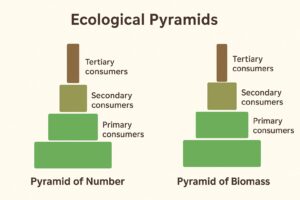
Ecological Pyramids:
Ecological pyramids are graphical representations of various ecological parameters at successive trophic levels of a food chain, with producers at the base and top carnivores at the apex. The length of each bar represents the quantity (number, biomass, or energy) at that trophic level. These are also called bar diagrams.
- Pyramid of Number
- Represents the numerical strength of populations at different trophic levels per unit area.
- Producers form the base, intermediate levels represent herbivores and carnivores, and top carnivores form the apex.
- The length of the bar is proportional to the number of individuals at that level.
Example:
- Grass → Grasshopper → Frog → Snake → Hawk (upright in grasslands; may be inverted in a large tree supporting many insects).
- Pyramid of Biomass
- Biomass is the total living matter measured in fresh or dry weight; dry weight is preferred to avoid seasonal variations in moisture.
- This pyramid represents the amount of biomass per unit area across trophic levels, with producers at the base and top carnivores at the apex.
- Length of the bar indicates the comparative amount of biomass.
- Biomass is maximum at the producer level, and only 10–20% of biomass is transferred to the next level.
Example:
- Terrestrial ecosystem: Grass (high biomass) → Herbivores → Carnivores (decreasing biomass) → Upright pyramid.
- Aquatic ecosystem: Phytoplankton (low biomass) → Zooplankton → Fishes (higher biomass) → Inverted pyramid.
Question 9.
What is primary productivity? Give brief description of factors that affect primary productivity.
Answer:
Primary productivity is the amount of biomass or organic matter produced per unit area over a specific time period by plants during photosynthesis. It is usually expressed in terms of weight (g/m²/yr) or energy (kcal/m²/yr).
There are two types of primary productivity:
- Gross Primary Productivity (GPP): The total rate of production of organic matter during photosynthesis.
- Net Primary Productivity (NPP): The organic matter remaining after the plants use some energy for respiration.
Factors Affecting Primary Productivity:
- Solar Radiation: Maximum sunlight is received in the tropics, leading to higher photosynthesis and NPP (>20 t ha⁻¹ yr⁻¹) compared to temperate forests (~8 t ha⁻¹ yr⁻¹).
- Temperature: Warm tropical climates favor higher productivity, while cooler temperate regions have lower productivity.
- Moisture: Adequate rainfall and humidity increase ecosystem productivity.
- Nutrients: Essential minerals support producer growth. Nutrient-poor soils, like deserts, result in lower productivity.
- Photosynthetic Efficiency of Producers: C4 plants have higher productivity than C3 plants due to more efficient photosynthesis.
Question 10.
Define decomposition and describe the processes and products of decomposition.
Answer:
Decomposition is the breakdown of dead organic matter and waste into simpler substances. It is a complex, enzymatic process that gradually degrades detritus, making nutrients available for plants and other organisms in the ecosystem.
The process of decomposition involves three main steps:
- Fragmentation of Detritus: Large organic matter is broken into smaller pieces by detritivores, which increases the surface area for microbial action.
- Leaching: Water-soluble inorganic nutrients are washed out from dead organic matter into the soil.
- Catabolism (Humification and Mineralization):
- Humification: Partial decomposition produces humus, a stable organic material that enriches the soil.
- Mineralization: Complete decomposition converts organic matter into inorganic substances such as CO₂, H₂O, and essential nutrients like nitrates and phosphates.
Products of Decomposition:
- Humus: Improves soil fertility and water retention.
- Inorganic Nutrients: Nitrogen, phosphorus, potassium, and other minerals available for plants.
- Gases: CO₂ and H₂O released during decomposition.
Question 11.
Give an account of energy flow in an ecosystem.
Answer:
Energy Flow:
Energy flow is the passage of energy through various trophic levels of an ecosystem. Energy does not circulate; instead, it flows unidirectionally from producers to consumers and finally to decomposers.
- Capture of Energy:
- Producers capture 1–5% of solar radiation under favorable conditions and use it for photosynthesis, forming gross primary productivity (GPP).
- About 20% of GPP is used by producers for their own life processes.
- The remaining energy, called net primary productivity (NPP), is available to herbivores, approximately 8–4% of incident radiation.
- Transfer to Herbivores (Primary Consumers):
- Herbivores consume a part of the NPP. The remaining plant matter becomes detritus, which provides energy to decomposers.
- About 30% of ingested energy is used by herbivores for life activities and lost as heat.
- Only ~10% of producer energy is converted into herbivore biomass.
- This transfer of 10% of biomass energy from one trophic level to the next is known as the 10% law.
- Transfer to Primary Carnivores (Secondary Consumers):
- Primary carnivores feed on herbivores.
- Around 60% of assimilated energy is used in metabolic activities and lost as heat.
- The remaining energy is transferred to secondary carnivores.
- Transfer to Higher-Level Carnivores:
- 10% of biomass energy from the primary carnivores becomes part of secondary carnivore biomass.
- Similarly, if there are tertiary or quaternary carnivores, they receive ~10% of the energy from the previous trophic level.
- Because energy decreases sharply at each level, ecosystems rarely have more than 3–5 trophic levels.
Question 12.
Write important features of a sedimentary cycle in an ecosystem.
Answer:
In a sedimentary cycle, the materials involved in circulation between the biotic and abiotic components of the ecosystem are mostly non-gaseous, and the lithosphere (soil and rocks) acts as the main reservoir.
Key Features:
- Non-gaseous Nature: Elements like phosphorus, calcium, and magnesium circulate in non-gaseous forms. Sulphur is an exception, as it has both sedimentary and gaseous phases.
- Lithospheric Reservoir: The primary storage of nutrients is in rocks and soil, rather than in the atmosphere.
- Slow Cycle: Sedimentary cycles are slower than gaseous cycles because nutrient release depends on weathering and soil processes.
- Less Perfect Cycle: Compared to gaseous cycles, sedimentary cycles are less complete and often localized.
Question 13.
Outline salient features of carbon cycling in an ecosystem.
Answer:
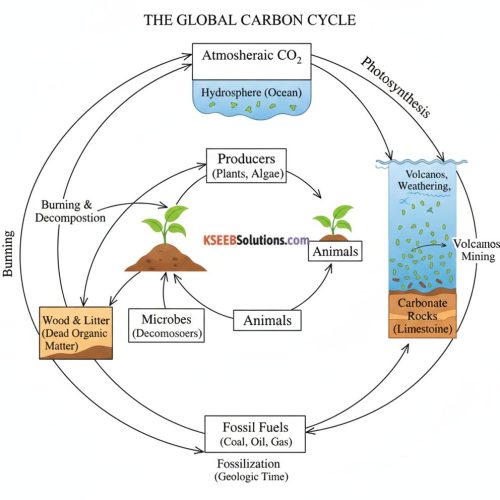
Carbon is the most abundant element as it occurs in every organic substance. It forms 49% of the dry weight of organic matter. Carbon occurs as free carbon dioxide in the atmosphere and dissolved as CO2 in the hydrosphere. Carbon dioxide is being added to the cycling pool of the atmosphere and hydrosphere through two processes, biological and non-biological.
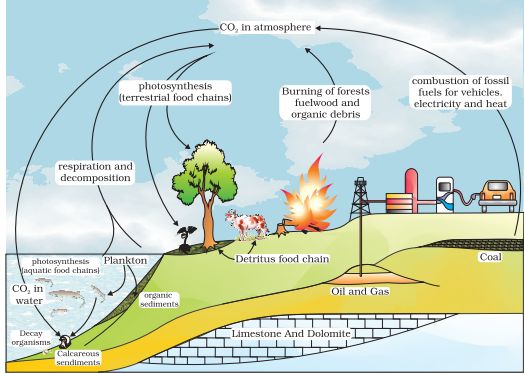
Biological- All living organisms produce carbon dioxide through respiration Carbon trapped in organic matter is released as CO2 during its decomposition.
Non-Biological – Combustion or burning of biomass and fossil fuels produce carbon dioxides.
Additional Questions And Answers
One Mark Questions
Question 1.
Define an ecosystem.
Answer:
An ecosystem is a functional unit of nature where living organisms interact among themselves and with the surrounding physical environment.
Question 2.
Give two examples each of terrestrial and aquatic ecosystems.
Answer:
- Terrestrial: Forest, Grassland
- Aquatic: Pond, River
Question 3.
What are the two main structural features of an ecosystem?
Answer:
Species composition and stratification.
Two Marks Questions
Question 4.
Distinguish between gross primary productivity (GPP) and net primary productivity (NPP).
Answer:
- GPP is the total organic matter produced by photosynthesis.
- NPP is the biomass remaining after plants use some of GPP for respiration: NPP = GPP – R.
Question 5.
What are the types of nutrient cycles? Give one example each.
Answer:
- Gaseous cycle – Carbon cycle
- Sedimentary cycle – Phosphorus cycle
Question 6.
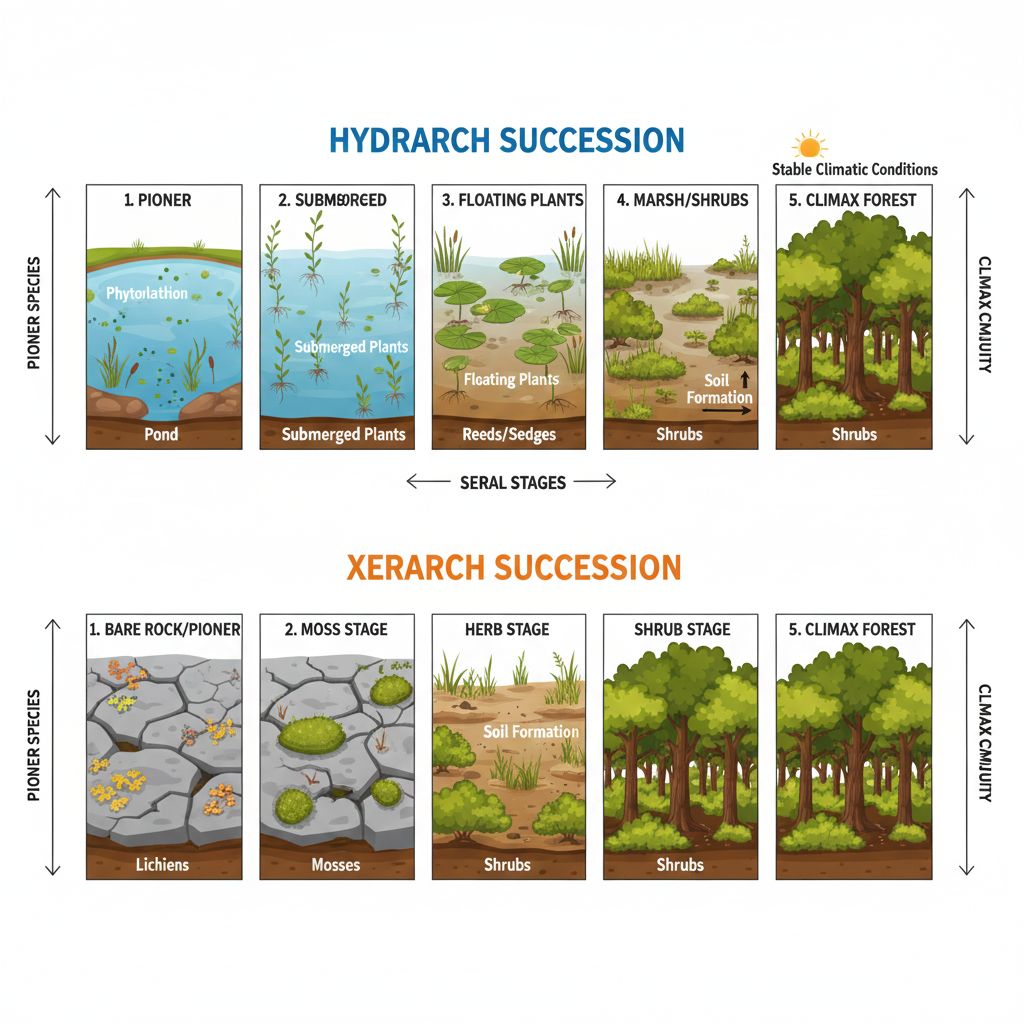
What is the difference between hydrarch and xerarch succession?
Answer:
- Hydrarch succession occurs in wet areas and progresses from hydric to mesic conditions.
- Xerarch succession occurs in dry areas and progresses from xeric to mesic conditions.
Three Marks Questions
Question 7.
Explain the steps involved in decomposition.
Answer:
- Fragmentation: Detritivores break down detritus into smaller particles.
- Leaching: Water-soluble nutrients move down into soil.
- Catabolism: Microbial enzymes degrade detritus into simpler inorganic substances.
- Humification: Formation of humus, a resistant nutrient reservoir.
- Mineralisation: Conversion of humus into inorganic nutrients for plant use.
Question 8.
Describe the grazing food chain (GFC) and detritus food chain (DFC).
Answer:
- GFC: Starts with producers, passes energy to herbivores (primary consumers), then to carnivores (secondary and tertiary consumers).
- DFC: Begins with dead organic matter (detritus) and energy is transferred to decomposers like fungi and bacteria.
Five Marks Questions
Question 9.
Explain ecological succession and distinguish between primary and secondary succession.
Answer:
- Ecological succession: Gradual and predictable change in species composition in an area over time leading to a climax community.
- Primary succession: Occurs in areas where no life existed before (e.g., bare rocks, lava). Soil formation is slow.
- Secondary succession: Occurs in areas where soil is already present but the existing community was disturbed (e.g., abandoned farmland). Faster than primary succession.
Question 10.
Describe the carbon cycle in an ecosystem.
Answer:
- Carbon is fixed by autotrophs via photosynthesis.
- It is passed to consumers through food chains.
- Decomposers release carbon back as CO₂.
- Additional sources include combustion of fossil fuels and forest fires.
- Oceans act as a major reservoir of carbon, regulating atmospheric CO₂.