
2nd PUC Biology Question and Answer: Organisms and Populations
Looking for 2nd PUC Biology textbook answers? You can download Chapter 13: Organisms and PopulationsQuestions and Answers PDF, Notes, and Summary here. 2nd PUC Biology solutions follow the Karnataka State Board Syllabus, making it easier for students to revise and score higher in exams.
Karnataka 2nd PUC Biology Textbook Answers—Reflections Chapter 13
Organisms and Populations Questions and Answers, Notes, and Summary
2nd PUC Biology Chapter 13
Organisms and Populations
Scroll Down to Download Organisms and Populations PDF
Question and Answer:
Question 1.
How is diapause different from hibernation?
Answer:
Diapause | Hibernation |
(i) It is a dormant stage in the development of an organism (especially insects). | (i) It is a state of inactivity in a mature organism (e.g., mammals). |
(ii) It can occur during both summers and winters depending on environmental conditions. | (ii) It occurs only during winters when the temperature becomes extremely low. |
(iii) There is a reduction in free water and metabolic activities. | (iii) No such specific adaptation is seen; the organism simply enters a deep sleep-like state. |
Question 2.
If a marine fish is placed in a fresh water aquarium, will the fish be able to survive? Why or why not?
Answer:
No, a marine fish will not be able to survive in a freshwater aquarium. Marine fish are adapted to live in saline (hypertonic) seawater. When they are placed in freshwater, the outside environment becomes hypotonic. Due to this difference, excess water enters the fish’s body by osmosis, causing severe osmoregulation problems. The fish cannot cope with this imbalance and eventually dies.
Question 3.
Most living organisms cannot survive at temperature above 45°C. How are some microbes able to live in habitats with temperatures exceeding 100°C?
Answer:
Some microbes, especially thermophilic archaebacteria, can survive in extremely high temperatures such as those in hot springs and deep-sea hydrothermal vents because:
- They possess heat-stable enzymes (thermo-resistant enzymes) that do not denature at high temperatures, unlike the enzymes of most organisms.
- Their cell membranes contain special heat-resistant lipids that remain stable and functional even above 100°C.
- Their proteins and DNA have special structural adaptations that prevent them from getting damaged by heat.
Most organisms cannot survive above 45°C because:
- Their enzymes get denatured at high temperatures.
- Protoplasm coagulates (precipitates), making survival impossible.
Question 4.
List the attributes that populations possess but not individuals.
Answer:
Populations have certain attributes that are not exhibited by individual organisms. An individual is born and dies, but a population shows birth rate (natality) and death rate (mortality). A population also has age distribution, genetic composition, and population growth patterns.
Similarly, an individual is either male or female, but a population shows a sex ratio.
Question 5.
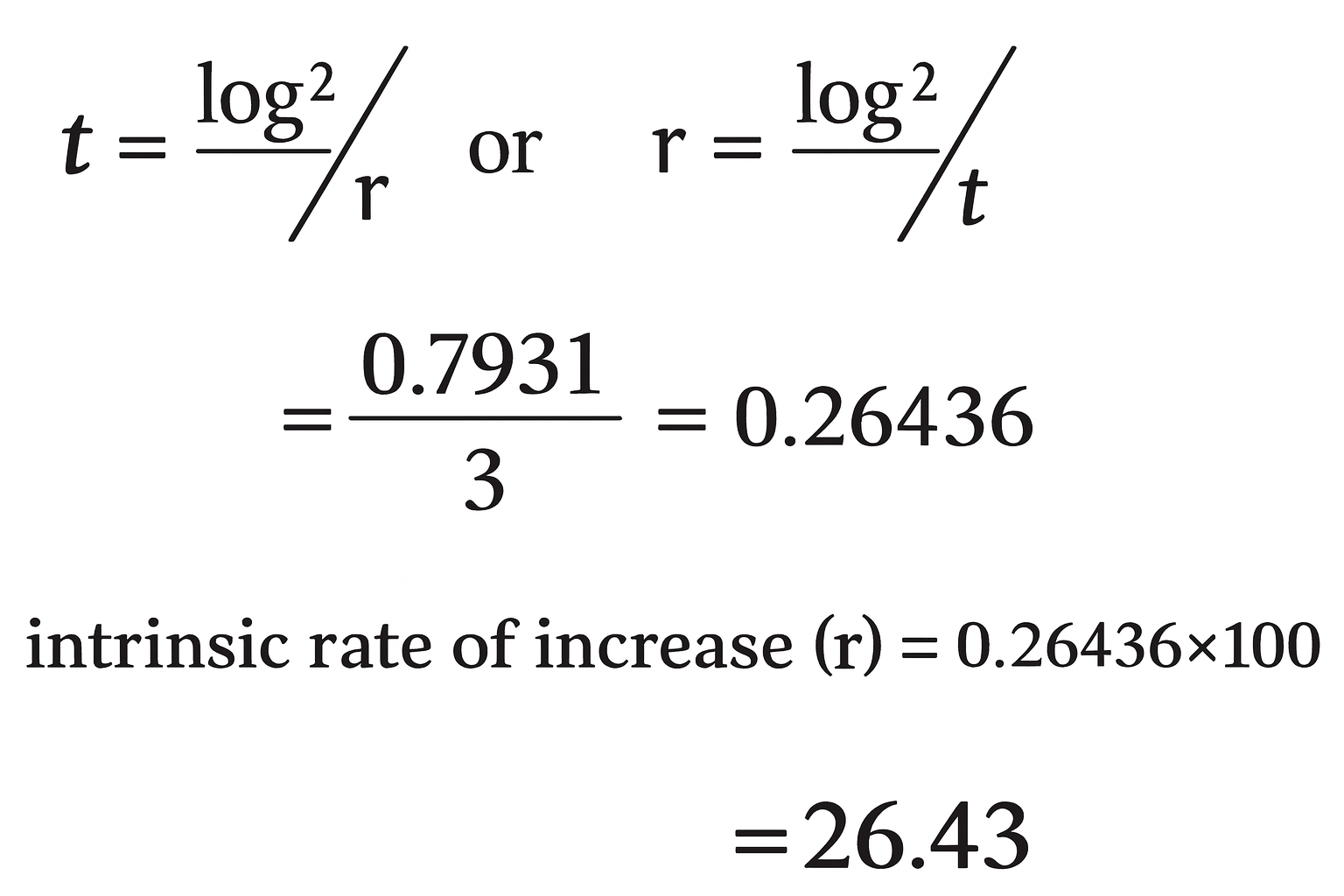
If a population growing exponentially double in size in 3 years, what is the intrinsic rate of increase (r) of the population?
Answer:
Question 6.
Name Important defence mechanisms in plants against herbivory.
Answer:
Plants cannot escape from herbivores, so they have developed several defence mechanisms to protect themselves. These defences can be structural or chemical:
- Structural (Morphological) Defences
- Thorns and spines: Example – Bougainvillea, Acacia. These prevent animals from eating the plant.
- Sharp, silicate leaf edges: Example – grasses with silica deposits that make leaves hard and difficult to chew.
- Hairy (trichome-covered) leaves: These irritate or discourage herbivores.
- Chemical Defences
Plants produce toxic, repellent, or distasteful chemicals such as:
- Morphine – produced by Papaver somniferum (opium poppy)
- Nicotine – produced by Nicotiana tabacum (tobacco plant)
- Strychnine – produced by Strychnos nux-vomica
- Cardiac glycosides, tannins, latex, resins, alkaloids – harmful or bitter to herbivores
These adaptations reduce herbivore attacks and increase the plant’s chances of survival.
Question 7.
An orchid plant is growing on the branch of mango tree. How do you describe this interaction between the orchid and the mango tree?
Answer:
An orchid growing on the branch of a mango tree is an epiphyte. Epiphytes are plants that grow on other plants but do not obtain nutrients from them. Therefore, the relationship between the orchid and the mango tree is an example of commensalism, where one species benefits while the other is neither harmed nor benefited.
In this interaction:
- The orchid is benefited as it gets support and better access to light.
- The mango tree remains unaffected.
Question 8.
What is the ecological principle behind the biological control method of managing with pest insects?
Answer:
The ecological principle behind the biological control of pest insects is the predator–prey relationship. Biological control depends on the ability of natural predators, parasites, or pathogens to regulate and reduce the population of pest insects.
By introducing or enhancing these natural enemies, pest populations are controlled in an eco-friendly and sustainable manner.
Question 9.
Distinguish between the following:
(a) Hibernation and Aestivation
(b) Ectotherms and Endotherms
Answer:
(a) Hibernation and Aestivation
Hibernation | Aestivation |
A state of dormancy during winter. | A state of dormancy during summer. |
Occurs in response to cold and low food availability. | Occurs in response to high temperature and scarcity of water. |
Reduces metabolic rate to survive extreme cold. | Reduces metabolic rate to avoid heat stress and desiccation. |
Seen in animals like frogs, reptiles, bears, and rodents. | Seen in animals like snails, earthworms, and certain desert amphibians. |
(b) Ectotherms and Endotherms
Ectotherms | Endotherms |
Body temperature depends on external environment. | Body temperature is maintained internally, independent of environment. |
Also called cold-blooded animals. | Also called warm-blooded animals. |
Show behavioural adaptations like basking in the sun to regulate temperature. | Show physiological mechanisms like sweating, shivering, and metabolic heat production. |
Examples: fishes, amphibians, reptiles. | Examples: birds and mammals. |
Question 10.
Write a short note on
(a) Adaptations of desert plants and animals
(b) Adaptations of plants to water scarcity
(c) Behavioural adaptations in animals
(d) Importance of light to plants
(e) Effect of temperature or water scarcity and the adaptations of animals.
Answer:
(a) Adaptations of desert plants and animals
Desert plants show several adaptations to reduce water loss and survive extreme heat:
- Deep and extensive root systems to absorb maximum water.
- Thick, waxy cuticle on leaves and stems to prevent transpiration.
- Leaves reduced to spines (e.g., cactus) to minimize water loss.
- Green, fleshy stems to store water and perform photosynthesis.
- Presence of mucilage in tissues to retain moisture.
Desert animals also exhibit special adaptations:
- They remain burrowed during daytime to avoid heat.
- Produce dry faces and concentrated urine to conserve water.
- Kangaroo rat meets 90% of its water requirement from metabolic water obtained by oxidation of fats and never drinks water.
- Camel avoids sweating until body temperature reaches 55–66°C and tolerates 40% dehydration.
(b) Adaptations of plants to water scarcity
Xerophytes exhibit four types of adaptations:
- Ephemerals (Drought escapers):
- Complete life cycle quickly during rains.
- Example: Euphorbia prostrate, Tribulus terrestris.
- Annuals (Drought evaders):
- Survive for a few months even after rains.
- Have modifications to reduce transpiration.
- Example: Echinus echinates.
- Succulents (Drought resistant’s):
- Store water in fleshy leaves/stems.
- Stems are green and photosynthetic.
- Examples: Opuntia, Euphorbia, Asparagus.
- Non-succulent perennials (Drought endures):
- Extensive deep root systems.
- Waxy coating, hairs, sunken stomata, reduced leaves.
- Examples: Acacia nilotica, Calotropis proceri.
(c) Behavioural adaptations in animals
Some animals use behaviour to survive environmental extremes:
- Desert lizards regulate body temperature by basking in the sun when cold and moving into shade when hot.
- They lack physiological thermoregulation like mammals but maintain comfort temperature through movement.
- Many species also burrow into soil to avoid high temperatures.
(d) Importance of light to plants
Light affects several physiological activities in plants:
- Photosynthesis:
- Depends on light intensity, quality, and duration.
2. Growth:
- Red light promotes growth; blue light regulates normal development.
- UV light induces rosette habit.
3. Transpiration:
- Light opens stomata and enhances transpiration.
4. Seed germination:
- Some seeds are photoblastic (require light), e.g., Viscum, Lactuca.
5. Movements:
- Phototaxis in Chlamydomonas, Euglena.
- Shoots show positive phototropism.
6. Photoperiodism:
Flowering depends on light duration (short-day, long-day, day-neutral plants).
(e) Effect of temperature or water scarcity and adaptations of animals
Animals adopt structural, physiological, and behavioural adaptations:
- Kangaroo rat:
- Never drinks water.
- 90% of its water comes from metabolic oxidation of fats.
- Produces solid urine and faces.
- Nocturnal and remains in burrows during daytime.
- Thick fur reduces evaporative water loss.
- Camel:
- Body temperature fluctuates widely; avoids sweating until 55–66°C.
- Can tolerate up to 40% dehydration.
- Produces dry faces and concentrated urine.
- Stores urea during extreme water scarcity.
Question 11.
List the various abiotic environmental factors.
Answer:
Abiotic environmental factors are the non-living components that influence organisms. They include:
- Atmospheric Factors
- Light
- Temperature
- Wind
- Water (humidity, rainfall)
- Lithosphere
- Rocks
- Soil
- Hydrosphere
- Pond
- River
- Lake
- Ocean
- Edaphic Factors (soil-related)
- Soil texture
- Soil water
- Soil air
- Soil microorganisms
- Soil pH
- Mineral content
- Topographic Factors
- Slope
- Altitude
- Valley
Question 12.
Give an example for:
(a) An endothermic animal
(b) An ectothermic animal
(c) An organism of benthic zone
Answer:
(a) An endothermic animal – Monkey (mammal)
(b) An endothermic animal Frog (amphibian), snake (reptile)
(c) An organism of the benthic zone – Angle Fish
Question 13.
Define population and community.
Answer:
Population:
A population is a group of individuals of the same species living in a specific geographical area at a given time and capable of interbreeding.
Community:
A community is a group of different populations of various species living and interacting in the same habitat.
Question 14.
Define the following terms and give one example for each:
(a) Commensalism
(b) Parasitism
(c) Camouflage
(d) Mutualism
(e) Interspecific competition
Answer:
(a) Commensalism
Definition:
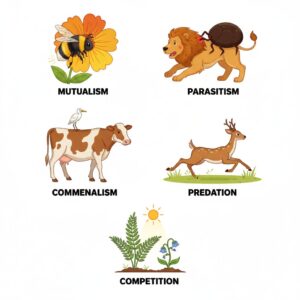
Commensalism is an interaction between two individuals of different species in which one organism benefits, while the other is neither harmed nor benefited to any significant extent.
Example:
The pilot fish (Naucratis) accompanies a shark and feeds on pieces of food left over when the shark eats, without affecting the shark.
(b) Parasitism
Definition:
Parasitism is an interaction in which one organism (parasite) derives food and shelter directly from another living organism (host). The parasite spends part or whole of its life in or on the host’s body and benefits at the host’s expense.
Example:
Lice living on the human scalp.
(c) Camouflage
Definition:
Camouflage (cryptic appearance) is the ability of an organism to blend with its surroundings so that it remains unnoticed. It is a common protective adaptation used either to escape predators or to catch prey.
Example:
Praying mantis (Mantis religiosa) is green and resembles plant stems, allowing it to remain hidden till prey approaches.
(d) Mutualism
Definition:
Mutualism is an interaction between two species in which both organisms’ benefit. (The word symbiosis is often used in the same sense.)
Example:
Termites and protozoans in their gut. Protozoans digest cellulose from wood and release sugars for termites; termites provide food and shelter to protozoans.
(e) Interspecific competition
Definition:
Interspecific competition occurs when individuals of different species compete for the same natural resources, such as light, nutrients, water, pollinators, or space.
Example:
In a forest, trees, shrubs, herbs, and vines compete with each other for sunlight, nutrients, and water.
Question 15.
With the help of suitable diagram describe the logistic population growth curve.
Answer:
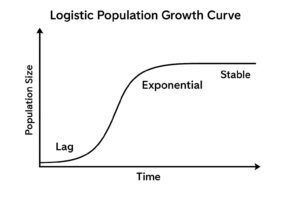
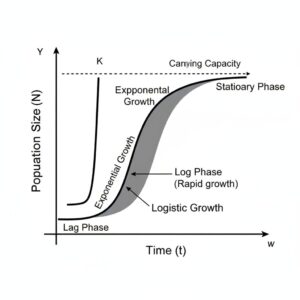
Logistic growth occurs because of natural selection. Nature acts as a filter through the principle of “survival of the fittest.” Every environment has limited resources that can support only a certain maximum number of individuals. This limit is called the carrying capacity (K).
When a population is small, resources are abundant and the growth rate is high, giving rise to the accelerating phase. As the population increases, resources become limited and growth slows down. Finally, the population becomes stable at K, resulting in a sigmoid (S-shaped) curve, known as the Verhulst–Pearl logistic growth curve.
Symbols:
- N = Population density at time t
- K = Carrying capacity
- r = Intrinsic rate of natural increase
Question 16.
Select the statement which explains best parasitism.
(a) One organism is benefited.
(b) Both the organisms are benefited.
(c) One organism is benefited; other is not affected.
(d) One organism is benefited, other is affected.
Answer: (d)
✔ One organism is benefited, other is affected.
Question 17.
List any three important characteristics of a population and explain.
Answer:
The three important characteristics of a population are:
- Population Density
Population density is the number of individuals of a species per unit area or volume.
It is calculated using the formula:

Where:
- PD = Population density
- N = Number of individuals in the region
- S = Unit area or volume of the region
- Birth Rate (Natality)
Birth rate is the number of births per 1000 individuals of a population per year.
It determines how fast a population is increasing through reproduction.
- Death Rate (Mortality)
Death rate is the number of deaths per 1000 individuals of a population per year.
It indicates the rate at which individuals are lost from a population.
Additional Questions and Answers
Question 1.
What is acclimatisation? Give an example.
Answer:
Acclimatisation is the short-term reversible physiological adjustment made by organisms to cope with changes in their environment.
Example: When humans travel to high altitudes, they experience breathlessness but gradually adjust by increasing the number of red blood cells.
Question 2.
What is carrying capacity?
Answer:
Carrying capacity (K) is the maximum number of individuals of a population that the environment can support sustainably with available resources.
Question 3.
What is Allen’s Rule?
Answer:
Allen’s Rule states that mammals from colder climates have shorter ears and limbs to reduce heat loss, while those in warmer climates have longer appendages.
Example: Arctic fox (short ears) vs. Desert fox (long ears).
Question 4.
Define stenothermal and eurythermal organisms with examples.
Answer:
- Stenothermal organisms: Can tolerate a narrow range of temperatures.
Example: Polar bears. - Eurythermal organisms: Can tolerate a wide range of temperatures.
Example:
Question 5.
What is age pyramid? Name its types.
Answer:
Age pyramid is a graphical representation of age distribution of a population.
The three types are:
- Expanding age pyramid
- Stable age pyramid
- Declining age pyramid
Question 6.
What is predation? Give one ecological importance.
Answer:
Predation is an interaction in which one organism (predator) kills and eats another organism (prey).
Ecological importance: It helps maintain population balance and prevents overpopulation of prey species.
Question 7.
What are conformers?
Answer:
Conformers are organisms that cannot regulate their internal environment. Their body temperature and physiological processes change according to external conditions.
Example: Fishes and amphibians.
Question 8.
Give an example of brood parasitism.
Answer:
Brood parasitism occurs when one species lays eggs in the nest of another bird.
Example: Koel laying its eggs in the crow’s nest.
Question 9.
What is amensalism?
Answer:
Amensalism is an interaction where one species is inhibited or harmed, while the other is unaffected.
Example: Penicillium fungus releases antibiotic that kills bacteria.
Question 10.
What is a niche?
Answer:
A niche is the functional role and position of an organism in its environment, including habitat, food habits, interactions, and activities.