
1st PUC Geography Chapter 7 Q&A – Biosphere
Looking for 1st PUC Geography Chapter 7 Q&A? Here you can download the complete Chapter 7: Biosphere Questions and Answers, notes, and summary. These 1st PUC Geography solutions follow the Karnataka State Board syllabus, making it easier for students to revise and score higher in exams.
1st PUC Geography Chapter 7
Biosphere
Scroll Down to Download Biosphere PDF
I. One Mark Questions – 1st PUC Geography Chapter 7 Q&A
Question 1.
Why is the Earth called ‘Living Planet’?
Answer:
Because it is the home of various forms of life, supported by lithosphere, hydrosphere, and atmosphere.
Question 2.
What is Environment?
Answer:
The sum of surrounding external conditions within which an organism, a community, or an object exists.
Question 3.
Define Ecology.
Answer:
Ecology is the science of the relationship between living organisms and their surroundings.
Question 4.
What is Biomes?
Answer:
A biome is a large geographical area with a distinct plant and animal community interacting under specific climatic conditions.
Question 5.
Define the term Biodiversity.
Answer:
Biodiversity is the variety of life forms—plants, animals, and microorganisms—within a specified geographic region, including their genes and ecosystems.
II. Two Marks Questions – 1st PUC Geography Chapter 7 Q&A
Question 1.
What are the components of Biosphere?
Answer:
The components of the biosphere include all living organisms—plants, animals, and microorganisms—that exist in the contact zone of lithosphere, hydrosphere, and atmosphere. These components interact with land, water, and atmospheric elements like temperature, wind, and precipitation.
Question 2.
Name the two types of Environment.
Answer:
The two types of environment are:
- Physical Environment – naturally formed environment including land, water, soil, rainfall, and biological features.
- Cultural Environment – created by humans, including civilization, culture, religion, language, customs, and economic activities.
Question 3.
What is ‘Ecological balance’?
Answer:
Ecological balance is the stable equilibrium in ecological systems, where small changes are corrected by negative feedback to maintain balance between organisms and their environment.
Question 4.
Mention any four types of biomes.
Answer:
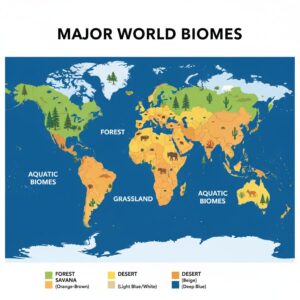
Four types of biomes are: Forest biome, Savanna biome, Grassland biome, and Desert biome.
Question 5.
State the features of Genetic biodiversity.
Answer:
Genetic biodiversity refers to the variation of genes within a species. It ensures healthy breeding and variation in characteristics like height, color, and physical traits, which is essential for survival and evolution.
III. Five Marks Questions – 1st PUC Geography Chapter 7 Q&A
Question 1.
Briefly explain the Biomes (T.B.Q)
Answer:
A distinct group of life forms and the environment in which they are found is called Biomes. In other words, a biome is a plant and animal community that covers a large geographical area. Based on the dominant life form, six major biomes are identified:
- Forest Biome:
Trees are the dominant life form. High temperature, humid climate, and soil moisture help thick tree cover. Forest biomes are dominant in the equatorial region. - Savanna Biome:
It is a transitional biome between forest and grassland biomes. It comprises trees, grasses, and herbs, and occurs in areas with low and seasonal rainfall. - Grassland Biome:
Grasses are the dominant vegetation. Grasslands are found in regions with moderate soil water deficit, semi-arid areas of dry tropical, sub-tropical, and mid-latitude regions. - Desert Biome:
Organisms in deserts can survive moderate to severe water deficit for most of the year. Temperatures range from hot to cool, and xerophytes are the common plants. - Tundra Biome:
It includes small plants that grow quickly during a short warm or cool summer. Found in low temperature and high latitude areas. - Aquatic Biome:
Aquatic regions house numerous species of plants and animals. Life began in water billions of years ago. Ponds, lakes, rivers, wetlands, and oceans are examples of aquatic biomes.
Question 2.
Describe the main aspects and three levels of study of Biodiversity.
Answer:
The varied range of flora and fauna found within a specified geographic region is called Biodiversity. The study of biodiversity is done at three levels:
- Genetic Diversity:
Genes are the basic building blocks of life forms. Genetic diversity refers to the variation of genes within a species. It includes differences among individual organisms in physical characteristics and is essential for healthy breeding and evolution. - Species Diversity:
Species diversity refers to the variety and number of species in a defined area. It is measured by richness, abundance, and types of species. Areas with high species diversity are called biodiversity “hot spots.” - Ecosystem Diversity:
Ecosystem diversity refers to the differences between ecosystem types and the diversity of habitats and ecological processes within them. It includes the variety of ecological communities and interactions occurring in each ecosystem.
Additional Questions & Answers
One Mark :
Question 1.
What is the meaning of the word ‘Biosphere’?
Answer:
Biosphere comes from ‘Bio’ meaning life and ‘Sphaira’ meaning sphere or zone. It is the zone of life where plants, animals, and microorganisms interact with the lithosphere, hydrosphere, and atmosphere.
Question 2.
How does the environment affect human activities?
Answer:
Humans depend on the environment for living and development. If natural resources are overused, it disrupts the environment, leading to pollution, habitat loss, and ecological imbalance.
Question 3.
What are the major factors that determine the boundaries of biomes?
Answer:
The boundaries of biomes are mainly determined by climatic conditions such as rainfall, temperature, humidity, and soil type.
Question 4.
Why is aquatic biome important for life on Earth?
Answer:
Aquatic biomes are home to countless species of plants and animals. Life began in water billions of years ago, and water is essential for sustaining most life forms on Earth.
Question 5.
What is the difference between physical and cultural environment?
Answer:
- Physical Environment: Naturally formed environment, e.g., land, water, soil, climate.
- Cultural Environment: Created by humans, e.g., civilization, language, customs, economy.
Question 6.
Name the major gene pool centres in India.
Answer:
The major gene pool centres in India are:
- Western Ghats (Nilgiris)
- North East India
- Western Himalayas
Question 7.
What are biodiversity hotspots?
Answer:
Biodiversity hotspots are areas rich in species diversity and endemic species. They are regions where the variety of flora and fauna is exceptionally high.
Question 8.
How does urbanization affect the biosphere?
Answer:
Urbanization, industrialization, and modern lifestyles disturb the natural environment, leading to pollution, habitat loss, and changes in ecological balance.
Question 9.
Give an example of organisms adapted to the desert biome.
Answer:
Desert plants like xerophytes survive with very little water. Animals like camels and lizards are adapted to survive extreme heat and water scarcity.
Question 10.
What is the significance of studying ecology?
Answer:
Studying ecology helps understand the interaction between organisms and their environment, manage natural resources, conserve biodiversity, and maintain ecological balance.
CLICK HERE TO DOWNLOAD Biosphere PDF
CLICK HERE TO WATCH Biosphere VIDEO
Students can use this 1st PUC Geography Chapter 7 Q&A – Biosphere, Biomes, and Biodiversity for quick revision. This PDF is perfect for understanding ecology, environment, and the life-supporting systems of the Earth.