
1st PUC Geography Question and Answer – Landforms
Looking for 1st PUC Geography textbook answers? You can download Chapter 4: Landforms Questions and Answers PDF, Notes, and Summary here. 1st PUC Geography solutions follow the Karnataka State Board Syllabus, making it easier for students to revise and score higher in exams.
Karnataka 1st PUC Geography Textbook Answers—Reflections Chapter 4
Landforms Questions and Answers, Notes, and Summary
1st PUC Geography Chapter 4
Landforms
Scroll Down to Download Landforms PDF
I. Answer the following in a word or a sentence each
Question 1.
What is geomorphic process?
Answer:
Geomorphic processes are the processes carried out by endogenic and exogenic forces that shape the Earth’s surface.
Question 2.
Define Diastrophism.
Answer:
Diastrophism refers to the processes that move, elevate, or build portions of the Earth’s crust.
Question 3.
Mention the force responsible for Mass movement.
Answer:
Gravity is the force responsible for mass movement.
Question 4.
What is Weathering?
Answer:
Weathering is the process of disintegration and decomposition of rocks at or near the Earth’s surface.
Question 5.
Name any two factors of Mechanical weathering.
Answer:
Temperature and frost are two factors of mechanical weathering.
Question 6.
How does granular disintegration occur?
Answer:
Granular disintegration occurs due to unequal expansion and contraction of different minerals in a rock.
Question 7.
What is the role of oxygen in Oxidation?
Answer:
Oxygen reacts with iron-containing minerals in rocks to form oxides.
Question 8.
Which region is predominant in Carbonation?
Answer:
Carbonation is predominant in limestone regions.
Question 9.
What is River capture?
Answer:
River capture is the process in which one river captures the headwaters of another river through headward erosion.
Question 10.
How are Ox-bow lakes formed?
Answer:
Ox-bow lakes are formed when a meander loop is cut off from the main river channel due to erosion and deposition.
II. Answer the following in two or three sentences each
Question 1.
State the difference between Endogenic and Exogenic forces.
Answer:
Endogenic forces originate from within the Earth and are mainly land-building forces like earthquakes, volcanoes and mountain building. Exogenic forces act on the Earth’s surface and bring changes through erosion, transportation and deposition by agents like rivers, wind and glaciers.
Question 2.
What is Mass movement?
Answer:
Mass movement is the downward movement of rock debris or soil along a slope under the direct influence of gravity. It does not involve transporting agents like running water, wind or glaciers.
Question 3.
Name any two types of Weathering processes.
Answer:
Mechanical (physical) weathering and chemical weathering are two types of weathering processes.
Question 4.
Distinguish between Oxidation and Hydration.
Answer:
Oxidation occurs when oxygen in rainwater reacts with iron-bearing minerals to form oxides. Hydration occurs when minerals absorb water, increase in volume and break down into powder.
Question 5.
How does Biological weathering take place?
Answer:
Biological weathering takes place due to the action of plants, animals and human beings. Plant roots widen rock cracks, animals burrow into the soil, and human activities like mining and agriculture break rocks.
Question 6.
Mention any two agents of denudation.
Answer:
Rivers and glaciers are two important agents of denudation.
Question 7.
What is Canyon? Give example.
Answer:
A canyon is a wide, deep and steep-sided valley with almost vertical walls formed mainly in arid or semi-arid regions. The Grand Canyon of the Colorado River in the USA is an example.
Question 8.
Distinguish between Meanders and Ox-bow lakes.
Answer:
Meanders are crescent-shaped loops or bends formed in the lower course of a river due to lateral erosion and deposition. Ox-bow lakes are formed when a meander loop is cut off from the main river channel.
Question 9.
What is Delta? Name any two types of delta.
Answer:
A delta is a triangular shaped alluvial deposit formed at the mouth of a river. Arcuate (common) delta and Bird-foot delta are two types of deltas.
Question 10.
Mention the difference between Tributaries and Distributaries.
Answer:
Tributaries are small streams or rivers that join a main river. Distributaries are branches that break away from the main river, usually near its mouth.
III Answer the following.
Question 1.
What is landform? Explain the different types of geomorphic processes.
Answer:
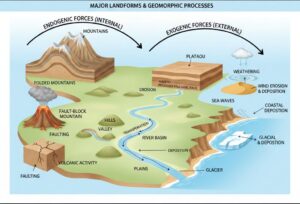
A landform is any natural formation of rock and soil found on the Earth. A landform may be as large as a mountain range or as small as a hill. Landforms are natural physical features of the Earth’s surface such as valleys, plateaus, mountains, plains, hills and loess plains. The minor landforms include hills, ridges, valleys and basins. According to geoscientists, landforms are formed by forces acting from the interior and on the surface of the Earth.
The processes carried out by endogenic and exogenic forces are called geomorphic processes. These are of two types:
- Endogenic processes:
Endogenic forces are internal forces that originate inside the Earth. They are mainly land-building forces. Diastrophism includes all the processes that move, elevate or build portions of the Earth’s crust. Earthquakes and volcanic activities are also important endogenic processes. - Exogenic processes:
Exogenic forces are external forces that act on the surface of the Earth. These forces bring changes through degradation and aggradation processes. Rivers, glaciers, wind and sea waves are the major agents of exogenic forces.
Thus, geomorphic processes play a vital role in shaping and modifying the landforms of the Earth.
Question 2.
Describe the factors affecting Physical weathering.
Answer:
Physical or mechanical weathering is the disintegration of rocks without any chemical change in their composition. It takes place mainly due to the following factors:
- Temperature:
During the day, rock surfaces are heated and expand, while at night they cool and contract due to a fall in temperature. This repeated expansion and contraction create stress and tension in rocks, resulting in cracks and breaking of rocks. This leads to block disintegration.
Rocks are composed of different minerals, which expand and contract at different rates. This causes the rocks to break into smaller grains, known as granular disintegration. Due to temperature variation between the outer and inner layers, the outer layers peel off in thin sheets. This process is called exfoliation. - Frost:
In cold and temperate regions, water enters the cracks of rocks and freezes during night time. When water freezes, it expands, and during the day it melts and contracts. Continuous freezing and thawing widen the cracks and break rocks into blocks. This process is known as frost shattering. - Rain:
When rain suddenly falls on highly heated rocks in hot deserts, numerous cracks develop due to sudden cooling. In humid regions, heavy rain drops strike rock surfaces and loosen rock particles, leading to disintegration. - Wind:
In desert regions, strong winds carry sand and rock particles. These particles collide with each other or strike rock surfaces, causing abrasion and weathering on a large scale. - Sea Waves:
Sea waves continuously strike coastal rocks. This repeated action enlarges joints and fractures and breaks rocks into smaller blocks. Weathering also occurs due to hydraulic pressure, abrasion and attrition. - Slope:
Steep slopes in mountainous and hilly regions help in weathering. Rock fragments move down the slope due to gravity and break into pieces while rolling. - Gravitation:
Gravity causes large rock masses to roll down slopes. While rolling, rocks strike against each other and disintegrate into smaller pieces.
Thus, temperature, frost, rain, wind, sea waves, slope and gravitation are the major factors affecting physical weathering.
Question 3.
Explain chemical weathering with examples.
Answer:
Chemical weathering is the process of disintegration and decomposition of rocks by chemical reactions. In this process, the original minerals of rocks are changed into new or secondary minerals. Rainwater and atmospheric gases are the main agents of chemical weathering, and it is most active in humid regions.
The important types of chemical weathering are:
- Oxidation:
Oxidation occurs when oxygen in rainwater reacts with iron-containing minerals in rocks to form oxides. The rusting of iron is a common example of oxidation. - Carbonation:
Carbonation takes place when rainwater mixes with carbon dioxide and forms weak carbonic acid. This acid reacts with calcium carbonate or limestone to form calcium bicarbonate, which dissolves easily. This process is common in limestone regions. - Hydration:
Hydration occurs when rock minerals absorb water, increase in volume and develop internal stress. As a result, minerals like feldspar and gypsum are reduced into powder. - Solution:
In this process, rainwater dissolves soluble minerals such as rock salt, gypsum and potash. These minerals are carried away in solution form.
Thus, chemical weathering plays an important role in breaking down rocks and altering their composition.
Question 4.
Describe the landforms associated with the work of a river.
Answer:
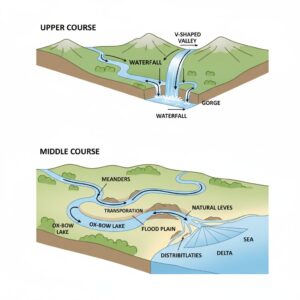
A river is an important agent of denudation. The work of a river includes erosion, transportation and deposition, and each stage of the river course produces different landforms.
- Landforms due to Erosional work
These are mainly formed in the upper course of the river where the speed and vertical erosion are high.
- V-shaped Valley: Formed due to rapid vertical erosion in mountainous regions.
- Gorge: A deep and narrow valley with steep rocky sides formed by continuous vertical erosion.
- I-shaped Valley: A very deep and steep-sided valley resembling the letter ‘I’.
- Canyon: A wide, deep valley with almost vertical sides, commonly found in arid regions (e.g., Grand Canyon).
- Potholes: Circular depressions formed on the river bed by the swirling action of pebbles and sand.
- Waterfalls: Formed when hard and soft rocks occur alternately across the river course.
- River Capture: Occurs when one river captures the headwaters of another river through headward erosion.
- Landforms due to Transportational work
These are formed when the river carries eroded materials from one place to another.
- Alluvial Fans: Fan-shaped deposits formed when a river enters plains from mountains and loses velocity.
- Alluvial Cones: Cone-shaped deposits formed at the foothills due to sudden deposition of materials.
- Landforms due to Depositional work
These are mainly formed in the lower course of the river where the slope is gentle and speed is slow.
- Meanders: Crescent-shaped loops formed due to lateral erosion and deposition.
- Ox-bow Lakes: Crescent-shaped lakes formed when a meander loop is cut off from the main river.
- Flood Plains: Flat plains formed by the deposition of fine silt during floods.
- Natural Levees: Raised river banks formed by the deposition of sediments near the river channel.
- Distributaries: Branches of a river formed near its mouth.
- Delta: Triangular-shaped alluvial deposit formed at the mouth of a river.
- Estuary: A tidal mouth of a river where river water mixes with sea water.
Thus, through erosion, transportation and deposition, a river plays a major role in shaping various landforms on the Earth’s surface.
Additional Questions & Answers
I. One Mark Questions :
Question 1.
What is denudation?
Answer:
Denudation is the wearing away of the Earth’s surface by natural agents.
Question 2.
Name the study of landforms.
Answer:
Geomorphology.
Question 3.
What is an agent of denudation?
Answer:
A natural force that shapes the Earth’s surface.
Question 4.
What is mechanical weathering also called?
Answer:
Physical weathering.
Question 5.
Name one internal force of the Earth.
Answer:
Earthquake.
Question 6.
What is a watershed?
Answer:
A high land that separates two river systems.
Question 7.
What is a tributary?
Answer:
A small river that joins a main river.
Question 8.
Name one product of chemical weathering.
Answer:
Oxides.
Question 9.
What is a flood plain?
Answer:
A flat plain formed by river deposition during floods.
Question 10.
Which force causes mass wasting?
Answer:
Gravity.
II. Two Mark Questions :
Question 1.
Define exogenic forces.
Answer:
Exogenic forces are external forces acting on the Earth’s surface causing erosion, transportation and deposition.
Question 2.
What is mass wasting?
Answer:
It is the downward movement of rock debris under the influence of gravity without a transporting agent.
Question 3.
Mention any two types of mass movements.
Answer:
Landslides and rockfalls.
Question 4.
What is block disintegration?
Answer:
It is the breaking of rocks into large blocks due to repeated expansion and contraction caused by temperature variation.
Question 5.
What is oxidation?
Answer:
Oxidation is a chemical process in which oxygen reacts with iron minerals to form oxides.
Question 6.
What is hydration?
Answer:
Hydration is the absorption of water by minerals causing expansion and disintegration.
Question 7.
What is a meander?
Answer:
A crescent-shaped bend formed in the lower course of a river.
Question 8.
Define river basin.
Answer:
The area drained by a river and its tributaries is called a river basin.
Question 9.
What is an estuary?
Answer:
An estuary is the tidal mouth of a river where river water mixes with sea water.
Question 10.
Name any two agents of denudation.
Answer:
River and wind.
III. Five Mark Questions :
Question 1.
Explain Endogenic forces.
Answer:
Endogenic forces are internal forces originating inside the Earth. They are land-building forces responsible for the formation of mountains, plateaus and continents. These forces include diastrophism, earthquakes and volcanic activity. Diastrophism consists of orogenic movements (mountain building) and epeirogenic movements (continental uplift or subsidence). These forces disturb the Earth’s crust and create major landforms.
Question 2.
Describe Mechanical weathering.
Answer:
Mechanical weathering is the disintegration of rocks without chemical change. It is caused by temperature variation, frost action, wind, rain, gravity and sea waves. Expansion and contraction lead to block disintegration, granular disintegration and exfoliation. It is most common in desert, cold and mountainous regions.
Question 3.
Explain Mass movements.
Answer:
Mass movements are gravity-induced movements of rock debris down slopes. They do not involve agents like rivers or wind. Types include rockfall, landslide, mudflow and earthflow. These movements depend on slope, material, water content and gravity.
Question 4.
Explain erosional landforms of a river.
Answer:
Erosional landforms formed by rivers include V-shaped valleys, gorges, canyons, I-shaped valleys, potholes, waterfalls and river capture. These features are mainly formed in the upper course where vertical erosion is dominant.
Question 5.
Explain depositional landforms of a river.
Answer:
Depositional landforms include meanders, ox-bow lakes, flood plains, natural levees, distributaries, delta and estuary. These are mainly formed in the lower course where the river speed is slow and deposition is dominant.
IV. Ten Mark Questions :
Question 1.
Explain Weathering and its types.
Weathering is the process of disintegration and decomposition of rocks at or near the Earth’s surface. It prepares rocks for erosion and soil formation.
Answer:
Types of Weathering:
- Mechanical Weathering: Disintegration without chemical change due to temperature, frost, wind and waves.
- Chemical Weathering: Decomposition of rocks through oxidation, carbonation, hydration and solution.
- Biological Weathering: Weathering caused by plants, animals and human activities.
Weathering plays an important role in soil formation, landscape development and agriculture.
Question 2.
Describe the work of river.
Answer:
A river performs three important functions:
- Erosion:
Forms V-shaped valleys, gorges, canyons, waterfalls and potholes. - Transportation:
Carries rock debris as load and forms alluvial fans and cones. - Deposition:
Creates flood plains, natural levees, meanders, ox-bow lakes, distributaries, deltas and estuaries.
Thus, rivers continuously modify the Earth’s surface through erosion, transportation and deposition.