
1st PUC Geography Question and Answer – The Earth
Looking for 1st PUC Geography textbook answers? You can download Chapter 2: The Earth Questions and Answers PDF, Notes, and Summary here. 1st PUC Geography solutions follow the Karnataka State Board Syllabus, making it easier for students to revise and score higher in exams.
Karnataka 1st PUC Geography Textbook Answers—Reflections Chapter 2
The Earth Questions and Answers, Notes, and Summary
1st PUC Geography Chapter 2
The Earth
Scroll Down to Download The Earth PDF
I. Answer the following in a word or a sentence each:
Question 1.
What is the approximate age of the Earth ?
Answer:
The approximate age of the Earth is 4.6 billion years.
Question 2.
Name the oldest proof in respect of shape of the Earth ?
Answer:
The lunar eclipse is the oldest proof of the shape of the Earth.
Question 3.
Who conducted the Bed Ford level experiment ?
Answer:
Dr. Alfred Russel Wallace conducted the Bed Ford level experiment.
Question 4.
What is the total geographical area of the Earth ?
Answer:
The total geographical area of the Earth is 510 million square kilometres.
Question 5.
Who was the first person to calculate the distance between places ?
Answer:
Eratosthenes was the first person to calculate the distance between places.
Question 6.
What is Earth’s axis ?
Answer:
Earth’s axis is an imaginary line passing through the centre of the Earth joining the North and South Poles.
Question 7.
What amount of time does the Earth take to complete one rotation ?
Answer:
The Earth takes 24 hours to complete one rotation.
Question 8.
Define Orbit ?
Answer:
An orbit is the fixed path on which the Earth revolves around the Sun.
Question 9.
On what date does the Summer Solstice occur ?
Answer:
The Summer Solstice occurs on June 21st.
Question 10.
How many temperature zones are there on the globe ?
Answer:
There are three temperature zones on the globe.
II. Answer the following in two or three sentences each:
Question 1.
What is Geoid?
Answer:
Geoid is the actual shape of the Earth which is slightly flattened at the poles and bulged at the equator. This shape is also known as an oblate spheroid.
Question 2.
Mention the Equatorial and Polar diameter of the Earth.
Answer:
The Equatorial diameter of the Earth is 12,756 km, while the Polar diameter is 12,714 km. The difference is due to the Earth’s oblate spheroid shape.
Question 3.
Why are Northern and Southern hemispheres called as Land and Water hemisphere?
Answer:
The Northern Hemisphere is called the Land Hemisphere because about 60% of its area is land. The Southern Hemisphere is called the Water Hemisphere because about 81% of its area is covered by water.
Question 4.
Name the highest and lowest points on the land.
Answer:
Mount Everest (8,850 m) is the highest point on land. The Dead Sea (400 m below sea level) is the lowest point on land.
Question 5.
What is deflection of Winds?
Answer:
Deflection of winds refers to the change in the direction of winds due to the rotation of the Earth. Winds are deflected to the right in the Northern Hemisphere and to the left in the Southern Hemisphere.
Question 6.
What is Inclination of the Earth?
Answer:
Inclination of the Earth refers to the tilt of the Earth’s axis at an angle of 66½° to the plane of its orbit. This inclination is responsible for seasons and variation in day and night.
Question 7.
Distinguish between Perihelion and Aphelion.
Answer:
Perihelion is the position of the Earth when it is nearest to the Sun, which occurs on January 3rd.
Aphelion is the position of the Earth when it is farthest from the Sun, which occurs on July 4th.
Question 8.
State the difference between Autumn Equinox and Spring Equinox.
Answer:
Autumn Equinox occurs on September 23rd and marks the beginning of autumn in the Northern Hemisphere.
Spring Equinox occurs on March 21st and marks the beginning of spring in the Northern Hemisphere; on both days, day and night are equal.
Question 9.
Why is Norway called ‘Land of Mid-night Sun’?
Answer:
Northern parts of Norway lie north of the Arctic Circle, where the Sun does not set during summer. Hence, it experiences sunlight for nearly 24 hours, and is called the Land of Mid-night Sun.
Question 10.
Mention the difference between Torrid and Temperate zones.
Answer:
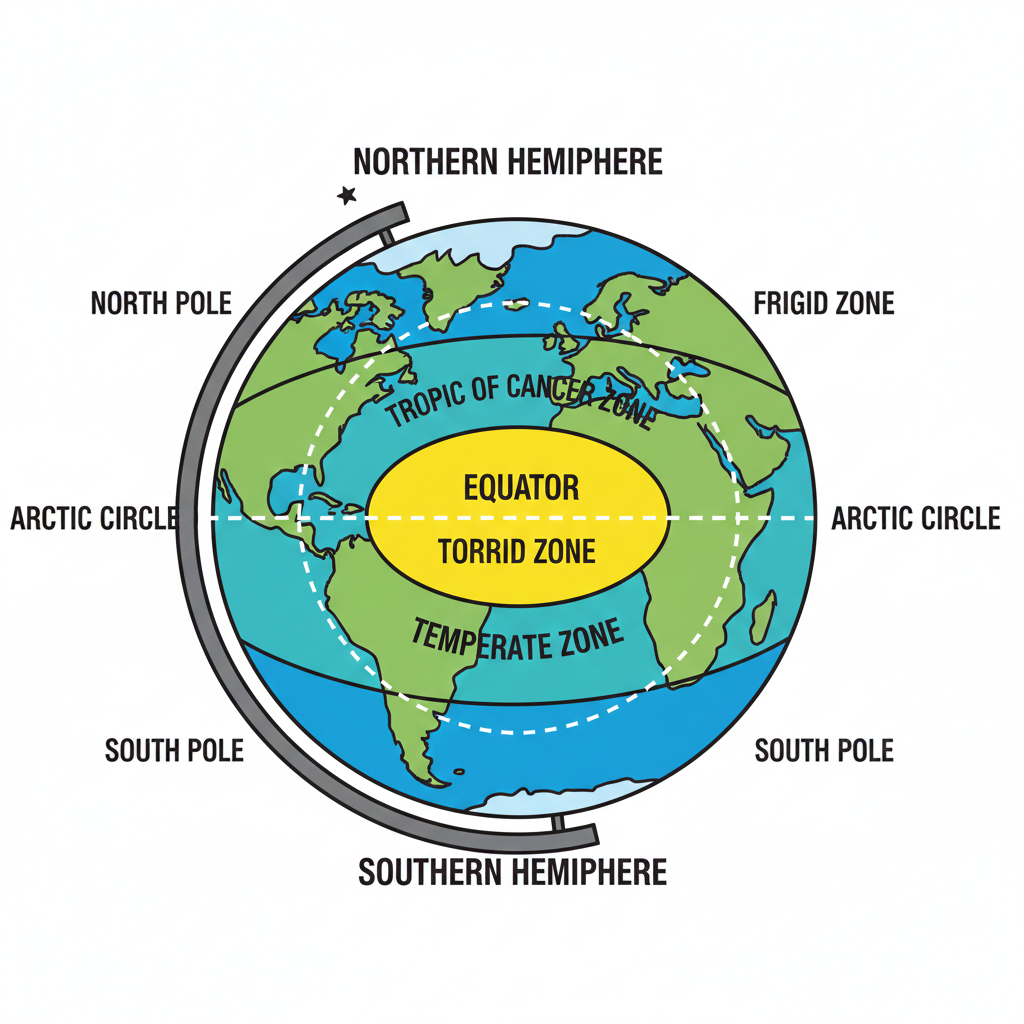
The Torrid Zone lies between the Tropic of Cancer and the Tropic of Capricorn and receives direct rays of the Sun, resulting in high temperatures.
The Temperate Zone lies between the Tropics and the Arctic/Antarctic Circles and receives slanting rays, leading to moderate temperatures.
III. Answer the Following in Five Sentences.
Question 1.
Describe the size of the Earth ?
Answer:
- About 2,000 years ago, the Greek astronomer Eratosthenes calculated the Earth’s circumference at the equator as 41,140 km, close to the modern value.
- Actual circumference: Equatorial – 40,076 km, Polar – 40,006 km (difference – 70 km).
- Diameter: Equatorial – 12,757 km, Polar – 12,714 km (difference – 43 km), due to the geoid shape of the Earth.
- Total surface area: 510.9 million sq km → 71% water (361 million sq km) and 29% land (149 million sq km).
- Land divisions: 7 continents – Asia, Africa, North America, South America, Antarctica, Europe, Australia.
- Water bodies: 5 oceans – Pacific, Atlantic, Indian, Antarctic, Arctic, plus gulfs, bays, and seas.
- Hemispheres: Divided by the equator → Northern Hemisphere has 2/3 of the land, Southern Hemisphere has 1/3. The Prime Meridian divides Eastern and Western Hemispheres.
Question 2.
Name and explain the proofs in support of the spherical shape of the Earth ?
Answer:
There are several proofs to regard the earth as a spherical shape of the Earth.
- Heavenly bodies appear to be spherical:
The Sun, the Moon and other heavenly bodies appear to be spherical when viewed from different position. The earth is one of them and hence it must also be spherical in shape. - The Lunar Eclipse:
The lunar eclipse proves that the Earth is in spherical shape. During lunar eclipse when the Earth is between the Sun and the Moon, the shadow of the Earth falls on the Moon. Aristotle was the first scholar to show this by looking at the shadow of the Earth on the lunar surface. Later, this was ascertained by Ptolemy. This is considered to be the oldest proof in respect of the shape of the Earth. - Sunrise and Sunset:
The time of Sunrise and Sunset is not the same everywhere in the world. This is due to spherical shape of the Earth. If the Earth were to be flat all places on the Earth would have had sunrise and sunset at the same time everywhere in the world. - Circumnavigation:
Circumnavigation of the world can only be possible when the Earth is in spherical shape. If one start on a sea voyage towards the east, by moving constantly in the same direction, he would be able to complete a circle of the world and reach the original point form where he had started. - The Bed Ford level experiment:
Dr. Alfred Russel Wallace conducted an experiment in 1956, along the Bed Ford level canal area in Britain. It is the most convincing proof of the curvature of the Earth. He fixed three poles of same height at an interval of about mile apart and observed through a telescope. It was found that the pole in the middle was higher than other two poles. It is due to the curvature of the Earth. If the Earth were to be flat all the poles would have the same horizontal level. - Sighting a ship:
A ship on the sea approaching the coast, when seen from the short does not come into view all at once. The observer first sees the mast and then the hull and finally the whole ship. A ship moving away from the coast disappears gradually and finally out of view. If the Earth were to be flat the whole ship would have come into view. - Aerial and Satellite Photographs:
The photographs taken by the cosmonauts in the recent decades and satellites have provided ample proof to show that the earth is spherical in shape.
Question 3.
Explain the effects of the rotation of the Earth ?
Answer:
Rotation of the Earth causes various effects. They are:
a. Day and night caused by the rotation of the earth on its axis. This is because parts of the earth which face the sun have day and the parts which do not face the sun have night. This happen with precision and progression and not suddenly – The time when the sun beings to cast its light in the sky is known as dawn. At noon. The sun is overhead. At dusk, it is twilight and the sun is seen disappearing in the sky. At night, it is completely dark.
- The duration of the day and night is not equal at all places on the earth because of the inclined axis. The length of days varies with respect to the seasons as well as latitude
- The sun, the moon and the stars seem to move from east to west. This is because the earth spins from west to east. This effect is similar to what one experiences while looking at trees from a moving train.
- The speed of rotation has created a centrifugal force resulting in a bulge in the middle portion of the earth and flattened top at the poles.
- The earth’s rotation affects the movement of water in the oceans. The tides are deflected because of the rotation of the earth.
- Rotation causes difference in time over various places on the earth.
- The Earth acts as huge magnet: The one end of the needle of the compass always points towards the north magnetic pole. That means, the earth acts as a magnet. The rotation . of the earth causes the earth to act as a magnet.
- Rotation of the Earth influences the movement of ocean water, particularly ocean currents.
- The rise and fall in the sea level is called tides. Rotation of the Earth causes the lacing of water bodies to the Moon. The gravitational attraction of the Moon and position of the water bodies cause tides. This is a regular phenomenon due to Earth’s rotation.
Question 4.
Describe the special latitudes and temperature zones of the globe.
Answer:
Due to the Earth’s inclination of 66½° and its revolution around the Sun, certain special latitudes can be recognized on the globe. The vertical rays of the Sun strike the Earth at different points at different times of the year. On March 21st and September 23rd, the Sun’s rays fall vertically on the Equator.
On June 21st, they fall vertically on 23½° North, known as the Tropic of Cancer, and on December 22nd, they fall vertically on 23½° South, called the Tropic of Capricorn. On June 21st, the Sun’s rays reach up to 66½° South, the Antarctic Circle. The North Pole (90° N) and the South Pole (90° S) mark the ends of the Earth’s axis.
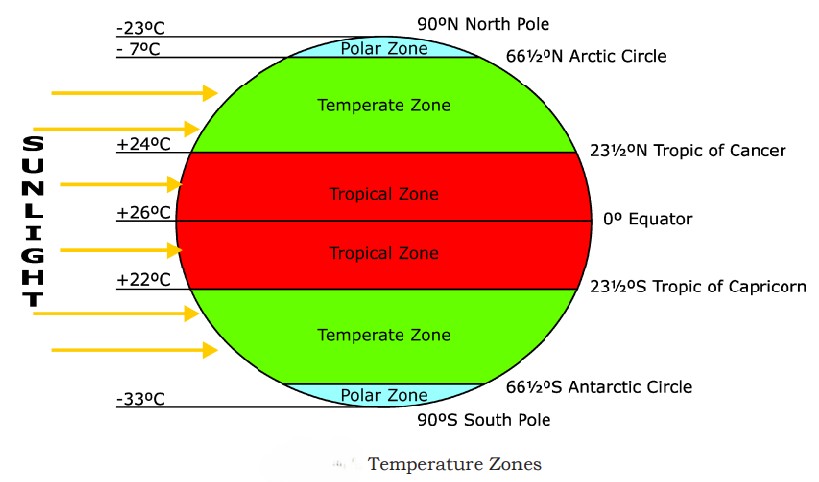
Based on these special latitudes, the Earth is divided into temperature zones or heat zones. Regions near the Equator receive more direct rays of the Sun, which are concentrated over a smaller area and produce more heat. As we move away from the Equator, the Sun’s rays strike the Earth at an angle, spreading over a larger area and producing less heat. This results in different temperature zones from the Equator to the poles.
- Torrid Zone: This zone lies between 23½° N and 23½° S. It receives nearly vertical rays of the Sun and experiences a hot climate throughout the year.
- Temperate Zone: Located between the Torrid and Frigid zones (23½°–66½° N and 23½°–66½° S), this zone receives oblique rays of the Sun and has a moderate climate.
- Frigid Zone: Extending from the Arctic Circle to the North Pole (66½°–90° N) in the Northern Hemisphere and from the Antarctic Circle to the South Pole (66½°–90° S) in the Southern Hemisphere, this zone receives very slanting rays and has an extremely cold climate.
Question 4.
How do seasons occur? Explain with a neat diagram.
Answer:
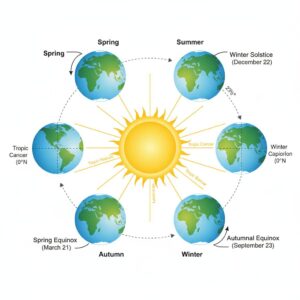
Seasons occur due to the revolution of the Earth around the Sun, combined with the tilt and parallelism of the Earth’s axis. Seasons are periods of the year that have distinct climatic conditions. The main factors responsible for seasons are:
- The inclination of the Earth’s axis (23½°)
- The parallelism of the Earth’s axis during its revolution
- The revolution of the Earth around the Sun
There are four seasons in a year: Summer, Autumn, Winter, and Spring, each lasting about three months. These seasons correspond to the positions of the Earth during solstices and equinoxes in its annual revolution around the Sun.
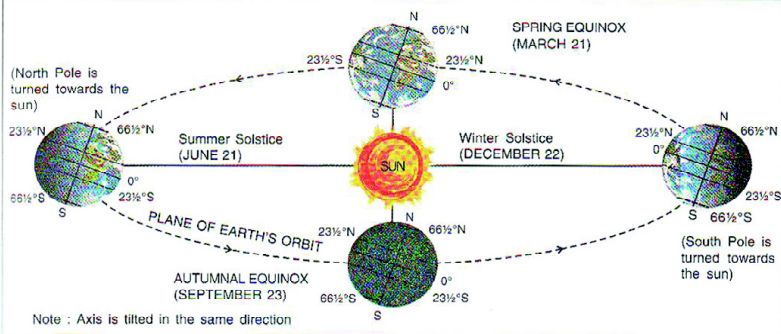
- Summer Season: On June 21st, the Northern Hemisphere is tilted towards the Sun while the Southern Hemisphere is tilted away. The Sun’s rays fall vertically on the Tropic of Cancer, and regions within the Arctic Circle receive sunlight for 24 hours. The Northern Hemisphere experiences longer days and shorter nights. This period is called the summer solstice, meaning the Sun “stops” moving northward.
- Autumn Season: On September 23rd, both hemispheres are equally inclined towards the Sun, and the Sun’s rays fall vertically on the Equator. Day and night are of equal length worldwide. The Northern Hemisphere experiences moderate temperatures, marking autumn, while the Southern Hemisphere experiences spring. This day is known as the autumnal equinox.
- Winter Season: On December 22nd, the Southern Hemisphere is tilted towards the Sun while the Northern Hemisphere is tilted away. The Sun’s rays fall vertically on the Tropic of Capricorn (23½° S). The Northern Hemisphere experiences shorter days and longer nights, marking winter, while the Southern Hemisphere enjoys summer. This is the winter solstice.
- Spring Season: On March 21st, both hemispheres are again equally inclined towards the Sun, similar to the conditions during the autumnal equinox. The Northern Hemisphere experiences spring, and the Southern Hemisphere experiences autumn. This season continues until June 21st, after which the cycle of summer begins again. In India, the start of spring is considered auspicious and marks the beginning of the year.
Additional Question and Answer
1-Mark Questions & Answers
Question 1.
What is the approximate age of the Earth?
Answer:
About 4.6 billion years.
Question 2.
Who conducted the Bedford Level experiment?
Answer:
Dr. Alfred Russel Wallace.
Question 3.
Name the oldest proof in respect of the shape of the Earth.
Answer:
Lunar eclipse.
Question 4.
What is Earth’s axis?
Answer:
An imaginary line passing through the North Pole and South Pole.
Question 5.
On what date does the Summer Solstice occur?
Answer:
June 21.
Question 6.
How many temperature zones are there on the globe?
Answer:
Three – Torrid, Temperate, and Frigid.
2-Mark Questions & Answers
Question 1.
Define Orbit.
Answer:
Orbit is the path followed by the Earth around the Sun.
Question 2.
Who was the first person to calculate the distance between places?
Answer:
Eratosthenes, the Greek astronomer.
Question 3.
Why are Northern and Southern Hemispheres called Land and Water Hemispheres?
Answer:
Northern Hemisphere has 2/3 of the Earth’s land, and Southern Hemisphere has more water than land.
Question 4.
What is deflection of winds?
Answer:
Winds do not blow in a straight path due to Earth’s rotation, causing Coriolis effect.
Question 5.
What is inclination of the Earth?
Answer:
The tilt of Earth’s axis to the plane of its orbit is 23½°.
5-Mark Questions & Answers
Question 1.
Describe the size of the Earth.
Answer:
The Earth’s equatorial circumference is 40,076 km and polar circumference is 40,006 km. The equatorial diameter is 12,757 km, and the polar diameter is 12,714 km. The total surface area is 510.9 million sq. km, of which 71% is water and 29% is land.
The land is divided into seven continents and the water into five oceans. The Equator divides the globe into Northern and Southern Hemispheres, while the Prime Meridian divides it into Eastern and Western Hemispheres.
Question 2.
Name and explain the proofs supporting the spherical shape of the Earth.
Answer:
The Earth is spherical because:
- Heavenly bodies like the Sun and Moon appear spherical.
- Lunar eclipse: Earth’s round shadow falls on the Moon.
- Sunrise and sunset vary with location.
- Circumnavigation is possible.
- Bedford Level experiment shows curvature.
- Sighting ships disappear gradually over the horizon.
- Satellite photographs confirm the spherical shape.
Question 3.
Explain the effects of the rotation of the Earth.
Answer:
- Causes day and night.
- Unequal duration of day and night due to tilt.
- Celestial bodies appear to move east to west.
- Creates centrifugal force, bulging at equator.
- Influences ocean currents and tides.
- Creates time differences across regions.
- Earth behaves like a magnet.
Question 4.
Describe the special latitudes and temperature zones of the globe.
Answer:
- Special latitudes: Equator (0°), Tropic of Cancer (23½°N), Tropic of Capricorn (23½°S), Arctic Circle (66½°N), Antarctic Circle (66½°S), Poles (90° N & S).
- Temperature zones:
- Torrid Zone: Between Tropics, hot.
- Temperate Zones: Between Tropics and Frigid zones, moderate climate.
- Frigid Zones: Near poles, extremely cold.
Question 5.
How do seasons occur?
Answer:
Seasons occur due to Earth’s revolution and tilt of axis:
- Summer (June 21): Northern Hemisphere tilts toward Sun; Tropic of Cancer receives vertical rays.
- Autumn (Sept 23): Equal sunlight on both hemispheres; days = nights.
- Winter (Dec 22): Northern Hemisphere tilts away; Tropic of Capricorn receives vertical rays.
- Spring (March 21): Similar to autumn; Northern Hemisphere experiences spring.